Sunday, 18 October 2015

30 Years of Revelation II

Hello to everybody,

interested to follow on about history of Fidelity. In my last article I did try to explain that at the beginning of the 1970ties a decisive step happened, when Japanese audio aficionados made some exceptional experiences with the earliest technologies in audio history. As in the last part bespoken, they came across that with first generation public address systems like for cinematographic use, audible superiority was already achieved in absolute perfection. Comparing such 40 year old vintage professional products with than actual mass market hifi products, the vintage technologies captivated with a by far wider range of expressive characteristics, harmonics and deeper emotional habits. These japanese evaluations did extract best possible engineering standards of those days in the 1930ties and perfectly instrumented productions responsible to gain exceptional audible results. More precisely said, these products were superior because of extremely low and simply realized power amplification and highly efficient supporting horn speaker systems perfectly designed. These systems did hardly vary the than common idea of audible fidelity. With exceptional homogeneously integrated structures of finest detail and far more realistic dynamic representation, such systems dominated the performance of contemporary equipment.

WE16a in a japanese installation

So legend started with Western Electric cinema applications of the 1930ties to be synonyms of such technologies, they have set the pace and got unsurpassed precept till today. The Western Electric wide band horn designs, like WE15a and WE16a together with the first compression drivers WE555a in history, were able to cover a frequency spectrum between 70 and 6000 hz, almost the bandwitdh of the human voice with one simple organized system. Thus driven from a WE 91a/b single ended 300B amplifier amplified by one single direct heated power tube, got to be the most remarkable amplifier of audio history by this fact and its resulting aural benefits. Less simpler it never ever got again. Today we do know that such early days marked already the zenith in quality terms within history of audio, a history with a inherent permanent decline in quality vs. growing mass as progression motor. Isn't it curious that at the same time when japanese mass market companies like Pioneer, Yamaha, Sansui and lots others flooded the world with "everything built in, plus extras for half the price"-products,  Japanese Audio aficionados praised hand made US american cinema products to be the "crown of Creation"!

Private Japanese Installation of original vintage Western Electric horns with tube amplification,
(the small horn centered reminds me to the classic Altec 811, just for the sizes) 

From these first evaluation days of vintage WE300b triodes these got the most wanted tubes of all times, together with several other direct heated triodes like 2A3, 45, AD1, R120, ED, PX25, 845, 211, etc.. These early findings created a new elaborated audio business around all necessary parts and hard to obtain products like amps, transformers, tubes, speakers, enclosures and horn developments in all different design issues. A typical asian replica boom started to bring several copies of unobtainable originals to the market within the early 1980ties. A new business model did evoke by refining such original designs with more modern technologies in Japan. Tango and Tamura as world class suppliers of all sorts of tube amplifier incorporated transformers might be a good example here to explain the unique exercises of the Japanese audio culture within these years.


Ad of GIP Company, a manufacturer of almost original and newly made Western Electric components in Japan

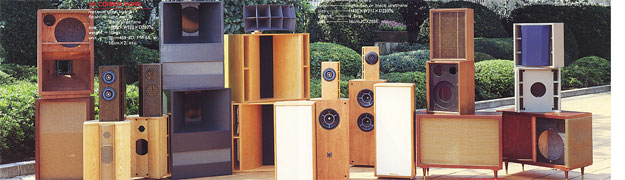
Small variety of japanese "Utopia" made enclosures for vintage speakers, they manufacture almost 100 different designs of enclosure types for the audio aficionado with vintage drivers.


In these days european or american ambitious hifi nuts did spend their money at hundreds of class a watts powering small sized compound coned low efficiency speakers with amplifier sized crossovers for advanced levelling of any impedance irregularities. They still did follow the dream of a technical perfected audio performance in theory, where any sort of imperfection was fought with antidotes. An ideal of perfection which was followed with master degrees in technical measurement parks and its testing praxis and a still unbroken solely belief in man made progression of advancement. On the other hand the cutting cost factors from Transistor design and later on integrated designs of highest wattage per dollar always have to be taken in mind with every question about quality till today.  Today we know a bit better that any commercial enterprise will fail once in its typical inherent dislocations. Just look today at the international banking system, Volkswagen escapades, Fifa, etc. ...


The Japanese culture building is traded with a thousand year old tradition were copying is the essential value in perfection for the achievement of mastership as progress. Subtile evaluation of differences will lead to final results and is mandatory to the expected success. Japanese culture is to my knowledge by far the most sensitive, subtile and the most evaluated world wide because thought from the end point. Just look at the tradition of food, beside the italian culture discipline here, the japanese food shows by far the most advancement in its refinement standards. Who is making the best Whisky in the world? Not the Swiss... Another fact here helps to understand what I do want to explain. I believe the japanese culture is as well one of the most hedonistic cultures in our world. They do not accept any limitation when quality of pleasure is in question. Several examples might illustrate this thesis. Look at the famous Kobe cow, who else beside the Italians would care a young in outer nature living cow for three years with everyday treatment of classical music, best organic grown food and beer massages, just in order to get the most perfect structured beef possible. Who else in the world would do such enormous effort to make "Dashi", a soup base made from seaweed and bonito flakes, just the flakes are masterpieces on its own. The Zen culture and its inherent "Wabi Sabi" formular is a well explaining tradition for those who want to learn more about this careful culture. Today the web is a good resource to get more informations about. I have the feeling sometimes we in our western influenced consumer culture could profit a lot, if we would accept only a tiny bit of such principles for our daily decisions.
I am quoting myself from the last entry: "In Japan the sense for qualities and historical role models is traditionally extremely sophisticated, independent of its business, so it does in audio." With other words I want to say, if the Japanese with one of the most successful audio cultures in commercial terms do verify and rate 80 year old tubes, dedicated amps and horn systems to be excessivly better than anything current made, than it was a quite easy formular for Jean Hiraga in the beginning 1980ties to be overtaken as main strategic issue for his restart in Europe.

Read on soon, Volker


Monday, 5 October 2015

30 Years of Revelation I

Next year it will be the 30's anniversary of "direct heated triode amplification rediscovery". Thanks to
Jean Hiraga, who did publish formerly unknown ideas about exceptional audio technologies in Paris 1986 the first time outside Japan. Beside loudspeakers, record players, tonearms and class a amplifiers his contribution had a main interest into vintage triode amplifiers. So Europe did learn  about the unique sound qualities of the DHT triode 300b after its fall into oblivion long times ago. His input was based on personal made first hand experiences living in Japan in the 1970ties. Over there he was integral part of a huge an vivid audio-scene, mainly confirmed from a unlimited research about superior audible qualities.


Hiraga at shootout at Tokyo Audio Fair 1972

In Japan the sense for qualities and historical role models is traditionally extremely sophisticated, independent of its business, so it does in audio. A long time before the originators did realize their own heritage, the Japanese have had collected what has been exemplary to their understanding.
They organized already in the 1970ties shootouts with vintage and diy made tube amplifiers and coupled them to a wide array of dedicated speakers. This process ended up in almost religious relationships to vintage products from Western Electric, Altec, RCA, Klangfilm, Tannoy, Triad, UTC and lot more others. Hiraga back in Europe organized to share his experiences at several platforms, in real life performances and with certain media of the french audio scene.
In a first step he concentrated on a handy formula: direct heated triode amplification with 300b triodes, manageable preamplifiers with phonostages and small scale efficient speakers. La Maison de L'Audiophile distributed excellent kit amplifiers built on topology of the famous WE 91A to bring the old superiority to new customers in the heart of Europe. These "300b- Legend" mono blocks have been equipped with superior Partridge output transformers, which made them to extraordinary examples of such design topology.  In the following years Hiraga published books about the history of tube amplification and vintage speaker design. So he prepared the ground for a completely different understanding of audio performance. He managed to align our interest to unknown facts and sensations of low power tube amplification and high efficient loudspeaker transducers. While the hifi mass market followed on its commercial mainstream to audible inefficiency based on cheapest wattage.


1986 first release

With La Maison de L'Audiophile he and a group of french audio nuts like J.C. Verdier, William Walther and others tried to establish such a completely different understanding of audible sensation, highly based on a so far unknown physical listening experience of a exceptional rich textured reality of harmonies.
Mainly realized with almost unobtainable products like the WE15A horns, they tried to institute modern equivalents for such obsolete products, like the new build Sato horns. These are a historic intended interpretations designed in Japan based on WE designs, but realized with available drivers and materials like from Altec or Yamaha to match similar specifics. The Sato wide frequency horn got extended with a sand filled doghouse sized low frequency reflex enclosure (Onken W). The french did publish original schematics for completion and drawings within their own magazine and produced other components like record players made with the same sense of avoiding any compromise. Their intention was like in Japan to bring audio playback to a before unknown level of quality. Remember, even the first drawings of the Platine Verdier got published here, as the player itself got a standard within all  their demonstrations in Espace Kiron... However, for those born with ears and working experience search, such giant installations have been a incomparable revelation of audio inauguration.

Sato horn installation with Onken four cell MF horn, Onken HF and Onken W LF enclosures in 1992.

Even in mother country of the legendary 300B tube it did took almost another decade before Joe Roberts followed its own historical roots when he published his article about the WE91A amplifiers in his Sound Practice Magazine, not before 1992. He combined the famous amplifier with Western Electrics smallest sized full range speaker made, the 8 inch paper cone design WE 755A in a open baffle enclosure. A completely different approach than in Paris but still a emotional expressive contented realization of aural superiority. But even such relatively cheap and room friendly realizations of listening sensation, took a while to built school in the US only a handful of aficionados did follow up. In Europe a broad movement started with small size full range speakers, mainly rescued from radio console units. Ending up in baffles or finally in resonant supporting enclosures build like traditional string instruments. Matching partners for vintage tube amplifiers such concepts have been for lots of people the first personal step to find into another audible reality beyond the common known strategies.


WE91A from a Japanese collector


Back into the early nineties it took a further while but even in wider terms tube amplified audio did act as a landslip for the saturated audio business. Tubes got widely fashionable and in particular  "cool looking" large bottled early DHT triodes like the WE 300B manifested some opposite distinction to the completely otherwise equalized market of indifferent interchangeable mass audio products. Other segmentation shifted to home cinema applications with dolby surround intentions. multi room realizations connected to dozens of speakers ...
In such a atmosphere tubes have made one major promise, they lead the interest back from a general functional overload and -kill as selling argument, back to a pure basic argument: the listenable sound quality.


Panacea of a commercial audio dream, the common audio amplifier a decade ago.


This was the floor on which DHT and SE established a completely opposite understanding of sound formation and articulation, a understanding of naturalness and realism, already some sort of a antithesis of the common audio thesis. Less was suddenly more, six watts of power output competed winning in a sudden with 250 watts and a similar amount of knobs at a black box.

Almost everybody I do know tried in the first half of the 1990ties a single ended triode amplifier. After been deeply involved into ordinary push-pull designs, the "single ended tube amplifier" was the thing to have. Companies like Audio-Note (GB), Audio Innovations, Cary Audio or Raphael Audio tried to fill this fast growing requests in Europe in the early nineties with diy kits and completed amps. Japanese designs from Shindo, Kondo or Uchida did set easily the pace, since other long term in Japan established brands like Morikawa, Sound Explorer, Sanei, TamaSound or Okaya never entered the western world. The transformers from Tango, Tamura or Hashimoto reached cult status and are beyond doubt.


A original WE 300B with yellow printed base.

But now after 30 years is the question: Were are all these amps gone? I do personally not know more than a handful of audio nuts which do still use a 300b amplifier in their actual set ups.
Lots of people use so called "digital amps" to create fully active three or four way amplifier arrays within DSP units to overcome the typical inherent problems of complex horn systems. Here the digital promises of improvements within several aspects of the technical sound structure (i.e. phasing, time alignments, room compensation, etc.) seem to overtake the elaborated human sensitive trained expertise of listening ability.
Others have come back to classic push-pull tube amps or do use more or less power horse transistor amplification to drive their needs. What is the reason? Does the single ended triode amplifier not feature enough control?

Today a period of 30 years summarizes a exceptional knowledge base and degree of experience through the distribution in the "world wide web".  Never before it was so easy to realize a complex setup, including wide band horn systems with precisely matching tube amplification. All components are available throughout the web (almost any WE horn development is available as exact copy, (13A, 14A, 15A, 16A, 22A, the Sato formula, several modern Japanese  designs like Goto, etc.). If you know what you are looking for, just order it.
You might be able to combine it with perfectly reproduced new Western Electric amplifiers made from vintage original parts, newly wound transformers to original iron cores and specifications, looking like new stock from Western or Northern Electric, but made in Japan or China. You just order it, 4000 EUR the pair in Japan, for half the amount you can get made the same from China.
If you need a matching low frequency enclosure like the WE 7331 dipole or a Onken type, just download the schematics from the web and find a carpenter for realization if you don't mind. Today everything has got so easy comparing the beginning in the 1970ties, you just need some money for your project...
WE 91A clone from China


Some Japanese DHT SE amps from the last two decades are showing up from time to time at Ebay and are hardly competing with cheap Chinese chrome traps. All these wonderfully hand made amplifers which never entered the western world are available very cheap, since the owners are becoming extinct and don't have descendants...A real bargain for those who know about. Sometime the transformers alone will cost even more second hand than the completely made amplifiers.


One of the speaker concepts designed by Maison de L'Audiophile thirty years ago, here realized
by Norbert Gütte from LignoLab in  technical perfection.


I have the hope that a smaller growing community of aficionados is still interested enough to keep the exchange about technologies, design features, components, ideas and ideals alive. I am still in hope that even some of the younger generation "without hardware" will unplug their earphones in order to share a more natural authentic experience of music articulation.
After this start I will continue about the history of fidelity with some articles about exceptional speaker designs which keep a similar orientated community alive. After my reports about the LineMagnetic Horns a year ago, I will try to present some competing products from other makers. And of course I will try to show alternative concepts, what I already did with my own Tannoy front loaded dipole enclosure. The Sato horn will be present, as the "Voice of the Theater A7" are in such a pool, other designs will follow...

Read on soon, Volker

Sunday, 27 September 2015

New Headshells and Other News

Hello to everybody,

after a longer period of absence I am back here without the final two parts about the Leak TL 12.1 restoration parts planned. As already introduced, it was some sort of a experiment to do the restoration as remote project with somebody realizing the steps near Malmö in Sweden. Unfortunately I had now to cut this project since my partner Marcus is extremely unreliable and unsafe about the forthcoming of the project for such regulary entries. He was unable to show any forthcoming within the last months... So I have learned my lessons again, my reservations to be completely dependent from somebody came out to be even worse... I will not do such a experiment again!

Last step of transferred progression in Malmö with the Leaks, the soldering of the housings for the caps...

I will show complete replacement cap housings soon myself to finish this issue, since some people are interested to get such replacements sets for their Leaks TL12.1.


But now the audio season has already restarted. Any longer waiting can not be accepted, so I will  restart this blog with several good news and entries coming soon. One topic will be the introduction of a new headshell project. I want to find good replacements for the long time classic and favorite Ortofon headshells in A- and G-type form since almost all customers of my kit or arms are asking for them. I am planning to bring out a own type made from highly advanced materials with several aural benefits in a very similar style. Even the good things can be made better and vintage stock has got almost unobtainable. The original G-type shells are skyrocketing in price terms at Ebay through the last years, 200 to 300 EUR for even broken, incomplete or unmatching ones has got quite normal.
The run on idler wheel turntables has not only grown a worldwide hunt on such classic record players and tonearms, it creates as well a high demand for matching vintage accessories in style.
People which have read my reports about different materials of such all side closed headshell designs know, that I have already rejected wood for such a dedicated use with advanced audio preferences. A new designed G-type headshell needs to be made from materials with better matching attitudes than wood. I did make several tests with plastic injected molding procedures and composite casting materials. Materials which will match low edition production issues are not very useful in audio terms, these don't match the well known established qualities. The very lightweight compositions and are not solid enough to give heavy cartridges a necessary strong support in a heavy 12-inch armwand, nothing came out to be a real alternative to the thick wanded bakelite vintage types from Ortofon. But even Ortofon does not longer make such shells from injectable materials. Beside their classic metal types their production has shifted to pressed composition processes, using flakes of wood with coumpound materials.


Prototypes for molding models of the gypsum form made from synthetic materials and marble in a 1: 1,3 scale  together with all necessary parts for the finally produced  headshells.

I will try to find a highly improved replacement, matching all traditional design terms. They should look very similar, vintage and old school, but in technical and audible terms highly improve the classic types by far. First test show that porcelain is a exquisite material which might match all expectations. But further test are here still necessary.
I will introduce the classic G-type as complement to my SME 3012 MK1 heritage tonearms in a first step. Customers of such tonearms are looking for matching headshells in terms of historical, visual and technical perfection. Porcelain has always been used as technical advanced material like as electrical or heat isolator, it is water resistent and it is resistive against high pressure loads. So it can act as a favorite material to match all preferences for a ideal headshell with low compliance cartridges like the SPU or the Denon DL 103. Some Japanese companies have already introduced ceramic made headshells  in the 1970ties.


Ceramics are exceptional well matching materials in such terms, but there are other problems to come by in a small scale serial production. Actually I am working to find final solutions of the molded size, which will shrink in two steps after finally formed. The firing of the porcelaine and its glass coating will both have a massive influence to its shrinking size (values between 17 and 26 % are varying on used materials) and represent a increase of its density in verso. The temperatures  between 1200° and 1300° C degrees have a massive influence to the final baked density and so will the audible sound properties of the finalized shell shift with such different production values. There will be still some work to be coordinated till the best G-shell will be available.


Customized materials and staining for the customers in comparison to my own enclosures

During summer the production values for the TrueFi Tannoy dipole speaker have been evaluated. I did contact several carpenters, wood workers, boat designers and loudspeaker specialist in order find a solid reliable and reproducable production process for my speakers. Inquiries from interested customers make a adequate solution here necessary. For this reason several specialist have examined my own prototypes to find figures for a reproduceable serial production of small amounts. The result was of course as expected: too complicated, too much work, too much different materials and with "the biggest enemy of the carpenter – the curved wood*" a lot too complicated to be made in Germany to be paid its labour and material costs in a adequate way. * quote: Norbert Gütte
The good answer first, it got solved, the production is in process, the bad answer it is not cheap. If you see it as lifetime investment (and which commercial introduced audio product will be?) what they easily can be in terms of comparable value, they are still a bargain. These speakers might solve your loudspeaker question finally, which other type can do so. I only know a handful...


Raw new fronts made from solid mahogany layers
of solid wood
The first pairs will be finished soon and I will document some progressions and major changes comparing my own prototypes here. But they will be a lot better made in every respect. The first sets will get send out into the world soon, the first pair will be shipped to Australia.

Read on soon, Volker


Sunday, 12 July 2015

Vintage Treasuries – The Restoration of Leak Valve Amplifiers, TL12 "Point One", Part III

Hello to everybody,

following on my restoration series about Leak TL12.1 amplifiers. After the general check out of the hardware, i.e. the test of continuity of all windings of each transformer coils and their check to shorts, it can be assumed that the expensive and irreplaceable hardware might work well. If it will operate flawless needs to be evaluated with precisely other tests running the units under current. We will see that later and take in mind that everything is ok.

A precise photo of the wiring details will help later to find the right connections.

Nice ensemble of expensive iron cores, the Leak TL12.1 mains transformer, the output transformer and the choke. Now they are ready for a careful cleaning.

Next step will be the solid cleaning of the chassis. For that reason it will be the best practice to disassemble the transformers and the PSU capacitor case from the chassis. But first I would suggest to make precise photos of the interior wire connections for a later reassembling guide. If all transformers and capacitor connections are documented, they can be desoldered from their wires. Next step is the unscrewing of parts from top. If all "black" components have been removed, normally a leave a "footprint" in form of dirt or wax edges will be visible. With a little effecting time, even with modest smooth household cleaner these edges can be wiped off easily. With a "Q-tip" all smaller edges (like slot screws, etc.) can be cleaned as well. If necessary the chromed screws on top of the transformers can be polished with steel wool to perfect shine. If rust makes more advanced labour necessary, these might be chromed again, in order to present the finished restoration of the amps as a detailed care mission. Such details are important optical signs of care.
I personally prefer a clean original look better than any complete new painting of the cases. The silk screen printing at the terminal side will make a new paint expensive and difficult to reproduce and finally I do prefer a clean authentic look. A 70 year old amplifier should shine with grandeur instead of a virtual competition with "chromed tube burgers from China", which are cheaper than a matched pair of NOS KT66s. The typical restoration of "like new" condition is actually very fashionable with the Hongkong based collector crowd. They restore all TL12.1s completely to new standard with reproduced main boards, new painting and silk screen printing, new covering boards and a new tar dipped paint for the transformers. Their results are looking expressive new, but lack clearly the superior charm of authenticity.


Typical dirt edges where the transformers were mounted need a good cleaning,
dish cleaner solvent and a little time might be good base to keep authenticity.

Mild cleaned chassis left comparing a untouched amp to the right
As already reported in part I, all broken bakelite parts like sockets, plugs, fuse holders, etc. can be found on Ebay in GB, when the main interest is original authenticity. Bulgin plugs and sockets are widely available in white and in black bakelite, as their matching modern successors from the same brand are supplied "new" from modern materials.

The main board might need necessarily to be desoldered completely as well. From the back side the soldering terminals are connected by wires. Isolated from the chassis it can be checked through for continuity measuring connection after connection. This process makes later disfunction problems obsolete, coming from the normally hidden wires. In general all electrolytic capacitors should be replaced definitivly, but after 60+ years of service even the oil paper coupling capacitors (5x 0.25uF/500V) should be replaced as well. Here the Russian caps are are a excellent and cheap value, much preferred above "boutique ware" for audio nuts. For the cathode bypassing (30uF at the input valve and 2x 25uF at the power valves) are several different types available today, a wide range from Black Gate Capacitors, over several audio optimized electrolytic capacitors with low ESR through classic bipolar tone frequency caps for crossovers, are a solution for replacement here. As well the cathode resistors of the power tubes should be replaced in general. They have heaten up a lot (burning marks at the board) might have got out of value a lot, so good 600 ohms wire types of 10 watts are a save solution.


Parts which should be removed after decades of service; red marked pio coupling caps (CC) , blue marked electrolytic cathode bypass caps (BC) and the cathode resistors of the power tubes (CR).


New stuffed board with new coupling and bypass caps (here 0.22uF/600V with porcelain tubes, the best non resonant material for coupling caps) and carbon composition restors.

Another big problem are the power supply capacitors hidden in the black box next to the output transformer. These are originally made by Plessey TCC, four units of 4uF/600V matched together in one can. It is widely common knowledge today that these will not fail, this is generally true. Paper in oil capacitors are sealed and so they don't dry out their coupling component like electrolytic capacitors do. But in real almost every set of Leak TL12.1s I have seen, one showed a leaking case. It might be the oil itself, the temperature or other chemical processes together which might solve the tin sealing the case for leaks. Beside such problems the used isolating mineral oil in 1950 was definitive far away from todays health preferences and did contain amounts of PCB. So this leaking oil is not should be avoided anyway, beside hefty hum problems the amp will show up with when leaking. The designed values here of 4uF for the loading cap, 8 uF for the filter cap and another 4uF for the smoothing cap are the lowest possible values for such a push-pull design and will only work if the used power valves are perfectly matched for symmetry. Any misbalance of tubes will show up with clear audible hum. If the cans leak, it will result directly as well in loss of filtering ability as audible hum. In almost all restoration descriptions in the web people use electrolytic caps with higher values, since they will fit physically inside the can and will "give a better filtering"-effect!? Some people don't realize that the most rectifier tubes cannot charge higher values than 16 to 24uF and it will quit service with short term live cycles. On the other hand are the huge metal-paper capacitors in the PSU rail is the key for the exceptional smooth sound attitudes these amps are known for. So the "black box" is a must in terms of originality and unmatched audible excellence.

I have observed the market for original and NOS paper capacitors since the beginning of Ebay in 1995, original replacements from TCC or similar manufacturers are almost impossible to find if they need to match physically the size of the original box. They are alway wider, higher or don't match electrically the preference.
The only company today able to produce perfect replacements in the western hemisphere might be Jensen in Copenhagen, but with considerable low amounts of units it might be impossible to start a realistic production. So here is now a option to keep both preferences up, originality and audible excellence.
I am happy to present here a general solution for all enthusiasts of these incomparable amplifiers for that problem.


Solid copper cases folded and welded from 1mm thick copper sheets. 
Exactly matching paper capacitors in terms of physical size and electrical preference

The unit will be potted with Carnauba-Wax against mechanical shock. They will get a primer coat and a finsh enamel coat in black to match the original cases.


I have made solid copper cases which match the sizes of the original Leak cases, which are filled with caper-in-oil-caps of the original values, 4-8-4uF/600V and will be potted with Carnauba-Wax for mechanical isolation. These will be available on request to match any Leak TL12.1 amp to resemble their original authentic appearance. The extreme smooth pio sound will be available again for the next 60 years of service...

Read on soon, Volker

Sunday, 21 June 2015

Vintage Treasuries – The Restoration of Leak Valve Amplifiers, TL12 "Point One", Part II

Hello to everybody,

interested following our remote restoration project of the Leak TL12.1's in Tjörnarp near Malmö. As one of the first steps after general optical inspection of the amplifiers it is necessary to work out all defective hardware. The most important parts are the transformers, so here a first concentration of interest should take place. A good start for safeness is to check the dc resistance of any single coil wound with a meter for continuity and dc resistance higher than 0 Z. Here the schematic (published already in part I ) is a great help to identify the numbered contact terminals. Beginning with the primary side of the mains transformer, each section of the input voltage selector between 0, 200, 230 and 250 Volts should be checked for continuity (here indicated in order as no. 1,2,3,4). As well a still working fuse is a good indicator for intactness of the amp, even when its last running service was some decades ago and typically during storage some parts may have deteriorated? So don't connect it to ac power before all checks might have taken place, when you don't know about the history of your amp.

Continuity check with analog meter set to ohms, here shown testing at the first half of the two heater coils between 5 and 12 as grounding center contact (12 and 6 build the other half )


Next check will follow to contacts no. 9, 10 and 11 for the high tension coils with 10 to be the grounding center contact. Final check of the mains transformer (part number TL12/T3, this here is the closed type where /T2 is the older open frame type). Final check of the mains transformer is the heater winding for the rectifier tube between no. 7 and 8.
Next check will follow on to the choke (contact terminals are not indicated with figures) and it is just a single coil. If it shows continuity the check will be forwarded on to the most difficile coils, the output transformer (indicated as here TL12/T2/2). Here two different transformers can be found, the TL12/T2/1 shows a higher output impedance value as option.
Beginning with the primary side of the transformer, it shows mirrored symmetry between terminals no. 9,13,and 10 as first half and 11, 14 and 12 as second half. Continuity should be seen between each contact to the next. This means beginning with 9 to 13, than from 13 to10. The same with the mirrored other side. As well the secondary side will show up with four different coils to be checked: terminals no. 1 and 2, 3 and 4, 5 and 6; as well 7 and 8.  If all contacts are checked at both amplifiers without any detected failure a first deep breath can be made, the continuity check was successful and everything irreplaceable seem to be intact. But this does not say that all isolated coils will work well with high voltages and realistic currents in the circuit?!


Here a 500k potentiometer was customized built in to keep the high sensitivity of Leaks input design variable. The high sensitivity was necessary in the early 1950's with low output components like tuners, tape recorders etc.. But today it is not any longer useful, since it makes a lot of unwanted side effects Today it might me more reasonable to go for a 100 to 250k stepped attenuator for the best sound.

One amplifier has got additionally equipped with some old style input socket and a attenuator for the input signal. Both parts are not original and might be rejected for this reason and for perfect matching of both amps. A much better way is to design such a attenuator for the input grid in a separate housing with octal plug in order to match physically the input socket (octal) of the amp (originally used to match the preamplifier until RC/PA/U. Here the common octal plugs (as used with Leaks connecting cables) or octal cases as used for relays are good components to build up for such a attenuated input circuit in combination with a rca socket. A excellent value here will be a stepped attenuators made from switched resistor pairs in order to keep only one exactly defined value in the signal loop instead of lossy carbon potentiometers. Another benefit will be that you can do different input modules for different reasons,  like one with symmetrical input transformer to match signals from studio equipment. So both variants will be plug&play!


Standard input module with RCA socket and 100k stepped attenuator with bulgin bakelite knob in separate octal bakelite housing, originally dedicated for relays.


For perfect care of the chassis it might be necessary to dismantle the hardware of both amplifiers further. If you want to go the whole way you should do perfect photographs from all sides in particular from all cable connections of the transformers (with flashlight) to identify later all connection again before you desolder these.
If you really have dismantled the chassis from all transformers, it can be cleaned perfectly. I am not a proponent of a complete dismantling with all parts like tube sockets, component board and cable tree,  or even further with new enamel and silk screen printing, because it might happen that working parts might brake and it will get difficult to find replacements matching the chassis. Octal sockets for example have to be the same type used by Leak itself, otherwise the sizes of holes will not match, very difficult to be found todays. Component boards need to be made completely by hand if necessary, but it is manageable. Aging parts need definitely to be replaced, so all electrolytic caps and lots of resistors need replacement, because their values have got out of range. As well here originality will be first choice and in almost all cases a better solution than modern "improved parts".


After dismantling the transformers and the capacitor housing the chassis need a good clean to get exempted from dirt, dust and grease of 60 years of service.

As already mentioned Leak did use for the smoothing and filtering rail of the power supply huge paper capacitors which were made to order by TCC in the 1950ties. Four capacitors of 4 uF/600V got sealed in one box with grease and oil as isolating liquids. The first one is the loading capacitor following the rectifier tube and heading a smoothing choke, followed by two of them in parallel to form a 8 uF filter unit with another 4 uF capacitor at the end of the rail. These paper capacitors normally will not fault, but after 60 years of service, storage and move, after heat, coldness and physical punishments almost all of them show oil at their base. This is a indicator of "leaks" which commonly will be accompanied with hefty audible hum. These leaking capacitors can be measured for capacity, but more important will be their esr (equivalent series resistance) factor. The esr can be measured only with disconnected capacitors with a special instrument, the most will not have such an option. The pure presence of grease might be reason enough to exchange the blocks, because the leak of oil will dry them out. And it will be pure pcb poisoned oil used within these days, so take care with such leaks, for yourself and for the environment!
At the well known heritage site for Leak amplifiers is shown how to replace the outworn capacitors with modern non lasting electrolytic types. By the one hand it is as already said extremely unpleasant to open up the original cans and clean them from all the pcb poisened grease and capacitor components. On the other hand the exchange of the exceptional sounding oil paper caps to modern electrolytic types degrade the sound characteristics to a mediocre level. I can not recommend using such components and would strictly rate to use paper capacitors again, if you want the full advantage these amps can show up with. But you will not find the matching sizes/values in needable amounts to drop into the cans. You might order them customized made with Jensen Capacitors in Copenhagen. They will be able to make them for you, but don't ask for costs. So what to do?


Capacitor block dismantled, showing clearly lots of leaking oil and grease as indicator of
a defective irreplaceble component. 

I hope I can show up within the next article of this thread about a authentic solution for all lovers of these amplifiers. A new set of perfectly matching cans made from sheet copper with paper capacitors built in perfect values of 4uF/8uF/4mF/600V might be ready to be shown than. Even better, I might be able to deliver these on request to people which only can accept a optical perfect original looking replacement with perfect sound characteristcs for their beloved amplifiers in order keep the desperate climbing values of these amps in mind.

Read on soon, Volker

Wednesday, 3 June 2015

Vintage Treasuries – The Restoration of Leak Valve Amplifiers, TL12 "Point One", Part I

Hello to everybody,

today I want to start with a first part of a step by step restoration project. The restoration of the well known monophonic tube power amplifiers made by the H. J. Leak & Co. LTD, first issued in 1948 and called TL12 "point one", will be covered with this series of entries. These amplifiers do have reached cult status for vintage audio aficionados within the last 60 years. Some would rate these the best vintage amps made ever. Direct opponent for the throne for the best audio amp of all times will be the Western Electric 91A with single direct heated triode 300B as power tube. A whole crowd of enthusiast for early US american cinema equipment in the western and eastern world will rate these legendary monitoring amps (6 watts directly heated triode) made by Western Electric Co. in the 1930ties, the WE 91A, to be the most favorite amp of all times. They have set the pace for the forty year old single ended audio virus to a hunt to find the right speaker matching such amps. But specially with professional broadcast designs, there is a whole lot of not so well known amplifiers, which work exceptional well too.

My own pair of restored Leak TL12.1, here shown with plugged octal input adjustment modules and NOS tubes. Unfortunately I own a mixed pair of both versions, one early open frame mains transformer type and one later closed mains transformer type. Technically seen identical options of the same design made by the same manufacturer (Haddon LTD.). The closed type came into order for improved humidity protection.

Such comparisons are for real life conditions as useless, as comparing fish with beef, specially if you are already on a vegan lane... Both designs can show tremendous advantages against each other when combined with the right matching components, in particular if the important fact of well matching efficient speakers will be part of the test. The most of us will not be able to make such a comparison anyway with a first hand impression, since both monophonic amplifiers are almost lost without trace as find for a consumer market, since their low productions figures and age have set them extremely rare.
The push-pull Leaks are by far more universal to use and they are exceptional transparent sounding examples of their bread (Williamson design derivate with 12 watts in triode mode KT66). I do personally know no other pp-tube-amplifier which I would prefer in any discipline better than the old Leaks TL12.1.

First I want to do a bit of historic digging about these famous amplifiers. In 1948 these amplifiers were released by Harold J. Leak in order to match as first audio amplifier in history with such low distortion figures of 0.1% as selling argument. Together with ultra conservative specifications for the established transformers (Haddon LTD.), a complex case protection (4 layer zinc grounded enamel to withstand any humidity stain) and elaborated manufacture specifications for long term operation in difficult conditions. Like glass sealed paper capacitors and sealed cathode bypass electrolytics are signs of a purely professional intended market introduction. Harold Leak did travel Britain doing live - versus - reproduced sound comparisons with his new TL12 and RC/PA (pre-)amplifier set. The sound was reproduced via the Leak system using an STC4033 microphone (also known as the WE639A in the USA) and a 15'' Tannoy Dual Concentric Speaker (Monitor Black) in a 280 liter sealed enclosure behind black curtains in order to show that there will not be any difference to the live signal!!


He published a expensivly printed triple tone color (metallic gold as separate tone) 28-pages sales brochure to inform his aimed customers about the realized qualities of these amplifiers, different available versions and optional preamplifiers. The BBC was one of the first customers who made the success of these amplifiers possible and with their continuous orders over two decades they manifested the name for the coming "world class supplier ".  The BBC got the first active speaker units equipped with Tannoy Dual Concentric speakers, where the amplifiers are positioned at a drawer in the base of the enclosure in 1950.

"The New B.B.C. Monitor Loudspeaker,
incorporating a Leak TL12 "Point One" amplifier and a 15'' Tannoy Monitor Black speaker to form a active unit. Underneath it says 731 amplifiers were ordered by the BBC! (mono!)

Till today it is hard to find another push-pull amplifier in history able to fetch up with similar audible qualities. Normally this today more common topography of tube amplifier design (push-pull, global feedback, etc.) establishes in a foremost way a clean technical defined soundstage. With a glass clear superficial aural attitude of more technical expression these designs are not known for their natural harmonic aural performance, not so the Leak TL12.1. Generations of US-american or European KT88, 6550 or similar tubed power horses did set the pace in terms of power, control or drivabilty, but never showed the slightest chance to demonstrate a bit of Leaks natural harmony. Instead they flooded the market in the late 1950ties with cheap EL84 PP designs in tremendous counts, again fast rejected by the even cheaper power ratio of transistor designs in 1960. It needed the delicate intimate knowledge of individual masters from the eastern world in the early 1970ties like Anzai, Shindo, Kondo, Sakuma and lots of others to give path to the understanding of the refinements as stairway to such natural harmonic soundstage of early vintage tube amplifiers like the We's, Leaks, Brooks, RCA's and others.

The Leak TL 12.1 are exceptional well made and harmonic sounding power amplifiers worth to be restored not only because of their increase of value, due to their low production figures and a well named reputation. When I bought a first pair in London around 1990 I had to pay 850 pounds, which was a good amount of money for a 40 year old tube amplifier wrack. A Leak Stereo 20 in these days was 85 £ just in comparison. Today a good stereo pair of TL12.1 is a rare find mostly coming from collectors or dealers which want already 7500 € and more, a single unit might be found for 2500 to 3000 €?
A well restored pair of such amps might give a whole lifetime audible satisfaction and musical performance, so such amounts are still paid by really interested people, who know about alternatives available for such rates. But the high boost of prices came with the early 2000 years, when Honkong based Chinese audio collectors did try to get any offered single Leak amp at Ebay for any price. Some of them are proud to show a whole line of these amps as some sort of new living standard...


Hongkong based line up of restored Leak TL12.1, you will never see a amount like this in real life...

A friend of mine in Sweden has got his pair decades ago, but he never used them or did restore them for everyday use. So now I will take the chance and try to do a experiment and guide him here online through a restoration of his pair as a remote project, so that everybody of yours interested to follow can participate.


This pair will be restored through the next articles in parallel as some sort of a remote experiment?!
The left one is missing its ac plug, no problem to become.


A list of the most necessary parts:


A real problem will be solid hardware defects like broken windings of transformers and chokes, missing parts of the amplifier, like the component board, shields or outer case parts. Original replacements are impossible to find, it needs another amplifier for spending its parts in transplantation. If you know a winding company, it might be possible to rewind the original iron cores (if you need further informations about winding details visit here). The company Sowter offers replacement transformers which are sold as technical copy of the original, but look and feel very different. Bulgin plugs can be found at Ebay-UK. Good Luck!

Exceptional rare tube shields for the input tubes, difficult to find two-pin Bulgin socket for the speaker terminal, the common three pin AC-socket and dedicated plug, both latter are still available as new parts.


First steps


1. First all electrolytic capacitors need exchange, after 60 years of use/storage they are dry out and need replacement. Within these amps they are only used as cathode bypass of the input and power tubes:
C1 = 30mF/32V
C7, 8= 25mF/100V
Several new capacitor topologies and materials (Black Gate, Bamboo fiber, etc. ask your audio boutique dealer) have been established in the audio market resulting in very different sound structures. A classic, cheap and authentic decision would be electrolytic bipolar tone capacitors for crossovers with smooth anode.

2. All coupling caps are oil impregnated paper types. These last a lot longer than any electrolytic designs, but after 60 years it might be time to reset as well here:
A wide range of types is available from NOS suppliers or new brands. Standard is the use of aluminum foil, Jensen and Audio Note are able to supply additionally copper and silver foils with oil impregnated paper. Modern substitute are polypropylene foil types as advanced isolation material for the one who likes their typical sound. Sound wise, smooth and cheap and a good all round decision are the Russian PIO types:

C2, 3, 4, 5 and 6 are originally stated to be 0.25mF/500V, even if the highest voltage at any of them will not be higher than 300 volts.


A range of usable capacitors for the restoration, on top:
Russian 4mF/600V PIO caps for the PSU filter stage;
from left: Russian 0.25mF/1000V PIO with glass sealed wires; two vintage silver mica types;
there different actual Jensen PIO coupling caps

3. In the power supply line the Leak does incorporate as well oil impregnated paper types, which were in these days extremely expensive (and bulky). These are hidden in the black cover left of the output transformer. They are welded as 4 pieces of 4mF/600V in that case. For transistor aficionados the unbelievable low values of 4mF as charging type and as well 8 mF plus 4 mF as filter capacitor rail is set here. The push-pull topology make such low values possible, but the efficiency of such design depends on perfectly matched power tubes for hum free performance.
These capacitors normally last a lifetime, but I have seen several amps with typical oil leaks. Here a replacement has got necessary. It is almost impossible to find matching types and sizes in such amounts (8 pieces for a pair of amps) from NOS stock. The originals are welded into that can, it is a lot of work to dismantle these to keep the metal boxes for some modern replacement capacitors. Several users do refill them with smaller sized electrolytic types, and in a foremost manner with higher values to improve the filtering effect. The result might bring optical authenticity by the reuse of the original metal case, but will be accompanied by technical and aural detoriaton from the electrolytic capacitors.
The common electrolytic capacitor rail will come along with a lost of the incomparable smoothness in sound typical for these amplifiers. It is a must to replace them all with oil-paper types to keep their sound qualities. Another problem is the capacity of the first loading capacitor, which will be charged from the rectifier tube to its ripple limitions and might do complex damages when set to a higher values than 16mF (depending on the tube type) and a short life time period will result together with noticeable sound deformation. I hope to present here soon a perfect replacement solution for Leak TL12.1 users within the next entries...

C10, 11 (two of them in parallel), 13  are each 4mF/600V. These need to that high!! Big cans, look at the image!

The small values C9, 14 are welcome to be replaced as well with highly selected and measured paper oil types for the shown values and perfect soundstage, but silver mica types (original) are another option to keep the tolerances in a low range.

4. All resistors are carbon composition types of high wattage (1 to 3 watts), the so called british bone types have been used. It will be almost impossible to find NOS replacements of that brand. But several other brands are available from different countries like US, Europeen countries or Japan to match here. To my understanding it needs to be carbon composition types of high wattage to prevent hiss and show up with exceptional tonal delicacy.

Look into the schematic for all built values.
The two KT66 cathode types R16, 17 of 600 ohms should be 5 to 10 watts wire wound.

5. Tubes should be NOS types, British brands. Otherwise with modern Chinese or Russian replacements the amplifiers will perform with some sort of withdrawn performance of its original sound abilities. Yes they MO/GEC KT66 are expensive! But to come back to the beginning of this article, a (one) NOS WE 300B tube with engraved base will cost the double amount of two complete sets for stereo use of NOS British tubes for two Leak TL12.1's.


Read on soon,
Volker

Thursday, 7 May 2015

Vintage Treasuries – The Restoration of Leak Valve Amplifiers, TL10.1

Hello to everybody,

today I want to start with a long planned series about vintage valve power amplifiers and their restoration for everyday use. I want to give some advanced help for enthusiasts following here to preserve some rare and incomparable products representing audio history with tremendous skills to perform music in many respects a lot better than later made products. Cost cutting issues were within audio products likely the same than in any other industrialized mass production the decisive argument killing any individual contribution towards quality.
I will start with one of the most famous european brands from the golden age of tube amplification, the H. J. LEAK & CO. LTD.. I want to introduce a bit history of this manufacturer and try to show the adequately organized preservation of early examples with well selected parts and components. Aim hereby will be the historical correct interpretation of the final result in perfect balance with the best possible audible ability in mind. Almost all Leak power amplifiers are excellent audio performers independent of any later built technology (transistor>integrated>classD). They don't shy any comparison with more modern examples of their bread, their exceptional realized superiority has made them to icon of the audio age. So a careful knowledge based restoration make them to be a lifetime investment with exceptional natural capabilties and as lively sounding instruments too, when properly implanted with efficient and expressive transducers.


Leak TL10 "point one", with their typical straight golden appearance with black transformer covers.
I will start the series of entries with a quite common example of the early 1950's Leak models, their last called "point one" amplifier, the TL10 point one. When Harold Joseph Leak started his business in 1934, he first manufactured several amplifiers as contractor for the cinema and recording industry (like Geaumont Kalee and General Electric Co. ). He introduced his first amplifier series, the early triple loop Type 15 four stage KT66 amp in 1945. In 1948 Leak released his most famous model the TL12.1 with 12 watts triode push-pull power and its bigger brother the TL25. The TL12.1 was the first model named "point one", because it was the first amplifier in history with such a low distortion figure as  0.1 percent. This codicil was proudly used for a period of time to demonstrate technical advancement against other competitors in a fast raising business. The TL12.1 was a very successful amplifier in the broadcast and recording business, since the BBC ordered a noticeable amount for their studios around the world. This success did consolidate the name Leak in the professional business as first grade supplier of amplifiers. The TL12.1 will be covered quite soon with a own multipart restoration documentation, shown here online as a work in progress.

The later TL10.1 amplifier was brought into the market to get as well access to the new home audio market, a well decreased lower cost version of the professional outrider TL12.1. These amplifiers are  in every respect a downscaled version of the former heavily oversized designs. Today the TL10.1 models are highly underrated, seen from the today pricing results of auctions. These are from time to time still available in pairs for quite low costs, comparing their built value of quality. Their predecessors are hardly found anymore for sale anymore as single, have almost completely disappeared as later coupled pairs. Their production counts never have been high, in monophonic times less than 2000 pieces, where the TL10.1 has been sold in a lot bigger amounts, even still as monophonic units.

Their later successors from the mid to late 1950ties, the monophonic TL12+, TL25+, TL50+ and their stereo counterparts made after 1958, the ST20, ST50 and ST60 have been produced in tremendous quantities (each model 10.000 to 100.000 expl.) due to their well establishment in the audio market (Leak did make on special request for the BBC special versions of the TL25+ as back up units or as replacement for the TL12.1 in the late 1950ties). All these late types as to been from today represent a wide spread treasury of the best times of audio products made in Britain, the only country in Europe with a similar prosperity and a common targeted market like the US in the 1950 years for home audio products.
Any of these amplifiers is still today a good valve amplifier to show the exceptional audible inherent qualitiy of solid manufacture standards, contrary to the modern built samples of the "tube amplifier revival since 1980". Any of this models is with a little bit care able to fill even highest expectations and in a well suiting surrounding, able to show the foremost qualities of tube amplification in general. So all Leak tube amp models have been collected since their disappearance in the early 1960 years. Their typical gentle style with various luxurious metallic golden paints and their perfect technical realization within open cased designs, have made them together with a whole lot of other British brands, to some sort of incarnation of "the valve amplifier" (AEI, Soundsales, Pye, GEC, Armstrong, etc.). All of them have been dedicated to reach the same luxury consumer at home and as well abroad. Major US brands like Marantz, HH Scott, Heathkit, Fisher, Eico and others shared the same strategy with golden paints, only a view tried different concepts and designs. In the foremost stage here again a Europeen company, Peter Walkers Quad is an exceptional example of a individualized design culture with a typical modernist understanding of formally reduced appearance. Some other US manufactures did try the strategy towards the chromed jukebox appearance to match the taste of a younger generation, like Macintosh or Radio Craftsmen.


Close view of the valve line up and between output and mains transformer a Siemens MKP oil cap for the PSU filtering adapted with golden paint.

A must for this amplifier: british NOS KT 61 valves 


A restauration project always starts with a first check of the capacitor conditions, typically electrolytic capacitors have been dried out after several years of use or even in storage. A long term use might have shifted the resistor values within permanent physical warming, tubes might have run out of order or might show other types of failure (like "gassing", loose parts or broken sockets). For such a first check all valves should be plugged off and the secondary readings of the power transformer might give a first check. If these are in a expected tolerance (without load the figures are higher), the rectifier tube should be plugged back into place. But now, even without load the PSU capacitors are seeing high voltages, so it will be helpful to use a rheostat variable transformer, which gives the opportunity slowly to increase the incoming voltage. Starting with 60 volts for a while, it can be set higher in 20 volt steps every 10 minutes till the final voltage has been archived without failure. Now the other valves can be plugged in with a first test to read the voltages at certain points of the design. First it needs high power resistors of 10 watts dissipation in values between 8 to 16 ohms to give the amp a dedicated load at the exit terminals. Tube amplifiers need a load and should not be used without a speaker or such a dummy load connected.
A first voltage reading should be made behind the last PSU filter cap, than all anode voltages beginning with the first driver stage, second the phase shift stage and finally both push-pull power stages. In the same order all cathode voltages should be checked as second test, as third test ac leakage of all coupling caps might be checked with a multi meter at all secondary terminals of all coupling caps. If all readings are in a acceptable tolerance for a 60 year old amplifier (20%) it might be checked now with a real signal and with loudspeakers connected (check to use the right speaker impedance terminals or the right setting at the output transformer with later Leak models). Hum and hiss are common signs that parts have got out of tolerance and do degrade the performance or may be  falling completely. Normally burned resistors, leaking capacitors can be detected visually by deformations, burning scuffs or wet surfaces surround capacitors. I always would recommend after sixty years of service a complete exchange of all resistors and liquid conducted capacitors.

The TL10.1 needs to be used with the original KT61 valves for best performance, all 6L6 types or similar types like EL33 even with dedicated changes at working points do not match the sonic excellence of the early and rarely used tube due to their higher internal impedance ratio and this matching output transformer.


Rarely seen in real, perfectly matching paints of two originally monophonic amplifiers. Normally they differ a lot since the production fluctuations were high.


Parts

For resistors the classic carbon composition types from different brands are available from different sources are the agent of choice for such classic amplifier. They sound generally better (i.e. more musical) than cheap metal types and are historically seen the right decision. Here the higher power resistance of 2 watt is to be preferred, since these don't show the typical hiss, known from low power types.


Silver mica caps in the feedback line, oil paper coupling caps, 2 watt cc-resistors from Beyschlag and bipolar cathode capacitors from F&T beside Rosenthal resistors for the cathodes.

Coupling caps are widely available now at almost any price and origin. Here plastic foil types are in competition with oil paper insulated types. Generally I do like "pio" or "mp" better than more expensive plastic foiled types. With "oil-paper" you have as well a wide choice to be selected. You might get hand rolled types. made "under new moon" conditions from of long term stored copper foil, or you might find several so called audio caps made from exotic materials like bamboo fibers in your audio boutique available from different brands and with "definitive different sound attitudes",  or you simply go for former Russian military graded pio caps –  nor of them will make you a different amp...


MP capacitors for the smooth filtering of the anode supply are the aim, even if they are a lot big


I was always a believer of long term usability, so I always preferred Metal-Paper-Capacitors (MP) over unreliable electrolythic types as well in the the power supply stage. But the oil-paper types are always bulky and hard to find, in particular if you want to restore a amplifier to look like the original. So it makes the process difficult, to find space underneath to install some extra caps to get it made without compromise. Her in my example the big golden painted type on top of the chassis is such a compromizing type. It is a Siemens 8mF type which resembles the original black container in-between the two transformers, containing three electrolytic types which are after 60+ years leaking anyway. There is no way to get MP-types in that small box with similar values, so I decided to change it and mounted another two caps underneath. The boxes are still in storage for physical completeness of both amps in theory.
The only position in such a power amplifier where I hardly accept electrolytic types is at the cathode of a valve. Here I did use bipolar tone frequency capacitors as to be used in crossover networks with smooth anodes, in these days one of the only opportunities at such delicate position. In the meanwhile several special audio products have established like the Black Gate types and several other brands which show up with a improved abilities, so it depends a lot at the taste of the owner which capacitor here might be used.
Leak amplifiers normally do use silver mica capacitors in the feedback line to match closest tolerances. These are very good and do normally not fail, so they can be reused or if they need to be exchanged, styroflex types are the value if no other mica type is available.


I did restore my pair around 1990, a time when it was already difficult to find the right spare parts for such a project. Carbon composition resistors, oil paper capacitors and nos tube stock had already disappeared within the traditional electronic supplies in 1990. So it needed good researched informations to find New Old Stock parts or even specialized side business products, like Danish Jensen Capacitors or the British Billington Valves.  For example a 2 watt type Beyschlag carbon composition resistors was still in sale back these days, but it needed a minimum order of 10 for each value costing some 30 DM each. For a typical Leak amplifier some 20+ values were necessary, which ended in a 600 DM region just for the resistors. Another 200 DM for the Jensens pio caps (each around 30 DM), some switches, cables, tubes (even than a set NOS KT61/EF86/6SN7/GZ32 was 250 £) together with new contacts and switches it did lead roughly up to 1500 DM base cost for such a restoration. If you take the basic costs of a pair of TL10.1 in GB in account, in these days 450 £, a equivalent of 1400 DM, the cost did add to 3000 DM, which is almost 1500 EUR. This amount will hardly cash back for such a good pair in this restored condition. So it is another example of  typical hobbyist projects, where costs are no option. Today though the easy access to NOS spare parts via internet such a project has got a lot cheaper. As well you can find the original resistors and caps to make it perfect, or alternatively with some former Russian NOS parts you have just to pay the shipping costs...


In order to improve the sound the TL10.1 a smoothing choke (10H/100mA) resembling the original 1K filter resistor is a must. Oil caps for improved smooth filtering in the power supply have been installed for completeness.


Schematic drawing of the Leak TL10.1 together with dedicated "point one"-preamplifier module, supplied from
the power amplifier through the dedicated octal socket.


Read on soon about the famous TL12.1 amplifiers, Volker