Sunday, 27 September 2015

New Headshells and Other News

Hello to everybody,

after a longer period of absence I am back here without the final two parts about the Leak TL 12.1 restoration parts planned. As already introduced, it was some sort of a experiment to do the restoration as remote project with somebody realizing the steps near Malmö in Sweden. Unfortunately I had now to cut this project since my partner Marcus is extremely unreliable and unsafe about the forthcoming of the project for such regulary entries. He was unable to show any forthcoming within the last months... So I have learned my lessons again, my reservations to be completely dependent from somebody came out to be even worse... I will not do such a experiment again!

Last step of transferred progression in Malmö with the Leaks, the soldering of the housings for the caps...

I will show complete replacement cap housings soon myself to finish this issue, since some people are interested to get such replacements sets for their Leaks TL12.1.


But now the audio season has already restarted. Any longer waiting can not be accepted, so I will  restart this blog with several good news and entries coming soon. One topic will be the introduction of a new headshell project. I want to find good replacements for the long time classic and favorite Ortofon headshells in A- and G-type form since almost all customers of my kit or arms are asking for them. I am planning to bring out a own type made from highly advanced materials with several aural benefits in a very similar style. Even the good things can be made better and vintage stock has got almost unobtainable. The original G-type shells are skyrocketing in price terms at Ebay through the last years, 200 to 300 EUR for even broken, incomplete or unmatching ones has got quite normal.
The run on idler wheel turntables has not only grown a worldwide hunt on such classic record players and tonearms, it creates as well a high demand for matching vintage accessories in style.
People which have read my reports about different materials of such all side closed headshell designs know, that I have already rejected wood for such a dedicated use with advanced audio preferences. A new designed G-type headshell needs to be made from materials with better matching attitudes than wood. I did make several tests with plastic injected molding procedures and composite casting materials. Materials which will match low edition production issues are not very useful in audio terms, these don't match the well known established qualities. The very lightweight compositions and are not solid enough to give heavy cartridges a necessary strong support in a heavy 12-inch armwand, nothing came out to be a real alternative to the thick wanded bakelite vintage types from Ortofon. But even Ortofon does not longer make such shells from injectable materials. Beside their classic metal types their production has shifted to pressed composition processes, using flakes of wood with coumpound materials.


Prototypes for molding models of the gypsum form made from synthetic materials and marble in a 1: 1,3 scale  together with all necessary parts for the finally produced  headshells.

I will try to find a highly improved replacement, matching all traditional design terms. They should look very similar, vintage and old school, but in technical and audible terms highly improve the classic types by far. First test show that porcelain is a exquisite material which might match all expectations. But further test are here still necessary.
I will introduce the classic G-type as complement to my SME 3012 MK1 heritage tonearms in a first step. Customers of such tonearms are looking for matching headshells in terms of historical, visual and technical perfection. Porcelain has always been used as technical advanced material like as electrical or heat isolator, it is water resistent and it is resistive against high pressure loads. So it can act as a favorite material to match all preferences for a ideal headshell with low compliance cartridges like the SPU or the Denon DL 103. Some Japanese companies have already introduced ceramic made headshells  in the 1970ties.


Ceramics are exceptional well matching materials in such terms, but there are other problems to come by in a small scale serial production. Actually I am working to find final solutions of the molded size, which will shrink in two steps after finally formed. The firing of the porcelaine and its glass coating will both have a massive influence to its shrinking size (values between 17 and 26 % are varying on used materials) and represent a increase of its density in verso. The temperatures  between 1200° and 1300° C degrees have a massive influence to the final baked density and so will the audible sound properties of the finalized shell shift with such different production values. There will be still some work to be coordinated till the best G-shell will be available.


Customized materials and staining for the customers in comparison to my own enclosures

During summer the production values for the TrueFi Tannoy dipole speaker have been evaluated. I did contact several carpenters, wood workers, boat designers and loudspeaker specialist in order find a solid reliable and reproducable production process for my speakers. Inquiries from interested customers make a adequate solution here necessary. For this reason several specialist have examined my own prototypes to find figures for a reproduceable serial production of small amounts. The result was of course as expected: too complicated, too much work, too much different materials and with "the biggest enemy of the carpenter – the curved wood*" a lot too complicated to be made in Germany to be paid its labour and material costs in a adequate way. * quote: Norbert Gütte
The good answer first, it got solved, the production is in process, the bad answer it is not cheap. If you see it as lifetime investment (and which commercial introduced audio product will be?) what they easily can be in terms of comparable value, they are still a bargain. These speakers might solve your loudspeaker question finally, which other type can do so. I only know a handful...


Raw new fronts made from solid mahogany layers
of solid wood
The first pairs will be finished soon and I will document some progressions and major changes comparing my own prototypes here. But they will be a lot better made in every respect. The first sets will get send out into the world soon, the first pair will be shipped to Australia.

Read on soon, Volker


Sunday, 12 July 2015

Vintage Treasuries – The Restoration of Leak Valve Amplifiers, TL12 "Point One", Part III

Hello to everybody,

following on my restoration series about Leak TL12.1 amplifiers. After the general check out of the hardware, i.e. the test of continuity of all windings of each transformer coils and their check to shorts, it can be assumed that the expensive and irreplaceable hardware might work well. If it will operate flawless needs to be evaluated with precisely other tests running the units under current. We will see that later and take in mind that everything is ok.

A precise photo of the wiring details will help later to find the right connections.

Nice ensemble of expensive iron cores, the Leak TL12.1 mains transformer, the output transformer and the choke. Now they are ready for a careful cleaning.

Next step will be the solid cleaning of the chassis. For that reason it will be the best practice to disassemble the transformers and the PSU capacitor case from the chassis. But first I would suggest to make precise photos of the interior wire connections for a later reassembling guide. If all transformers and capacitor connections are documented, they can be desoldered from their wires. Next step is the unscrewing of parts from top. If all "black" components have been removed, normally a leave a "footprint" in form of dirt or wax edges will be visible. With a little effecting time, even with modest smooth household cleaner these edges can be wiped off easily. With a "Q-tip" all smaller edges (like slot screws, etc.) can be cleaned as well. If necessary the chromed screws on top of the transformers can be polished with steel wool to perfect shine. If rust makes more advanced labour necessary, these might be chromed again, in order to present the finished restoration of the amps as a detailed care mission. Such details are important optical signs of care.
I personally prefer a clean original look better than any complete new painting of the cases. The silk screen printing at the terminal side will make a new paint expensive and difficult to reproduce and finally I do prefer a clean authentic look. A 70 year old amplifier should shine with grandeur instead of a virtual competition with "chromed tube burgers from China", which are cheaper than a matched pair of NOS KT66s. The typical restoration of "like new" condition is actually very fashionable with the Hongkong based collector crowd. They restore all TL12.1s completely to new standard with reproduced main boards, new painting and silk screen printing, new covering boards and a new tar dipped paint for the transformers. Their results are looking expressive new, but lack clearly the superior charm of authenticity.


Typical dirt edges where the transformers were mounted need a good cleaning,
dish cleaner solvent and a little time might be good base to keep authenticity.

Mild cleaned chassis left comparing a untouched amp to the right
As already reported in part I, all broken bakelite parts like sockets, plugs, fuse holders, etc. can be found on Ebay in GB, when the main interest is original authenticity. Bulgin plugs and sockets are widely available in white and in black bakelite, as their matching modern successors from the same brand are supplied "new" from modern materials.

The main board might need necessarily to be desoldered completely as well. From the back side the soldering terminals are connected by wires. Isolated from the chassis it can be checked through for continuity measuring connection after connection. This process makes later disfunction problems obsolete, coming from the normally hidden wires. In general all electrolytic capacitors should be replaced definitivly, but after 60+ years of service even the oil paper coupling capacitors (5x 0.25uF/500V) should be replaced as well. Here the Russian caps are are a excellent and cheap value, much preferred above "boutique ware" for audio nuts. For the cathode bypassing (30uF at the input valve and 2x 25uF at the power valves) are several different types available today, a wide range from Black Gate Capacitors, over several audio optimized electrolytic capacitors with low ESR through classic bipolar tone frequency caps for crossovers, are a solution for replacement here. As well the cathode resistors of the power tubes should be replaced in general. They have heaten up a lot (burning marks at the board) might have got out of value a lot, so good 600 ohms wire types of 10 watts are a save solution.


Parts which should be removed after decades of service; red marked pio coupling caps (CC) , blue marked electrolytic cathode bypass caps (BC) and the cathode resistors of the power tubes (CR).


New stuffed board with new coupling and bypass caps (here 0.22uF/600V with porcelain tubes, the best non resonant material for coupling caps) and carbon composition restors.

Another big problem are the power supply capacitors hidden in the black box next to the output transformer. These are originally made by Plessey TCC, four units of 4uF/600V matched together in one can. It is widely common knowledge today that these will not fail, this is generally true. Paper in oil capacitors are sealed and so they don't dry out their coupling component like electrolytic capacitors do. But in real almost every set of Leak TL12.1s I have seen, one showed a leaking case. It might be the oil itself, the temperature or other chemical processes together which might solve the tin sealing the case for leaks. Beside such problems the used isolating mineral oil in 1950 was definitive far away from todays health preferences and did contain amounts of PCB. So this leaking oil is not should be avoided anyway, beside hefty hum problems the amp will show up with when leaking. The designed values here of 4uF for the loading cap, 8 uF for the filter cap and another 4uF for the smoothing cap are the lowest possible values for such a push-pull design and will only work if the used power valves are perfectly matched for symmetry. Any misbalance of tubes will show up with clear audible hum. If the cans leak, it will result directly as well in loss of filtering ability as audible hum. In almost all restoration descriptions in the web people use electrolytic caps with higher values, since they will fit physically inside the can and will "give a better filtering"-effect!? Some people don't realize that the most rectifier tubes cannot charge higher values than 16 to 24uF and it will quit service with short term live cycles. On the other hand are the huge metal-paper capacitors in the PSU rail is the key for the exceptional smooth sound attitudes these amps are known for. So the "black box" is a must in terms of originality and unmatched audible excellence.

I have observed the market for original and NOS paper capacitors since the beginning of Ebay in 1995, original replacements from TCC or similar manufacturers are almost impossible to find if they need to match physically the size of the original box. They are alway wider, higher or don't match electrically the preference.
The only company today able to produce perfect replacements in the western hemisphere might be Jensen in Copenhagen, but with considerable low amounts of units it might be impossible to start a realistic production. So here is now a option to keep both preferences up, originality and audible excellence.
I am happy to present here a general solution for all enthusiasts of these incomparable amplifiers for that problem.


Solid copper cases folded and welded from 1mm thick copper sheets. 
Exactly matching paper capacitors in terms of physical size and electrical preference

The unit will be potted with Carnauba-Wax against mechanical shock. They will get a primer coat and a finsh enamel coat in black to match the original cases.


I have made solid copper cases which match the sizes of the original Leak cases, which are filled with caper-in-oil-caps of the original values, 4-8-4uF/600V and will be potted with Carnauba-Wax for mechanical isolation. These will be available on request to match any Leak TL12.1 amp to resemble their original authentic appearance. The extreme smooth pio sound will be available again for the next 60 years of service...

Read on soon, Volker

Sunday, 21 June 2015

Vintage Treasuries – The Restoration of Leak Valve Amplifiers, TL12 "Point One", Part II

Hello to everybody,

interested following our remote restoration project of the Leak TL12.1's in Tjörnarp near Malmö. As one of the first steps after general optical inspection of the amplifiers it is necessary to work out all defective hardware. The most important parts are the transformers, so here a first concentration of interest should take place. A good start for safeness is to check the dc resistance of any single coil wound with a meter for continuity and dc resistance higher than 0 Z. Here the schematic (published already in part I ) is a great help to identify the numbered contact terminals. Beginning with the primary side of the mains transformer, each section of the input voltage selector between 0, 200, 230 and 250 Volts should be checked for continuity (here indicated in order as no. 1,2,3,4). As well a still working fuse is a good indicator for intactness of the amp, even when its last running service was some decades ago and typically during storage some parts may have deteriorated? So don't connect it to ac power before all checks might have taken place, when you don't know about the history of your amp.

Continuity check with analog meter set to ohms, here shown testing at the first half of the two heater coils between 5 and 12 as grounding center contact (12 and 6 build the other half )


Next check will follow to contacts no. 9, 10 and 11 for the high tension coils with 10 to be the grounding center contact. Final check of the mains transformer (part number TL12/T3, this here is the closed type where /T2 is the older open frame type). Final check of the mains transformer is the heater winding for the rectifier tube between no. 7 and 8.
Next check will follow on to the choke (contact terminals are not indicated with figures) and it is just a single coil. If it shows continuity the check will be forwarded on to the most difficile coils, the output transformer (indicated as here TL12/T2/2). Here two different transformers can be found, the TL12/T2/1 shows a higher output impedance value as option.
Beginning with the primary side of the transformer, it shows mirrored symmetry between terminals no. 9,13,and 10 as first half and 11, 14 and 12 as second half. Continuity should be seen between each contact to the next. This means beginning with 9 to 13, than from 13 to10. The same with the mirrored other side. As well the secondary side will show up with four different coils to be checked: terminals no. 1 and 2, 3 and 4, 5 and 6; as well 7 and 8.  If all contacts are checked at both amplifiers without any detected failure a first deep breath can be made, the continuity check was successful and everything irreplaceable seem to be intact. But this does not say that all isolated coils will work well with high voltages and realistic currents in the circuit?!


Here a 500k potentiometer was customized built in to keep the high sensitivity of Leaks input design variable. The high sensitivity was necessary in the early 1950's with low output components like tuners, tape recorders etc.. But today it is not any longer useful, since it makes a lot of unwanted side effects Today it might me more reasonable to go for a 100 to 250k stepped attenuator for the best sound.

One amplifier has got additionally equipped with some old style input socket and a attenuator for the input signal. Both parts are not original and might be rejected for this reason and for perfect matching of both amps. A much better way is to design such a attenuator for the input grid in a separate housing with octal plug in order to match physically the input socket (octal) of the amp (originally used to match the preamplifier until RC/PA/U. Here the common octal plugs (as used with Leaks connecting cables) or octal cases as used for relays are good components to build up for such a attenuated input circuit in combination with a rca socket. A excellent value here will be a stepped attenuators made from switched resistor pairs in order to keep only one exactly defined value in the signal loop instead of lossy carbon potentiometers. Another benefit will be that you can do different input modules for different reasons,  like one with symmetrical input transformer to match signals from studio equipment. So both variants will be plug&play!


Standard input module with RCA socket and 100k stepped attenuator with bulgin bakelite knob in separate octal bakelite housing, originally dedicated for relays.


For perfect care of the chassis it might be necessary to dismantle the hardware of both amplifiers further. If you want to go the whole way you should do perfect photographs from all sides in particular from all cable connections of the transformers (with flashlight) to identify later all connection again before you desolder these.
If you really have dismantled the chassis from all transformers, it can be cleaned perfectly. I am not a proponent of a complete dismantling with all parts like tube sockets, component board and cable tree,  or even further with new enamel and silk screen printing, because it might happen that working parts might brake and it will get difficult to find replacements matching the chassis. Octal sockets for example have to be the same type used by Leak itself, otherwise the sizes of holes will not match, very difficult to be found todays. Component boards need to be made completely by hand if necessary, but it is manageable. Aging parts need definitely to be replaced, so all electrolytic caps and lots of resistors need replacement, because their values have got out of range. As well here originality will be first choice and in almost all cases a better solution than modern "improved parts".


After dismantling the transformers and the capacitor housing the chassis need a good clean to get exempted from dirt, dust and grease of 60 years of service.

As already mentioned Leak did use for the smoothing and filtering rail of the power supply huge paper capacitors which were made to order by TCC in the 1950ties. Four capacitors of 4 uF/600V got sealed in one box with grease and oil as isolating liquids. The first one is the loading capacitor following the rectifier tube and heading a smoothing choke, followed by two of them in parallel to form a 8 uF filter unit with another 4 uF capacitor at the end of the rail. These paper capacitors normally will not fault, but after 60 years of service, storage and move, after heat, coldness and physical punishments almost all of them show oil at their base. This is a indicator of "leaks" which commonly will be accompanied with hefty audible hum. These leaking capacitors can be measured for capacity, but more important will be their esr (equivalent series resistance) factor. The esr can be measured only with disconnected capacitors with a special instrument, the most will not have such an option. The pure presence of grease might be reason enough to exchange the blocks, because the leak of oil will dry them out. And it will be pure pcb poisoned oil used within these days, so take care with such leaks, for yourself and for the environment!
At the well known heritage site for Leak amplifiers is shown how to replace the outworn capacitors with modern non lasting electrolytic types. By the one hand it is as already said extremely unpleasant to open up the original cans and clean them from all the pcb poisened grease and capacitor components. On the other hand the exchange of the exceptional sounding oil paper caps to modern electrolytic types degrade the sound characteristics to a mediocre level. I can not recommend using such components and would strictly rate to use paper capacitors again, if you want the full advantage these amps can show up with. But you will not find the matching sizes/values in needable amounts to drop into the cans. You might order them customized made with Jensen Capacitors in Copenhagen. They will be able to make them for you, but don't ask for costs. So what to do?


Capacitor block dismantled, showing clearly lots of leaking oil and grease as indicator of
a defective irreplaceble component. 

I hope I can show up within the next article of this thread about a authentic solution for all lovers of these amplifiers. A new set of perfectly matching cans made from sheet copper with paper capacitors built in perfect values of 4uF/8uF/4mF/600V might be ready to be shown than. Even better, I might be able to deliver these on request to people which only can accept a optical perfect original looking replacement with perfect sound characteristcs for their beloved amplifiers in order keep the desperate climbing values of these amps in mind.

Read on soon, Volker

Wednesday, 3 June 2015

Vintage Treasuries – The Restoration of Leak Valve Amplifiers, TL12 "Point One", Part I

Hello to everybody,

today I want to start with a first part of a step by step restoration project. The restoration of the well known monophonic tube power amplifiers made by the H. J. Leak & Co. LTD, first issued in 1948 and called TL12 "point one", will be covered with this series of entries. These amplifiers do have reached cult status for vintage audio aficionados within the last 60 years. Some would rate these the best vintage amps made ever. Direct opponent for the throne for the best audio amp of all times will be the Western Electric 91A with single direct heated triode 300B as power tube. A whole crowd of enthusiast for early US american cinema equipment in the western and eastern world will rate these legendary monitoring amps (6 watts directly heated triode) made by Western Electric Co. in the 1930ties, the WE 91A, to be the most favorite amp of all times. They have set the pace for the forty year old single ended audio virus to a hunt to find the right speaker matching such amps. But specially with professional broadcast designs, there is a whole lot of not so well known amplifiers, which work exceptional well too.

My own pair of restored Leak TL12.1, here shown with plugged octal input adjustment modules and NOS tubes. Unfortunately I own a mixed pair of both versions, one early open frame mains transformer type and one later closed mains transformer type. Technically seen identical options of the same design made by the same manufacturer (Haddon LTD.). The closed type came into order for improved humidity protection.

Such comparisons are for real life conditions as useless, as comparing fish with beef, specially if you are already on a vegan lane... Both designs can show tremendous advantages against each other when combined with the right matching components, in particular if the important fact of well matching efficient speakers will be part of the test. The most of us will not be able to make such a comparison anyway with a first hand impression, since both monophonic amplifiers are almost lost without trace as find for a consumer market, since their low productions figures and age have set them extremely rare.
The push-pull Leaks are by far more universal to use and they are exceptional transparent sounding examples of their bread (Williamson design derivate with 12 watts in triode mode KT66). I do personally know no other pp-tube-amplifier which I would prefer in any discipline better than the old Leaks TL12.1.

First I want to do a bit of historic digging about these famous amplifiers. In 1948 these amplifiers were released by Harold J. Leak in order to match as first audio amplifier in history with such low distortion figures of 0.1% as selling argument. Together with ultra conservative specifications for the established transformers (Haddon LTD.), a complex case protection (4 layer zinc grounded enamel to withstand any humidity stain) and elaborated manufacture specifications for long term operation in difficult conditions. Like glass sealed paper capacitors and sealed cathode bypass electrolytics are signs of a purely professional intended market introduction. Harold Leak did travel Britain doing live - versus - reproduced sound comparisons with his new TL12 and RC/PA (pre-)amplifier set. The sound was reproduced via the Leak system using an STC4033 microphone (also known as the WE639A in the USA) and a 15'' Tannoy Dual Concentric Speaker (Monitor Black) in a 280 liter sealed enclosure behind black curtains in order to show that there will not be any difference to the live signal!!


He published a expensivly printed triple tone color (metallic gold as separate tone) 28-pages sales brochure to inform his aimed customers about the realized qualities of these amplifiers, different available versions and optional preamplifiers. The BBC was one of the first customers who made the success of these amplifiers possible and with their continuous orders over two decades they manifested the name for the coming "world class supplier ".  The BBC got the first active speaker units equipped with Tannoy Dual Concentric speakers, where the amplifiers are positioned at a drawer in the base of the enclosure in 1950.

"The New B.B.C. Monitor Loudspeaker,
incorporating a Leak TL12 "Point One" amplifier and a 15'' Tannoy Monitor Black speaker to form a active unit. Underneath it says 731 amplifiers were ordered by the BBC! (mono!)

Till today it is hard to find another push-pull amplifier in history able to fetch up with similar audible qualities. Normally this today more common topography of tube amplifier design (push-pull, global feedback, etc.) establishes in a foremost way a clean technical defined soundstage. With a glass clear superficial aural attitude of more technical expression these designs are not known for their natural harmonic aural performance, not so the Leak TL12.1. Generations of US-american or European KT88, 6550 or similar tubed power horses did set the pace in terms of power, control or drivabilty, but never showed the slightest chance to demonstrate a bit of Leaks natural harmony. Instead they flooded the market in the late 1950ties with cheap EL84 PP designs in tremendous counts, again fast rejected by the even cheaper power ratio of transistor designs in 1960. It needed the delicate intimate knowledge of individual masters from the eastern world in the early 1970ties like Anzai, Shindo, Kondo, Sakuma and lots of others to give path to the understanding of the refinements as stairway to such natural harmonic soundstage of early vintage tube amplifiers like the We's, Leaks, Brooks, RCA's and others.

The Leak TL 12.1 are exceptional well made and harmonic sounding power amplifiers worth to be restored not only because of their increase of value, due to their low production figures and a well named reputation. When I bought a first pair in London around 1990 I had to pay 850 pounds, which was a good amount of money for a 40 year old tube amplifier wrack. A Leak Stereo 20 in these days was 85 £ just in comparison. Today a good stereo pair of TL12.1 is a rare find mostly coming from collectors or dealers which want already 7500 € and more, a single unit might be found for 2500 to 3000 €?
A well restored pair of such amps might give a whole lifetime audible satisfaction and musical performance, so such amounts are still paid by really interested people, who know about alternatives available for such rates. But the high boost of prices came with the early 2000 years, when Honkong based Chinese audio collectors did try to get any offered single Leak amp at Ebay for any price. Some of them are proud to show a whole line of these amps as some sort of new living standard...


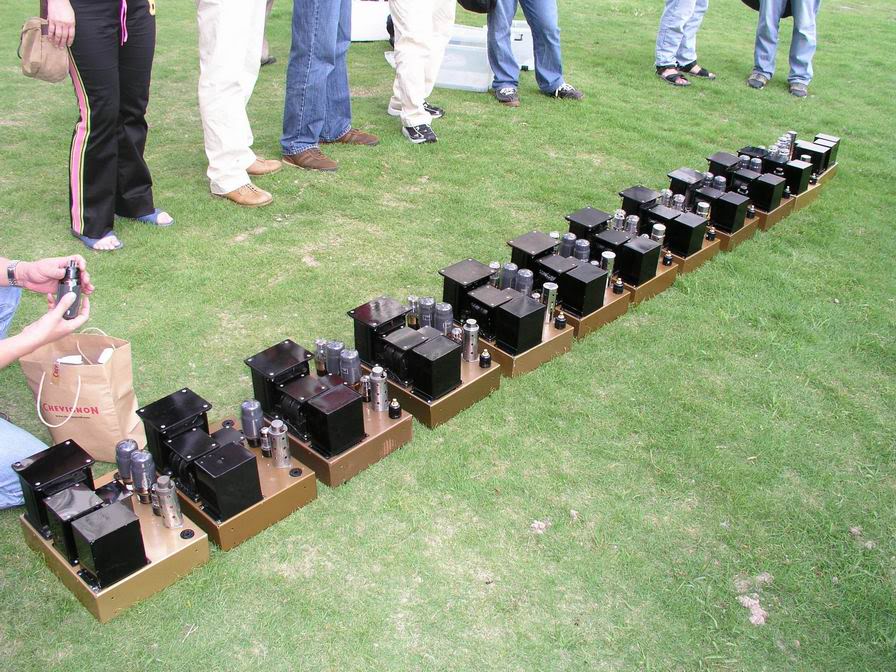
Hongkong based line up of restored Leak TL12.1, you will never see a amount like this in real life...

A friend of mine in Sweden has got his pair decades ago, but he never used them or did restore them for everyday use. So now I will take the chance and try to do a experiment and guide him here online through a restoration of his pair as a remote project, so that everybody of yours interested to follow can participate.


This pair will be restored through the next articles in parallel as some sort of a remote experiment?!
The left one is missing its ac plug, no problem to become.


A list of the most necessary parts:


A real problem will be solid hardware defects like broken windings of transformers and chokes, missing parts of the amplifier, like the component board, shields or outer case parts. Original replacements are impossible to find, it needs another amplifier for spending its parts in transplantation. If you know a winding company, it might be possible to rewind the original iron cores (if you need further informations about winding details visit here). The company Sowter offers replacement transformers which are sold as technical copy of the original, but look and feel very different. Bulgin plugs can be found at Ebay-UK. Good Luck!

Exceptional rare tube shields for the input tubes, difficult to find two-pin Bulgin socket for the speaker terminal, the common three pin AC-socket and dedicated plug, both latter are still available as new parts.


First steps


1. First all electrolytic capacitors need exchange, after 60 years of use/storage they are dry out and need replacement. Within these amps they are only used as cathode bypass of the input and power tubes:
C1 = 30mF/32V
C7, 8= 25mF/100V
Several new capacitor topologies and materials (Black Gate, Bamboo fiber, etc. ask your audio boutique dealer) have been established in the audio market resulting in very different sound structures. A classic, cheap and authentic decision would be electrolytic bipolar tone capacitors for crossovers with smooth anode.

2. All coupling caps are oil impregnated paper types. These last a lot longer than any electrolytic designs, but after 60 years it might be time to reset as well here:
A wide range of types is available from NOS suppliers or new brands. Standard is the use of aluminum foil, Jensen and Audio Note are able to supply additionally copper and silver foils with oil impregnated paper. Modern substitute are polypropylene foil types as advanced isolation material for the one who likes their typical sound. Sound wise, smooth and cheap and a good all round decision are the Russian PIO types:

C2, 3, 4, 5 and 6 are originally stated to be 0.25mF/500V, even if the highest voltage at any of them will not be higher than 300 volts.


A range of usable capacitors for the restoration, on top:
Russian 4mF/600V PIO caps for the PSU filter stage;
from left: Russian 0.25mF/1000V PIO with glass sealed wires; two vintage silver mica types;
there different actual Jensen PIO coupling caps

3. In the power supply line the Leak does incorporate as well oil impregnated paper types, which were in these days extremely expensive (and bulky). These are hidden in the black cover left of the output transformer. They are welded as 4 pieces of 4mF/600V in that case. For transistor aficionados the unbelievable low values of 4mF as charging type and as well 8 mF plus 4 mF as filter capacitor rail is set here. The push-pull topology make such low values possible, but the efficiency of such design depends on perfectly matched power tubes for hum free performance.
These capacitors normally last a lifetime, but I have seen several amps with typical oil leaks. Here a replacement has got necessary. It is almost impossible to find matching types and sizes in such amounts (8 pieces for a pair of amps) from NOS stock. The originals are welded into that can, it is a lot of work to dismantle these to keep the metal boxes for some modern replacement capacitors. Several users do refill them with smaller sized electrolytic types, and in a foremost manner with higher values to improve the filtering effect. The result might bring optical authenticity by the reuse of the original metal case, but will be accompanied by technical and aural detoriaton from the electrolytic capacitors.
The common electrolytic capacitor rail will come along with a lost of the incomparable smoothness in sound typical for these amplifiers. It is a must to replace them all with oil-paper types to keep their sound qualities. Another problem is the capacity of the first loading capacitor, which will be charged from the rectifier tube to its ripple limitions and might do complex damages when set to a higher values than 16mF (depending on the tube type) and a short life time period will result together with noticeable sound deformation. I hope to present here soon a perfect replacement solution for Leak TL12.1 users within the next entries...

C10, 11 (two of them in parallel), 13  are each 4mF/600V. These need to that high!! Big cans, look at the image!

The small values C9, 14 are welcome to be replaced as well with highly selected and measured paper oil types for the shown values and perfect soundstage, but silver mica types (original) are another option to keep the tolerances in a low range.

4. All resistors are carbon composition types of high wattage (1 to 3 watts), the so called british bone types have been used. It will be almost impossible to find NOS replacements of that brand. But several other brands are available from different countries like US, Europeen countries or Japan to match here. To my understanding it needs to be carbon composition types of high wattage to prevent hiss and show up with exceptional tonal delicacy.

Look into the schematic for all built values.
The two KT66 cathode types R16, 17 of 600 ohms should be 5 to 10 watts wire wound.

5. Tubes should be NOS types, British brands. Otherwise with modern Chinese or Russian replacements the amplifiers will perform with some sort of withdrawn performance of its original sound abilities. Yes they MO/GEC KT66 are expensive! But to come back to the beginning of this article, a (one) NOS WE 300B tube with engraved base will cost the double amount of two complete sets for stereo use of NOS British tubes for two Leak TL12.1's.


Read on soon,
Volker

Thursday, 7 May 2015

Vintage Treasuries – The Restoration of Leak Valve Amplifiers, TL10.1

Hello to everybody,

today I want to start with a long planned series about vintage valve power amplifiers and their restoration for everyday use. I want to give some advanced help for enthusiasts following here to preserve some rare and incomparable products representing audio history with tremendous skills to perform music in many respects a lot better than later made products. Cost cutting issues were within audio products likely the same than in any other industrialized mass production the decisive argument killing any individual contribution towards quality.
I will start with one of the most famous european brands from the golden age of tube amplification, the H. J. LEAK & CO. LTD.. I want to introduce a bit history of this manufacturer and try to show the adequately organized preservation of early examples with well selected parts and components. Aim hereby will be the historical correct interpretation of the final result in perfect balance with the best possible audible ability in mind. Almost all Leak power amplifiers are excellent audio performers independent of any later built technology (transistor>integrated>classD). They don't shy any comparison with more modern examples of their bread, their exceptional realized superiority has made them to icon of the audio age. So a careful knowledge based restoration make them to be a lifetime investment with exceptional natural capabilties and as lively sounding instruments too, when properly implanted with efficient and expressive transducers.


Leak TL10 "point one", with their typical straight golden appearance with black transformer covers.
I will start the series of entries with a quite common example of the early 1950's Leak models, their last called "point one" amplifier, the TL10 point one. When Harold Joseph Leak started his business in 1934, he first manufactured several amplifiers as contractor for the cinema and recording industry (like Geaumont Kalee and General Electric Co. ). He introduced his first amplifier series, the early triple loop Type 15 four stage KT66 amp in 1945. In 1948 Leak released his most famous model the TL12.1 with 12 watts triode push-pull power and its bigger brother the TL25. The TL12.1 was the first model named "point one", because it was the first amplifier in history with such a low distortion figure as  0.1 percent. This codicil was proudly used for a period of time to demonstrate technical advancement against other competitors in a fast raising business. The TL12.1 was a very successful amplifier in the broadcast and recording business, since the BBC ordered a noticeable amount for their studios around the world. This success did consolidate the name Leak in the professional business as first grade supplier of amplifiers. The TL12.1 will be covered quite soon with a own multipart restoration documentation, shown here online as a work in progress.

The later TL10.1 amplifier was brought into the market to get as well access to the new home audio market, a well decreased lower cost version of the professional outrider TL12.1. These amplifiers are  in every respect a downscaled version of the former heavily oversized designs. Today the TL10.1 models are highly underrated, seen from the today pricing results of auctions. These are from time to time still available in pairs for quite low costs, comparing their built value of quality. Their predecessors are hardly found anymore for sale anymore as single, have almost completely disappeared as later coupled pairs. Their production counts never have been high, in monophonic times less than 2000 pieces, where the TL10.1 has been sold in a lot bigger amounts, even still as monophonic units.

Their later successors from the mid to late 1950ties, the monophonic TL12+, TL25+, TL50+ and their stereo counterparts made after 1958, the ST20, ST50 and ST60 have been produced in tremendous quantities (each model 10.000 to 100.000 expl.) due to their well establishment in the audio market (Leak did make on special request for the BBC special versions of the TL25+ as back up units or as replacement for the TL12.1 in the late 1950ties). All these late types as to been from today represent a wide spread treasury of the best times of audio products made in Britain, the only country in Europe with a similar prosperity and a common targeted market like the US in the 1950 years for home audio products.
Any of these amplifiers is still today a good valve amplifier to show the exceptional audible inherent qualitiy of solid manufacture standards, contrary to the modern built samples of the "tube amplifier revival since 1980". Any of this models is with a little bit care able to fill even highest expectations and in a well suiting surrounding, able to show the foremost qualities of tube amplification in general. So all Leak tube amp models have been collected since their disappearance in the early 1960 years. Their typical gentle style with various luxurious metallic golden paints and their perfect technical realization within open cased designs, have made them together with a whole lot of other British brands, to some sort of incarnation of "the valve amplifier" (AEI, Soundsales, Pye, GEC, Armstrong, etc.). All of them have been dedicated to reach the same luxury consumer at home and as well abroad. Major US brands like Marantz, HH Scott, Heathkit, Fisher, Eico and others shared the same strategy with golden paints, only a view tried different concepts and designs. In the foremost stage here again a Europeen company, Peter Walkers Quad is an exceptional example of a individualized design culture with a typical modernist understanding of formally reduced appearance. Some other US manufactures did try the strategy towards the chromed jukebox appearance to match the taste of a younger generation, like Macintosh or Radio Craftsmen.


Close view of the valve line up and between output and mains transformer a Siemens MKP oil cap for the PSU filtering adapted with golden paint.

A must for this amplifier: british NOS KT 61 valves 


A restauration project always starts with a first check of the capacitor conditions, typically electrolytic capacitors have been dried out after several years of use or even in storage. A long term use might have shifted the resistor values within permanent physical warming, tubes might have run out of order or might show other types of failure (like "gassing", loose parts or broken sockets). For such a first check all valves should be plugged off and the secondary readings of the power transformer might give a first check. If these are in a expected tolerance (without load the figures are higher), the rectifier tube should be plugged back into place. But now, even without load the PSU capacitors are seeing high voltages, so it will be helpful to use a rheostat variable transformer, which gives the opportunity slowly to increase the incoming voltage. Starting with 60 volts for a while, it can be set higher in 20 volt steps every 10 minutes till the final voltage has been archived without failure. Now the other valves can be plugged in with a first test to read the voltages at certain points of the design. First it needs high power resistors of 10 watts dissipation in values between 8 to 16 ohms to give the amp a dedicated load at the exit terminals. Tube amplifiers need a load and should not be used without a speaker or such a dummy load connected.
A first voltage reading should be made behind the last PSU filter cap, than all anode voltages beginning with the first driver stage, second the phase shift stage and finally both push-pull power stages. In the same order all cathode voltages should be checked as second test, as third test ac leakage of all coupling caps might be checked with a multi meter at all secondary terminals of all coupling caps. If all readings are in a acceptable tolerance for a 60 year old amplifier (20%) it might be checked now with a real signal and with loudspeakers connected (check to use the right speaker impedance terminals or the right setting at the output transformer with later Leak models). Hum and hiss are common signs that parts have got out of tolerance and do degrade the performance or may be  falling completely. Normally burned resistors, leaking capacitors can be detected visually by deformations, burning scuffs or wet surfaces surround capacitors. I always would recommend after sixty years of service a complete exchange of all resistors and liquid conducted capacitors.

The TL10.1 needs to be used with the original KT61 valves for best performance, all 6L6 types or similar types like EL33 even with dedicated changes at working points do not match the sonic excellence of the early and rarely used tube due to their higher internal impedance ratio and this matching output transformer.


Rarely seen in real, perfectly matching paints of two originally monophonic amplifiers. Normally they differ a lot since the production fluctuations were high.


Parts

For resistors the classic carbon composition types from different brands are available from different sources are the agent of choice for such classic amplifier. They sound generally better (i.e. more musical) than cheap metal types and are historically seen the right decision. Here the higher power resistance of 2 watt is to be preferred, since these don't show the typical hiss, known from low power types.


Silver mica caps in the feedback line, oil paper coupling caps, 2 watt cc-resistors from Beyschlag and bipolar cathode capacitors from F&T beside Rosenthal resistors for the cathodes.

Coupling caps are widely available now at almost any price and origin. Here plastic foil types are in competition with oil paper insulated types. Generally I do like "pio" or "mp" better than more expensive plastic foiled types. With "oil-paper" you have as well a wide choice to be selected. You might get hand rolled types. made "under new moon" conditions from of long term stored copper foil, or you might find several so called audio caps made from exotic materials like bamboo fibers in your audio boutique available from different brands and with "definitive different sound attitudes",  or you simply go for former Russian military graded pio caps –  nor of them will make you a different amp...


MP capacitors for the smooth filtering of the anode supply are the aim, even if they are a lot big


I was always a believer of long term usability, so I always preferred Metal-Paper-Capacitors (MP) over unreliable electrolythic types as well in the the power supply stage. But the oil-paper types are always bulky and hard to find, in particular if you want to restore a amplifier to look like the original. So it makes the process difficult, to find space underneath to install some extra caps to get it made without compromise. Her in my example the big golden painted type on top of the chassis is such a compromizing type. It is a Siemens 8mF type which resembles the original black container in-between the two transformers, containing three electrolytic types which are after 60+ years leaking anyway. There is no way to get MP-types in that small box with similar values, so I decided to change it and mounted another two caps underneath. The boxes are still in storage for physical completeness of both amps in theory.
The only position in such a power amplifier where I hardly accept electrolytic types is at the cathode of a valve. Here I did use bipolar tone frequency capacitors as to be used in crossover networks with smooth anodes, in these days one of the only opportunities at such delicate position. In the meanwhile several special audio products have established like the Black Gate types and several other brands which show up with a improved abilities, so it depends a lot at the taste of the owner which capacitor here might be used.
Leak amplifiers normally do use silver mica capacitors in the feedback line to match closest tolerances. These are very good and do normally not fail, so they can be reused or if they need to be exchanged, styroflex types are the value if no other mica type is available.


I did restore my pair around 1990, a time when it was already difficult to find the right spare parts for such a project. Carbon composition resistors, oil paper capacitors and nos tube stock had already disappeared within the traditional electronic supplies in 1990. So it needed good researched informations to find New Old Stock parts or even specialized side business products, like Danish Jensen Capacitors or the British Billington Valves.  For example a 2 watt type Beyschlag carbon composition resistors was still in sale back these days, but it needed a minimum order of 10 for each value costing some 30 DM each. For a typical Leak amplifier some 20+ values were necessary, which ended in a 600 DM region just for the resistors. Another 200 DM for the Jensens pio caps (each around 30 DM), some switches, cables, tubes (even than a set NOS KT61/EF86/6SN7/GZ32 was 250 £) together with new contacts and switches it did lead roughly up to 1500 DM base cost for such a restoration. If you take the basic costs of a pair of TL10.1 in GB in account, in these days 450 £, a equivalent of 1400 DM, the cost did add to 3000 DM, which is almost 1500 EUR. This amount will hardly cash back for such a good pair in this restored condition. So it is another example of  typical hobbyist projects, where costs are no option. Today though the easy access to NOS spare parts via internet such a project has got a lot cheaper. As well you can find the original resistors and caps to make it perfect, or alternatively with some former Russian NOS parts you have just to pay the shipping costs...


In order to improve the sound the TL10.1 a smoothing choke (10H/100mA) resembling the original 1K filter resistor is a must. Oil caps for improved smooth filtering in the power supply have been installed for completeness.


Schematic drawing of the Leak TL10.1 together with dedicated "point one"-preamplifier module, supplied from
the power amplifier through the dedicated octal socket.


Read on soon about the famous TL12.1 amplifiers, Volker


Friday, 3 April 2015

Refinements of a Certain Stage  –  Low Frequency Decoupling Dampers

A german text version follows the end of the english text.


JBL 075 tweeter, modified with LignoLab bronze horn, decoupled from the low frequency enclosure underneath with special version LignoLab Niederfrequenzdämpfer DQ148 with support element.

Hello to everybody,

with this post I would like to introduce a new category "with rhyme or reason" into my blog. Here I will report about audio products in irregular sequence, which are made with intelligence, innovation and sense in mind. Such products are getting rare in a world made on top of a chinese workbench.


Today I would like to deal with a tiresome subject that is adequately known to every lover of high-quality audio reproduction – the influence of resonances to decrease the aural abilities within audio components. Too well such influences are treated with "sacred stones", decoupled cable beds foremost finished with massive CNC lathe machined anodised surfaces to be representative relicts in stores for "audio make worse trades", just to be lush money transformers. With profit margins reminiscent of dental technology, consumer products are thereby brought closer to guarantee always one thing: to mark a tremendous listenable difference as selling argument. All these products will have listenable effects, but will not substantially resolve the basic problem of decoupling down to the lowest oscillation frequencies below 10 hz, they just shift the resonances into another register of influence. All depends on the physical operational depth, its effect of insertion will have different effects with speakers in wooden enclosures electronic components or, at the most delicate place, within the pick up process of a analogue record player tonearm. This means the potpourrie of commercial offers is rich, sometimes reduced to simple home made recipes, voodoo and manly fashionable products from a audio boutique, but rarely based on solid physical principles, solutions and applications to master the problem. Naturally, the influence of such resonances in the analogous components of an audio chain is here greatest. Especially when evaluating a record player, where comparatively microphysical factors can produce enormous changes naturally the problem is fatal.

It was not until relatively late in the history of the analog palpation process realized that resonances in turntables have a large influence in this sort of sensitive application. Different it can not be explained why in particular the first division of brands for studio equipment turntables, namely EMT, Garrard, Thorens and Platine Clemént, but as well numerous refrigerator sized units from overseas with arm thick sized driving shafts, driven by bucket sized motor drives, have been mounted completely solid coupled to their studio consoles (the only exception proving the rule was the swing frame for the EMT 930, which was made to decouple the entire unit with a simple spring suspension frame, at least a first attempt in 1956). It started to be issue in 1959 with the first sub chassis player made by Acoustic Research, followed by Era 1962, Thorens in 1965 and later the well-known British players like the subscription project Sondek LP12 from the 1970s, managed to raise awareness of this problem.
These were and yet are still far away from a sustainable solution of the general problem. In order to visualize it in more detail, one must understand the physical preferences with delicate low (arm- / pick up-) mass of less than 50-100g and cantilever compliances from 5 to 25x10-6cm dyn. so that the oscillation frequency is below 10 Hz, better below 3 Hz. This value must be achieved so that the resonant frequency does not adversely affect the sensitive pick up process. This fact shows why a classic light weight sub chassis player of the above named types has a much higher resonance frequency due to the lack of damping properties for the spring suspension, resonances can be much easier develop from the input, decaying lack of mass and weight. This explains also equally sound wise their typical lack of colorrange and expression in the low frequeny response, even if they are well enabled to present all fine resolution within the middle and high frequency range as a benefit of their spring decoupling sub chassis designs.


Cuisine Française

Jean Constant Verdier, who died last autumn, was the unique design engineer of the turntable simply called  "Platine Verdier", which has written history in the past forty years in this regard and solved the topic of this article as much as possible.
Last but not least J.C. Verdiers early work with the company Era has led to a thorough analysis of the advantages and disadvantages of these light weight sub chassis constructions and have thus largely determined the structure and design of his unique first mass player to solve the problem. 
In the context of the French Maison de la L'Audiophile some developers have been in research between 1978 and 1988 about the conditions of the pick up process and around the player technology in general (P. Lurne). They tried extended analysis works with several main topic interests, since the turntable was still the foremost signal source for the audiophile in these years.
J.C. Verdier realized already in his first draft of his legendary turntable Platine Verdier (L'Audiophile, No 13, December 1979), the necessity not only of a precisely measured spring suspension, but also their pneumatic motion damping, so that this feet were damped down for maximum benefit to an oscillation frequency of 1-2 Hz. 
One would think the air damped suspension is a French specialty, because it was a similar pattern for the suspension of a French car maker Citroen (in the 1950s the Citroen 15CV was equipped with pneumatic damped suspension first time at one axis). Here with the Platine Verdier feet too, the combination of a loaded spring damped by a controlled air chamber for decoupling from typical vibrations was the innovation. In many other technical designs hence the more stronger made gas damper with higher frequency damping is used. In some vehicles even a simple torsion or leaf spring system were installed without any damping effect. The comparison may imagine a beautiful picture, where vehicles without damped suspension systems are just bumping over the road ... ?!


Drawing showing the first air damped spring suspended feet design from J.C. Verdier published
in L'Audiophile No. 13, Dec.1979


Together with the unique magnetic bearing design and the mass of 47 Kg for the complete turntable a incomparable "unit to play vinyl records" was invented by Verdier, at least in drawn theory published within three issued articles of the french audio magazine. Its realization is another completely different posting within this blog to follow later on some time. 
As we know today the Platine Verdier is a unique turntable, which did combine unmatched properties to a higher degree of interaction and led finally to a exceptional package of aural properties, which are even by todays standards almost 35 years after its first appearance, are still a milestone to pass. The Platine Verdier is the turntable that is still setting the pace for the today generation of all heavy mass players, oil rig inspired designs and ocean liner dashboard players (namely the ability of keeping the dynamic and musical content in a authentic flow of natural expression), combined to a higher degree with the typical known benefits from the best light weight sub chassis players (namely the finest resolution of micro dynamic harmonies), both welded together with an incomparable tranquility and homogeneity (by the magnetic bearing) in the finalized expression. No less and no more, and studied to date his master.
Unfortunately, this incomparable record players wide recognition success was denied in limited Iinternational scale, due to its heavy and bulky transport weight. In general, at overseas locations far outside central Europe, especially in Korea and Japan within the "audio gourmands" of the first hour, have been remained largely unknown about this design. Well, one can't have always the best...


Three different models are already designed to match almost any realistic mass in audio systems,
from left: Niederfrequenzdämpfer D172, D136 and SQ148, dedicated support element back in the middle.


At this point of the article I would like to focus on to Norbert Gütte, who was a long-time companion of Keith Aschenbrenner at Auditorium 23 from the start, not only as a carpenter of wide developed solutions for their speaker cabinets final realizations, but even as a "l'audiophile confessor". He has devoted all kinds of problems both supportive, as well with the adverse effects of resonances in the audio field extensively. Numerous speakers became addressed to the properties of musical instruments for taking advantage of harmonic skills from wood to be used with speaker enclosures. But also with reversed terms of the full scale avoiding the inherent resonant effects speakers have been designed and realized by Norbert Gütte, like the known component support rack called "Die Bank". This aim was achieved with subtle and complex unconventional material and joining technologies, still aimed to support the positive harmonious qualities in its stored audio components. So it is not surprising that Gütte began to examine the properties of Verdiers damped pneumatic spring principle at the turntable feet, since the Verdier turntable was distributed by Auditorium 23 from its beginning. The component rack "Die Bank" is typically a heavy mass unit, built with complex structures and joints, expanded in 2001 and equipped with Güttes first designed suspension damping feet series D172 for perfect decoupling of the total weight with more than 200 kg. The suspension of the rack can be adjusted to different weight support in order to match the important lowest resonance of 3 hz oscillation frequency. On top almost any record player can be positioned with all benefits known from this suspension/damping principle, additionally all other stored components like cd-players, amplifiers or recorders can profit from such a integrated completeness of decoupling.


The equipment rack Die Bank (100 kg) shown with centered three-feet damping system and security feet at the edges, the LignoLab preferred most efficient system. As well available with four D172 dampers in traditional edged position

Sectional cut through the side wall and carrying tray of Die Bank, shown with one D172 damper edge mounted in order to show the complex inner structure and the tonal best compound wood material for audio furniture, northern coniferous plywood.
Anybody who was not lucky enough to obtain a out sourced decoupling table from a physical research institute at a yard sale will get with "Die Bank" an sound key product for his high-quality audio components with incomparable attitudes to any other component decoupling system known. This is to be assumed in effective depth at least equal value of a exceptional audio component, – and it tops it with length for a fraction of costs. Here not only a extremely prone turntable can benefit, but this furniture also offers enough space much for the rest of the chain, such as pre- and power amps to be decoupled in one unit. The low frequency damper D178 can be equipped with different strong springs and can expand with further two or three dampers to a resonance system interconnected to the weights between 100 kg and 250 kg, decoupled precisely down 3 hz with different sized springs. Such a rack is a lifetime investment, which electronic components can do so?
As a logical consequence resulted from these dampers the complex built turntable bench TT100 (100 kg) is designed, since such a high mass optimizes the physical effect of a air damped spring suspended system. This table enables analog devices, so-called mass turntables perfectly to get into non resonant stage. Thus, these units can now get one of the unique features of the original Platine Verdier, namely their air damped suspension system, which is to my knowledge and experience may be even more important than the magnet bearing, been decisive for the remarkable sound quality of the Platine Verdier. Norbert Güttes TT100 can be impressively seen in action in a little Youtube video. Totally amazing, the entire unit can be irritated to several centimeters in vibration, without any sort of affection to the pick up process.

But amazement alone can not be a selling point, certainly when so little representation factor is associated with a product and since the feet purely functional appearance, then already sufficiently convincing properties have to play the role of desire. It can not be completely described with words, how a analog turntable can profit sound wise from such circumferentially decoupling. Very few have probably a assessed idea of ​​the actual aural signification to the skills of a high-end mass player. But if you follow the theoretical idea of a complete resonance elimination and to its sense of a system with low frequency isolation introduced and alternatively not in comparison the most will be more than surprised by the result and the depth of the effect. With a profoundness that goes far beyond completely different tone arm / pick up- / step up transformer sets, such a player wins exorbitant fine dynamic resolution, dynamic capabilities and allows the natural flow of music to follow a lot more with natural ease. Immediately one no longer recognizes his player back and actually begins now extensively to learn just as you have probably never heard it before. Norbert Gütte has varied the use of the D172 damper within a quartet or within an equilateral triangle as a triplet underneath "Die Bank" and with his newer turntable-bench TT100. Actually this first damper model is extended with two more smaller damper variants for lighter weighted components. The D136 can also be used in different versions with different inserted springs to match a range of three weights between 14 kg to 60 kg and is suitable to be mounted directly underneath a turntable, with built in weight adjustment and balancing option.

Laufwerktisch TT100 with Platine Verdier on top


Norbert Gütte takes the trouble to precisely tare the actually searched weight to adjust the usable range with the help of sample structures from brick stones to ensure a one hundred percent effective product. Thiese dampers can be placed directly under a component and are therefore also suitable for direct isolation of todays typical massive weight turntables. In addition, for lighter designs with plinth like the Thorens TD124, Garrard 301 u. 401, as well all other representatives of the typical idler wheel section, there is the low-frequency damper DQ148 of being able to balance weights between 4 to 25 kg. This damper type was originally designed for the decoupling of tweeters and midrange drivers in critical resonance mounting positions of loudspeaker enclosures, in order to protect these from the influence from heavy low frequency resonance insertion. Originally made for the JBL ring radiator 075 or 2402 may be provided with his own bronze horn, but these dampers can also decouple heavier drivers to the influence of powerful bass drivers in the same physical enclosure set for perfectly resonant freeness. I was not able to test this dedication within my own set up, but I know about such delicate decoupling issues from my own enclosures very well.

The only final word can be, that the decoupling effect and its profound values of refinement are second to none. Once installed nobody will reject such a system after personal evaluation, I swear. The remarkable profit in resolution and dynamic abilties is exceptional and exceeds the known dimension of change between two world class components in a given system by far, even not being cheap such a system can be counted as long term investment at the lower cost side of  the audio world. If you're wondering whether you really will need such a system, please answer the question: Whether you can do without a spring damper system in your car?The LignoLab dampers are the only universal available solution with such technical and audible efficiency and profit worldwide. Additionally all products from Norbert Gütte are produced in small series as pure manufacturing pieces, but deny any manual ductus of the emergence in absolute perfection in its execution, workmanship and finish. As to be typical for any LignoLab product.

For further informations about the LignolLab products you will find at the end of the German text all necessary addresses and links.


Evaluation to match perfectly the given weight of a customer with
3 hz oscillation frequency (here 46 kg).


German Version:


Heute möchte ich mich mit einem leidigen Thema beschäftigen, das jeder Liebhaber hochwertiger Audiowiedergabe hinlänglich kennt, dem Einfluss von Resonanzen in Audiokomponenten und deren wirksamer Isolation. Nur zu gut wird seit Jahr und Tag im repräsentativen Reliquienhandel für Audioverschlimmbesserungsprodukte der Einfluss geweihter Steine, gebetteter Kabel und dies alles vor allem mit massiver CNC-Dreh- und Eloxaloberflächentechnik optisch wirksam geltend gemacht bzw. zu sattem Geld transformiert. Mit Gewinnspannen die an zahnmedizinische Technik erinnern, werden dem Verbraucher dabei Produkte näher gebracht, die eines auf jeden Fall fast immer garantieren, nämlich einen gewaltigen klanglichen Einfluss zu markieren. Häufig werden dazu dehnfähige Polymere, in einfacher oder komplexer Verbundtechnik als Allheilmittel mit wirkfördernder Namensgebung eingesetzt.
Inhärente Resonanzen in ihren unterschiedlichsten Ausprägungen beeinflussen den Klang von Audiokomponenten in gravierender Weise, sie können diesen sogar umfänglich verändern. Jedoch selten gelingt es mit solcherart Boutique-Produkten, den Hebel an die Ursache oder Wirkungsweise und -tiefe anzulegen und die gezielte Beseitigung des Problems zu bewerkstelligen. Häufig verändern diese Produkte die resonanten Eigenschaften oder verschieben die sie in ein anderes Register, in den wenigsten Fällen werden sie minimiert oder gar beseitigt. Dabei ist das Potpourri mehr als reichhaltig, nicht nur einfache Hausrezepte, Voodoo und zahlreiche Mode-Produkte aus der Audioboutique werden eingesetzt, sondern auch auf physikalische Grundlagen beruhende solide Anwendungen und Lösungen versuchen den Problemen Herr zu werden. Naturgemäss ist der Einfluss solcher Resonanzen gerade bei sensiblen analogen Wandlern wie Plattenspieler oder Lautsprecher einer Audiokette sehr deutlich erfahrbar. Beim Abtastvorgang eines Tonabnehmers, wo vergleichsweise mikrophysikalische Einflussgrößen ungeheuere Veränderungen durch die darauf folgende riesige Verstärkung von fast 100 dB erzeugen können, ist naturgemäss das Problemfeld der Resonanzanregung besonders fatal.

Norbert Gütte uses his Niederfrequenzdämpfer within his Sato-Horn installations, in order to
decouple the sensitive wide range horn from the sand filled Double-Onken-type cabinet.

Erst relativ spät in der Geschichte der analogen Tonabtastung hatte man erkannt, dass Resonanzen in Abspielgeräten einen großen Einfluss an dieser sensiblen Stelle nehmen. Anders lässt sich eigentlich nicht erklären, warum insbesondere die Erstligisten der Studioausstattung, nämlich EMT, Garrard, Thorens, Platine Clement und zahlreiche kühlschrankgrosse Studioprodukte aus Übersee (wie Fairchild, RCA und Gates mit armdicken Antriebswellen und eimergrossen Motoren) noch in den sechziger Jahren ihre Tonarme massiv mit den Antriebskonstruktionen verschraubten. Selbst im Verbund als Einbaugerät für Studiokonsolen wurden die Laufwerke weitestgehend steif angekoppelt. Eine effektive Entkopplung fand bestensfalls mit gefederten Einbautrahmen für die Gesamtkonstruktion nur unzureichend statt (Der Schwingrahmen des EMT 930 sollte das gesamte Laufwerk mit eine Federaufhängung entkoppeln, zumindest ein erster Versuch in 1956). Erst mit den sogenannten Subchassisspielern für den Heimaudiomarkt der ersten Generationen wie Acoustic Research 1959, Era 1962, Thorens 1965 und später die bekannten britischen Abonnementkonzepte wie der Sondek LP12 (wird seit Erscheinen in den 1970er Jahren fortwährend mit den gefühlt 56sten Upgrade verbessert), schafften ein Bewusstsein für dieses komplexe Problemfeld. Sie waren und sind aber von einer nachhaltigen Lösung immer noch weit entfernt. Um sich das Problem etwas genauer zu vergegenwärtigen, ist zu verstehen, dass der Einfluss beim sensiblen Abtastvorgang mit relativ geringen (Arm-/Abtaster-)Massen von weniger als 50-100g und Nadelnachgiebigkeiten von 5 bis 25x10-6cm dyn. gravierend ist. Dementsprechend ebenso plausibel, daß die Schwingfrequenz unter 10 Hz, besser unter 3 Hz zu liegen hat. Dieser niedrige Wert muss erreicht werden damit die Anregung sich nicht nachteilig auf den Abtastvorgang auswirkt. Ein klassischer Subchassisspieler der genannten Typen liegt aufgrund mangelnder Bedämpfung des Ein- und Ausschwingvorgangs, aber auch mangelnder Masse sehr viel höher und damit noch sehr deutlich im Hörspektrum. Dies erklärt auch gleichermassen derer Mangel an durchgezeichneter Farbigkeit und komplexer Ausdrucksfähigkeit in der Wiedergabe des Grundtonbereichs, obschon sie allesamt in den mittleren und höheren Frequenzen die Vorzüge einer solchen Entkopplung vorteilhaft zu präsentieren wissen. In diesen Frequenzbereichen funktionieren die weitestgehend ungedämpften Entkopplungsmethoden nachhaltig gut.
Viele vermuten bei Entkoppelungsmaßnahmen vor allen Dingen positive Effekte bei der Trittschallentkopplung von Plattenspielern, diese wird zwar auch wirkungsvoll mit diesen hier vorgestellten Dämpfern erreicht, jedoch geht es in diesem Artikel um weit umfänglichere Einflüsse, vor allem sollen die weitaus weniger wahrnehmbaren geräteinternen Resonanzanregungen beleuchtet werden, die durch feinste mechanische Schwingungskopplungen entstehen und sich unkontrolliert ausbreiten.


Cuisine Française

Jean Constant Verdier, der im vergangenen Herbst verstorbene Konstrukteur einzigartiger Laufwerke, schlicht „Platine Verdier“ genannt, haben in den zurückliegenden vierzig Jahren Geschichte in dieser Hinsicht geschrieben und hatten das angesprochene Problem bereits damals weitestgehend gelöst. 
Nicht zuletzt seine Tätigkeit bei der Firma Era hat Verdier genaue Erkenntnisse über Vor- und Nachteile der leichten Subchassiskosntruktionen verliehen und diese Erkenntnisse haben somit massgeblich die Konstruktion seines legendären ersten Masselaufwerks zur Lösung vorbestimmt. 
Im Umfeld vom französischen Maison de la L’Audiophile waren in den Jahren 1978 bis 1988 einige Entwickler mit Fragestellungen um die damals wichtigste Signalquelle Plattenspieler befasst (P. Lurne) und bemühten sich mit erheblichem Aufwand, Versuchen und physikalischen Messungen den ungelösten Problemen der Schallplattenabtastung beizukommen.
Verdier gebührt deshalb auch die Ehre, das Prinzip der aufwendig bedämpften Federwirkung, hier pneumatisch realisiert, für Plattenspieler eingeführt zu haben. Man sollte meinen die pneumatische Dämpfung ist eine französische Spezialität, denn sie wurde auch ähnlich funktionierend für die Federung eines französischen Automobils entwickelt (die erste hydropneumatischer Federung wurde im 15CV der der 1950er Jahre von Citroen verbaut, zunächst nur auf einer Achse). Auch hier bewirkt die Kombination von belasteter Feder und einer kontrolliert eingesetzten Luftkammer als Dämpfungseinheit den erwünschten Grad der Entkopplung von tiefstfrequenten Schwingungen. In vielen anderen technischen Bauformen wird deshalb der einfacher zu verbauende und härtere Gas-/Öldruckdämpfer mit höherfrequenter Dämpfung eingesetzt. In manch einfachen Fahrzeugen sind oder sogar noch Torsions- oder Blattfedersysteme ohne Dämpfung verbaut. Der Vergleich mag eine schönes Bild entwickeln, Fahrzeuge ohne bedämpfte Federsysteme springen über die Strasse…?!

Niedrigfreqeunzdämpfer D172 set as used with Laufwerktisch TT100 and Die Bank for perfect central alignement of masses


Verdier realisierte bereits bei seinem ersten Entwurf zu seiner Platine Verdier (L’Audiophile, No13. Dezember 1979) deshalb nicht nur eine präzise bemessene Federung sondern auch deren pneumatische Bewegungsdämpfung, so dass diese Einheit nach eigenen Aussagen bis hinab zu einer Schwingungsfrequenz von 1-2 Hz optimal wirken konnte. Zusammen mit der Magnetlagerkonstruktion und der Masse von 47 Kg war ein bis heute unvergleichliches Laufwerk zum „Abspielen von Schallplatten" zumindest theoretisch erfunden worden, dass es dann zu einer Realisierung kam ist eine weitere ganz andere Geschichte, die ich an dieser Stelle sicherlich auch noch vorstellen werde. Wie man eben inzwischen umfänglich erkannt hat, ist erst durch diese Kombination ein Zusammenspiel möglich geworden, welches unerreichte Eigenschaften in sich vereint. Die Platine Verdier ist das Laufwerk, welches die Eigenschaften sämtlicher Masselaufwerke (nämlich die Fähigkeit auch dynamische Musikpassagen mit authentischer Kraft, Ausdruck und Farbigkeit wiederzugeben im Stande ist) mit den typischen Eigenschaften der besten subchassisentkopplten Laufwerke kombiniert (nämlich mit feinster Auflösung mikrodynamischer Harmonien) und beides zusammen mit einer unvergleichlichen Ruhe und einem Fluss (Magnetlager) in der Musikdarstellung verbindet. Nicht weniger aber auch nicht mehr, und das sucht bis heute seinen Meister. Leider ist diesem unvergleichlichen Laufwerk der ganz grosse Anerkennungserfolg im internationalen Masstab aufgrund seines mächtigen Transportgewichts versagt geblieben. In Übersee generell, vor allem bei koreanischen und japanischen „Audio-Gourmants“ der ersten Stunde ist dieses Laufwerk weitestgehend unbekannt geblieben. Naja, man kann ja nicht immer nur das Beste haben....


Component base realized with heavy sand filled platform and three DQ148 Niederfrequenzdämpfer in triangle order for lighter weighted turntables and amplifiers, seen from underneath.


An dieser Stelle möchte ich auf Norbert Gütte zu sprechen kommen, der als langjähriger Weggefährte von Keith Aschenbrenner im Auditorium 23 von Beginn an nicht nur als gelernter Tischler vielfältige Lösungen für Lautsprechergehäuse mitentwickelt und realisiert hat, sondern selbst als l’audiophil Bekennender sich bereits früh für allen möglichen Fragestellungen sowohl der unterstützenden, wie auch der unerwünschten Wirkungen von Resonanzen im Audiobereich ausgiebig gewidmet hat. Dabei entstanden zahlreiche Lautsprecher die die Eigenschaften von Musikinstrumenten zur Vorteilsnahme harmonischer Fähigkeiten nutzen. Aber auch mit umgekehrter Zielsetzung, nämlich zur Absorbierung unerwünschter Resonanzen wurde z.B. das Komponentenrack „Die Bank“ entwickelt. Diese erreicht mit subtil und aufwendig umgesetzter Material- und Verarbeitungstechnik ebenfalls eine Unterstützung der harmonischen positiven Eigenschaften der ihm anvertrauten Komponenten. So ist es nicht verwunderlich, dass Gütte das pneumatische bedämpfte Feder-Prinzip der Füsse Verdiers auf universellere Wirkzusammenhänge hinreichend zu untersuchen begann, war doch das Auditorium 23 von Beginn an der Vertrieb für das Verdier Laufwerk. Gütte hat das Prinzip der bedämpften Federfüße schon seit längerem weiterentwickelt. Die bewusst schwer gebaute "Bank“ wurde dann seit 2001 mit der ersten Niederfrequenzdämpfer-Serie D172 um eine perfekte tieffrequente Entkopplung erweitert. Wer nicht zufällig in den Besitz eines ausgemusterten Kopplungstisches einer physikalischen Versuchsanstalt gelangt ist, bekommt mit der „Bank“ eine unvergleichliches klangentscheidendes Produkt zur Steigerung seiner hochwertigen Audiokomponenten an die Hand, das diesen in Wirkungstiefe mindestens als gleichwertig zu bemessen ist. Hier können nicht nur die generell extrem anfälligen Laufwerke profitieren, sondern dieses Möbel bietet auch noch Platz einen Großteil der restlichen Kette unterzubringen, so können Vor- und Endverstärker gleich mit entkoppelt werden. Der Niederfrequenzdämpfer D172 kann mit verschiedenen Federn ausgerüstet werden und kann somit im Verbund mit weiteren zwei oder drei Dämpfern zu einem resonanzfreien System ausgebaut werden. Mit individuell nach Kundenwunsch bemessenen Federn können dann Gewichte zwischen 100 kg und 250 kg präzise bis hinab 3 hz entkoppelt werden. Als logische Konsequenz daraus ergab sich dann mit diesen Erfahrungen der aufwendig gebaute Laufwerkstisch TT100 (100 kg Eigengewicht zur Masseoptimierung der Dämpfung). Mit diesem Tisch können schwere Analoglaufwerke, sogenannte Masselaufwerke perfekt entkoppelt werden. Somit können auch andere Laufwerke sich eines der beiden entscheidend wichtigen Alleinstellungsmerkmale der Platine Verdier, nämlich ihre Dämpferfüsse nun nachträglich als Vorteil zu eigen machen. Norbert Gütte führt auf seiner Homepage eindrucksvoll in einem kleinen Youtube-Video die nachhaltige Funktionsweise der Einheit vor. Völlig verblüffend kann diese im laufenden Betrieb um mehrere Zentimeter in Schwingung versetzt werden, ohne das der Abtastvorgang davon im geringsten beeinträchtigt wird. 

Aber Verblüffung allein kann kein Verkaufsargument sein. Schon gar nicht wenn so wenig Repräsentationshabitus damit verbunden ist und das in einem Geschäftsbereich, der eigentlich heutzutage nichts anderes mehr als genau diesen verkauft. Dann müssen schon hinlänglich überzeugende Eigenschaften wirken und diese sind mit Worten kaum zu beschreiben. Die Wenigsten haben vermutlich eine Vorstellung davon die tatsächliche Wirktiefe der Niederfrequenzdämpfer auf die Fähigkeiten eines hochwertigen Laufwerks zu übertragen. Aber wenn man den schlüssig physikalisch abgeleiteten Erkenntnissen folgt, ist man immer noch mehr als überrascht über den realen Zugewinn. Die Tragweite ist eher mit einer möglichen Investition in eine höchstwertige Audiokomponente vergleichbar. Dabei gewinnt jedes wertige Laufwerk an feindynamischem Auflösungsvermögen, dynamischen Ausdrucksfähigkeiten und macht es möglich dem natürlichen Fluss des musikalischen Geschehens müheloser zu folgen. Man erkennt sein Laufwerk eigentlich nicht mehr wieder und beginnt damit es nun umfänglich komplett neu zu erfahren, genau so, wie man es vermutlich noch nicht zuvor gehört hat. Norbert Gütte hat inzwischen den Niederfrequezdämpfer D172, der im Quartett bei der Bank oder auch im von ihm präferierten gleichseitigen Dreieck als Triplett auch beim Laufwerkstisch TT100 eingesetzt wird, um zwei weitere kleinere Varianten nach unten erweitert. Der D136 kann auch mit geringeren Gewichten als sein größerer Bruder optimal eingesetzt werden. Er deckt in verschieden bestückten Ausführungen im Dreierset Gewichte von 14 kg bis 60 kg ab und ist somit geeignet direkt unter entsprechend schweren Laufwerken montiert zu werden. Hier kann Gütte vier Gewichtsvarianten anbieten. 
Er macht sich die Mühe das tatsächlich gesuchte Gewicht seiner Kunden mit Hilfe von Probeaufbauten exakt auszutarieren, um eine einhundertprozentige Wirkweise sicherzustellen. Zusätzlich für die noch leichter bauenden Zargenlaufwerke, wie den Thorens TD124, Gararrd 301 u. 401, sowie weitere typische Vertreter der Reibradtechnik, gibt es noch den kleinen quadratisch gebauten Niederfrequenzdämpfer DQ148, der in verschieden bestückten Versionen in der Lage ist Gewichte von 4 kg bis 25 kg zu entkoppeln. Dieser Dämpfer wurde ursprünglich entwickelt um Hoch- und Mitteltontreiber in resonanzkritischen Montagepositionen bei Lautsprechern (s. Bild am Beginn des engl. Teils) vom Einfluss der tieffrequenten Schallwandler zu schützen. Zu diesem Zweck kann man ihn mit einem veränderten Auflageaufbau ausrüsten, wie z. B. für den JBL-Ringradiator 075 oder 2402 der auch mit Norbert Güttes Bronzehorn aufgewertet werden kann. Aber auch schwerere Treiber lassen sich komplett vom Einfluss der kraftvollen Basstreiber im gleichen Gehäuseverbund perfekt resonanzfrei trennen.

Abschließend kann man zusammenfassen, die Wirktiefe einer pneumatisch bedämpften Federung ist in empfindlichen Einsatzpositionen von ungeheurer Bedeutung und ist sie einmal ausprobiert danach schnell auch unverzichtbar geworden. Das diese Dämpfer natürlich auch nachhaltig Trittschallprobleme auf schwingenden Fußböden absorbieren, ist eigentlich nach allem Gesagten selbstverständlich wie naheliegend. Wenn Sie sich jetzt fragen ob Sie ein solches System wirklich benötigen, beantworten Sie sich die Frage: Ob Sie in Ihrem Auto auf eine Federdämpfersystem verzichten könnten?

Erst recht bei analogen Laufwerken und auch bei hochfrequenten Hornlautsprechern (der Wirkungsgrad der Resonanzen und damit verbundenen Irritationen auf die feinsten übertragenen Frequenzen ist einem einem mechanischen Verstärkerprinzip wie einem Horn naturgemäss sehr hoch) ist der tatsächliche Gewinn an musikalischer Auflösungen als ein mehrfaches einer höchstwertigen Komponente jeweils anzusehen. Die Dämpfersysteme und -Möbel decken in allen Varianten fast jede denkbare Möglichkeit zur Entkopplung ab. Die LignoLab Niederfrequenzdämpfer sind das einzige universell adaptierbare Produkt ihrer Art, diese bieten eine einzigartige nachhaltige Lösung der Resonanzproblematik und dies mit absolutem Alleinstellungsmerkmal. Selbst das Original, die mit pneumatischen Dämpferfüssen ausgerüstete Platine Verdier kann bei schwinganfällgen Fußböden in Kombination mit Bank oder Laufwerkstisch durch das gesteigerte Gesamtgewicht noch einmal deutlich profitieren.
Sowohl die Bank, als auch der Laufwerkstisch und auch die Niederfrequenzdämpfer werden in Kleinserien als reine Manufakturarbeit hergestellt. In ihrer Ausführung, Verarbeitung und in ihrem Finish repräsentieren sie allesamt Güttes Auffassung hochwertigster Funktionalität verbunden mit einer konsequent von überflüssigem Habitus befreiten Ästhetik in jedem Detail. Die Dämpfersysteme und -Möbel sind wahrlich kein Sonderangebot, aber deren klanglicher Einfluss auf hochwertige Audiokomponenten ist im gleichen Maßstab derer Kosten als Sonderangebot zu werten und das auch noch mit Langzeitstabilität. So betrachtet bekommt eigentlich auch noch jeder "Geiz ist Geil"-Einwand seine unverdiente Belohnung.


Weiterführende Informationen zu den Produkten von LignoLab:

LignoLab
info (at) lignolab (dot) com
Norbert Gütte
Telefon: 02327 54 66 97
Fax: 02327 54 66 98
Mausegatt 59
44866 Bochum
Germany