Hello to everybody reading my blog. In November I did already mention Trio EM as a wonderful talented young german jazz trio. Amazing new ideas about jazz music, wining prizes over prizes, Michael Wollny is extremely creative with unbelievable output, a skyrocketing career. Here his newest piece "Weltentraum", came out last week. It is in a way a bit different to former performances, it is finer and more subtile, less dynamic, almost intimate in musical character, it is wonderful to listen to.
As far as I do know, his second analogue long playing album, – it is as well a brilliant recording were the older cd's often lack a bit of this quality. ACT did release this record in parallel with cost free mp3 download for the buyer !? Get it, it's just amazing good music.
Read on soon, Volker
Showing posts with label Music. Show all posts
Monday, 10 February 2014
Saturday, 2 November 2013
Trio EM – Eva Kruse, Michael Wollny, Eric Schaefer – Jazz for the Next Generation
Last year in February a friend of mine asked me if I would like to come over and visit a small jazz festival in the city of Essen. He was set into interest because of his trumpet teacher, who did act with a band there and he had recommended this little jazz festival. Without being personally involved I was in the first stage a bit reserved about going there. But I got persuaded to visit and at some saturday night in February the event did take place. The concert was opened up by a very young quartett of musicians who all had found together after finishing the quite well known Folkwang Music School. They played some moderate "resumee-jazz", a bit from all directions without any real emphasis. I started already to regret being there, in particular when I realized to see another two songs of this young band.
The next band was a quintet (here my friends trumpet trainer played himself the horn) with typically well known influences from the 1970ties as some sort of rock-jazz-crossover. I never was a real fan of rock music, nor did I like this sort of typical mixture with classic jazz elements from the bop era. I noticed after the second song that my interest did fall against zero and I would have fallen asleep, if the pa would have been not so loud. My friend told me in the meanwhile, that the third band of this evening, a young trio from Berlin, has a very good reputation already and that his trumpet teacher does not only know them well, but likes their music a lot. Ok I said to myself, I hope I will survive till the end of this evening, it already had got 22:30h. A good half hour later the last act of the evening started and on stage were three young people in their end twenties setting up a classic trio with piano, contra bass and drums. When they started it did not take longer than 10 seconds for me to be back completely alive and able to immidiate that there something extremely good and very exiting new happened. There was a presence of energy with all three, which did overcome me completely. Now I did feel very well again, my feet snapped and my brain started to relax, I could enter into the mood for the first time at that day. Trio EMs music has a very intense energetic drive as a typical component. This energetic drive is a result of a deep percussive understanding of each musicians instrument. Eva Kruses bass is often setting the pace, were Eric Schaeffers percussions add rhytmic structures and Michael Wollny often turns the piano into a giant percussion instrumentation. I have never seen a pianist sitting so agile and limber at the keyboards, he is extremely nimble and shifts from explosive maneuvers into sedative passages back almost lying completly in the inside of his piano plucking the strings with his fingers and beating them with the his underarms.
This music was some of the best jazz music I have heard in my live due to the incomparable performance all three are acting. At this evening they played four or five acts and I went home completely satisfied from what I saw. I was so convinced that I would rate the trio as one of the best jazz acts for years. Immediatly it did buy all existing recordings and went to three further live acts. When I did "google" them I found out that they had been rated in 2011 as best young jazz act since 25 years by the Süddeutsche Zeitung. This is the first time in my blog that I show work released on digital media, if you are looking for contemporary music, there is no other chance. At youtube you might get a good impression about their phantastic work.
In the meanwhile Michael Wollny is a rising star in the jazz world, he brings out lots of records were he acts together with other musicians, and it is not allways jazz, he is trying some unusual crossovers to new music and other conceptual ideas. For example the work with Heinz Sauer and Wolfgang Kühn is exceptional as well the CD shown called "Wunderkammer XXL". I think he is one of the most interesting musicians of todays music scene without any category.
Stay tuned, Volker
The next band was a quintet (here my friends trumpet trainer played himself the horn) with typically well known influences from the 1970ties as some sort of rock-jazz-crossover. I never was a real fan of rock music, nor did I like this sort of typical mixture with classic jazz elements from the bop era. I noticed after the second song that my interest did fall against zero and I would have fallen asleep, if the pa would have been not so loud. My friend told me in the meanwhile, that the third band of this evening, a young trio from Berlin, has a very good reputation already and that his trumpet teacher does not only know them well, but likes their music a lot. Ok I said to myself, I hope I will survive till the end of this evening, it already had got 22:30h. A good half hour later the last act of the evening started and on stage were three young people in their end twenties setting up a classic trio with piano, contra bass and drums. When they started it did not take longer than 10 seconds for me to be back completely alive and able to immidiate that there something extremely good and very exiting new happened. There was a presence of energy with all three, which did overcome me completely. Now I did feel very well again, my feet snapped and my brain started to relax, I could enter into the mood for the first time at that day. Trio EMs music has a very intense energetic drive as a typical component. This energetic drive is a result of a deep percussive understanding of each musicians instrument. Eva Kruses bass is often setting the pace, were Eric Schaeffers percussions add rhytmic structures and Michael Wollny often turns the piano into a giant percussion instrumentation. I have never seen a pianist sitting so agile and limber at the keyboards, he is extremely nimble and shifts from explosive maneuvers into sedative passages back almost lying completly in the inside of his piano plucking the strings with his fingers and beating them with the his underarms.
![]() |
| A small selection of CDs from the last couple of years, but there is a lot more to find out. |
In the meanwhile Michael Wollny is a rising star in the jazz world, he brings out lots of records were he acts together with other musicians, and it is not allways jazz, he is trying some unusual crossovers to new music and other conceptual ideas. For example the work with Heinz Sauer and Wolfgang Kühn is exceptional as well the CD shown called "Wunderkammer XXL". I think he is one of the most interesting musicians of todays music scene without any category.
Stay tuned, Volker
Saturday, 20 July 2013
Nina Simone – The First Decade on Vinyl
Nina Simone is born as Eunice Kathleen Waymon in February 21st 1933 and died at April 21st in 2003 in France. She was an american singer, songwriter, pianist, arranger, and civil rights activist widely associated with jazz music. Simone aspired to become a classical pianist while working in a broad range of styles including classical, jazz, blues, folk, R&B, gospel, and pop.
Her musical style arose from a fusion of gospel and blues songs with classical music, in particular with influences from her first inspiration, Johann Sebastian Bach. She injected as much of her classical background into her music as possible to give it more depth and quality and accompanied with her expressive jazz-like singing in her characteristic contralto. Her intuitive grasp on the audience–performer relationship was gained from a unique background of playing piano accompaniment for church revivals and sermons regularly from the early age of six years old.
To fund her private lessons, Simone performed at the Midtown Bar & Grill on Pacific Avenue in Atlantic City, whose owner insisted that she sing as well as play the piano. In 1954 she adopted the stage name Nina Simone. "Nina" (from niña, meaning 'little girl' in Spanish) was a nickname a boyfriend had given to her, and "Simone" was taken from the French actress Simone Signoret, whom she had seen in the movie Casque d'or. Simone's mixture of jazz, blues, and classical music in her performances at the bar earned her a small, but loyal, fan base.
In 1958 she befriended and married Don Ross, a beatnik who worked as a fairground barker, but quickly regretted their marriage. Playing in small clubs in the same year she recorded George Gershwin's "I Loves You, Porgy", which she learned from a Billie Holiday album and performed as a favor to a friend. It became her only Billboard top 20 success in the United States, and her debut album Little Girl Blue soon followed on Bethlehem Records. Simone lost more than $1 million in royalties (notably for the 1980s re-release of "My Baby Just Cares for Me") and never benefited financially from the album's sales because she had sold her rights outright for $3,000.
Despite this terrible facts the album is by far the best album of all her career. It explodes from energy, intensity and musical input. I think she did know very well about the importance of that first recording. If there is one Nina Simone record to own, that it is this one. It is as well a very good recording in terms of fidelity. This is said about both versions, the stereo and the mono version, even if I do like the mono record better that the stereo one.
She covered Billie Holiday's "Strange Fruit", a song about the lynching of black men in the South, on Pastel Blues (1965). She also sang the William Waring Cuney poem "Images" on Let It All Out (1966), about the absence of pride she saw among African-American women. Simone wrote "Four Women", a song about four different stereotypes of African-American women, and included the recording on her 1966 album Wild Is the Wind.
Simone moved from Philips to RCA Victor during 1967. She sang "Backlash Blues", written by her friend Langston Hughes on her first RCA album, Nina Simone Sings the Blues (1967). On Silk & Soul (1967), she recorded Billy Taylor's "I Wish I Knew How It Would Feel to Be Free" and "Turning Point". The album 'Nuff Said! (1968) contains live recordings from the Westbury Music Fair, April 7, 1968, three days after the murder of Martin Luther King, Jr.. She dedicated the whole performance to him and sang "Why? (The King Of Love Is Dead)", a song written by her bass player, Gene Taylor, directly after the news of King's death had reached them. In the summer of 1969 she performed at the Harlem Cultural Festival in Harlem's Mount Morris Park.
I did take care about her first decade of album releases between 1958 and 1968. From everything I know, I think it was her most productive time in her live. She continued on with record releases, but she never could build on the same level of intensity comparing her first years.
Nina Simone died in 2003 in Carry-le-Roue in southern France. She was one of the absolute most soulfull and remarkable singers in the 20th century despite of genre and as well a brilliant piano player. A real solitaire.
Read on soon about other lady singers, Volker
For further informations on records from Nina Simone visit her illustrated discography:
Her musical style arose from a fusion of gospel and blues songs with classical music, in particular with influences from her first inspiration, Johann Sebastian Bach. She injected as much of her classical background into her music as possible to give it more depth and quality and accompanied with her expressive jazz-like singing in her characteristic contralto. Her intuitive grasp on the audience–performer relationship was gained from a unique background of playing piano accompaniment for church revivals and sermons regularly from the early age of six years old.
To fund her private lessons, Simone performed at the Midtown Bar & Grill on Pacific Avenue in Atlantic City, whose owner insisted that she sing as well as play the piano. In 1954 she adopted the stage name Nina Simone. "Nina" (from niña, meaning 'little girl' in Spanish) was a nickname a boyfriend had given to her, and "Simone" was taken from the French actress Simone Signoret, whom she had seen in the movie Casque d'or. Simone's mixture of jazz, blues, and classical music in her performances at the bar earned her a small, but loyal, fan base.
In 1958 she befriended and married Don Ross, a beatnik who worked as a fairground barker, but quickly regretted their marriage. Playing in small clubs in the same year she recorded George Gershwin's "I Loves You, Porgy", which she learned from a Billie Holiday album and performed as a favor to a friend. It became her only Billboard top 20 success in the United States, and her debut album Little Girl Blue soon followed on Bethlehem Records. Simone lost more than $1 million in royalties (notably for the 1980s re-release of "My Baby Just Cares for Me") and never benefited financially from the album's sales because she had sold her rights outright for $3,000.
Despite this terrible facts the album is by far the best album of all her career. It explodes from energy, intensity and musical input. I think she did know very well about the importance of that first recording. If there is one Nina Simone record to own, that it is this one. It is as well a very good recording in terms of fidelity. This is said about both versions, the stereo and the mono version, even if I do like the mono record better that the stereo one.
| Nina Simones first recording "Little Girl Blue", released by Bethlehem Records in 1958 |
After the success of Little Girl Blue, Simone signed a contract with Colpix Records (a subsidary of Columbia records), and recorded a string of studio and live albums. Colpix relinquished all creative control to her, including the choice of material that would be recorded, in exchange for her signing the contract with them. At this point, Simone only performed music to make money to continue her classical music studies, and was indifferent about having a recording contract. She kept this attitude toward the record industry for most of her career.
The half of the colpix albums are recorded live at different public concert houses. So these early recordings give a very well insight into the atmosphere of the concerts and Nina Simones presence at stage. Here mostly a unique opportunity is given to get part of a extremely intimate moment of performance, as to listen to a very present singer in the other event. Even if the recorded fidelity of the most of the colpix albums is not very good, I like these recordings together with following phillips and rca recordings as her major work. I believe that colpix did not use not own recording equipment like other companies in these days (famous Mercury living presence), instead they seem to have used the inhouse installed equipment of the concert halls.
In 1964, she changed record distributors, from the American Colpix to the Dutch Philips, which also meant a change in the contents of her recordings. Simone had always included songs in her repertoire that drew upon her African-American origins (such as "Brown Baby" and "Zungo" on Nina at the Village Gate in 1962). On her debut album for Philips, Nina Simone in Concert (live recording, 1964), however, Simone for the first time openly addressed the racial inequality that was prevalent in the United States with the song "Mississippi Goddam", her response to the murder of Medgar Evers and the bombing of a church in Birmingham, Alabama that killed four black children.
From then on, a civil rights message was standard in Simone's recording repertoire, becoming a part of her live performances. Simone performed and spoke at many civil rights meetings, such as at the Selma to Montgomery marches. Simone advocated violent revolution during the civil rights period, rather than Martin Luther King's non-violent approach, and she hoped that African Americans could, by armed combat, form a separate state. Nevertheless, she wrote in her autobiography that she and her family regarded all races as equal.
The half of the colpix albums are recorded live at different public concert houses. So these early recordings give a very well insight into the atmosphere of the concerts and Nina Simones presence at stage. Here mostly a unique opportunity is given to get part of a extremely intimate moment of performance, as to listen to a very present singer in the other event. Even if the recorded fidelity of the most of the colpix albums is not very good, I like these recordings together with following phillips and rca recordings as her major work. I believe that colpix did not use not own recording equipment like other companies in these days (famous Mercury living presence), instead they seem to have used the inhouse installed equipment of the concert halls.
![]() |
| A typical Colpix record of that time with golden label. The company changed in the early 1960ties several times the color of the labes. |
In 1964, she changed record distributors, from the American Colpix to the Dutch Philips, which also meant a change in the contents of her recordings. Simone had always included songs in her repertoire that drew upon her African-American origins (such as "Brown Baby" and "Zungo" on Nina at the Village Gate in 1962). On her debut album for Philips, Nina Simone in Concert (live recording, 1964), however, Simone for the first time openly addressed the racial inequality that was prevalent in the United States with the song "Mississippi Goddam", her response to the murder of Medgar Evers and the bombing of a church in Birmingham, Alabama that killed four black children.
![]() |
| A typical Philips deep groove first release with rainbow stripe. This records are generally a lot better recorded than the earlier Colpix records. |
From then on, a civil rights message was standard in Simone's recording repertoire, becoming a part of her live performances. Simone performed and spoke at many civil rights meetings, such as at the Selma to Montgomery marches. Simone advocated violent revolution during the civil rights period, rather than Martin Luther King's non-violent approach, and she hoped that African Americans could, by armed combat, form a separate state. Nevertheless, she wrote in her autobiography that she and her family regarded all races as equal.
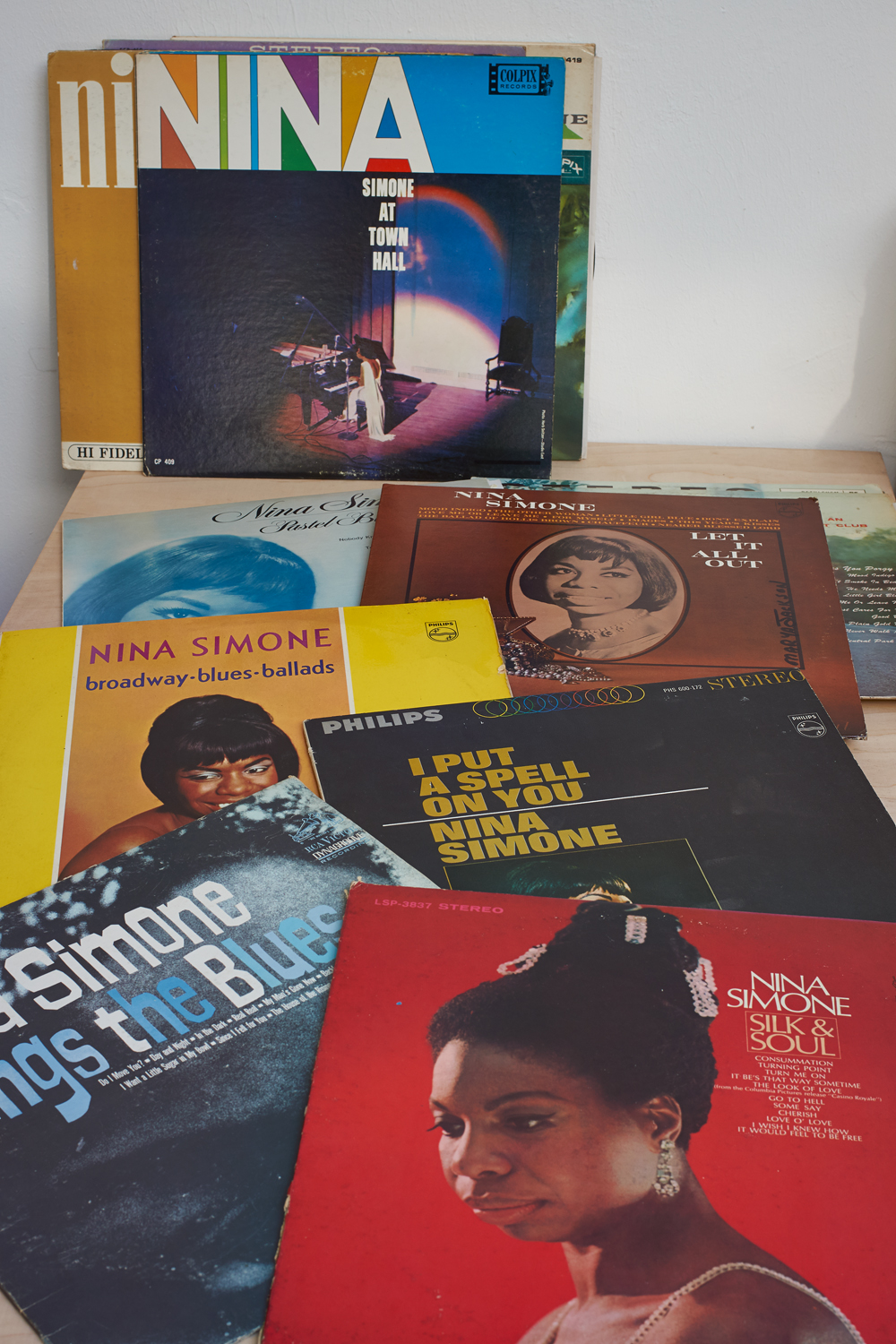
![]() |
| Some of the Philips first releases and two early RCA releases in front. |
She covered Billie Holiday's "Strange Fruit", a song about the lynching of black men in the South, on Pastel Blues (1965). She also sang the William Waring Cuney poem "Images" on Let It All Out (1966), about the absence of pride she saw among African-American women. Simone wrote "Four Women", a song about four different stereotypes of African-American women, and included the recording on her 1966 album Wild Is the Wind.
Simone moved from Philips to RCA Victor during 1967. She sang "Backlash Blues", written by her friend Langston Hughes on her first RCA album, Nina Simone Sings the Blues (1967). On Silk & Soul (1967), she recorded Billy Taylor's "I Wish I Knew How It Would Feel to Be Free" and "Turning Point". The album 'Nuff Said! (1968) contains live recordings from the Westbury Music Fair, April 7, 1968, three days after the murder of Martin Luther King, Jr.. She dedicated the whole performance to him and sang "Why? (The King Of Love Is Dead)", a song written by her bass player, Gene Taylor, directly after the news of King's death had reached them. In the summer of 1969 she performed at the Harlem Cultural Festival in Harlem's Mount Morris Park.
I did take care about her first decade of album releases between 1958 and 1968. From everything I know, I think it was her most productive time in her live. She continued on with record releases, but she never could build on the same level of intensity comparing her first years.
Nina Simone died in 2003 in Carry-le-Roue in southern France. She was one of the absolute most soulfull and remarkable singers in the 20th century despite of genre and as well a brilliant piano player. A real solitaire.
Read on soon about other lady singers, Volker
For further informations on records from Nina Simone visit her illustrated discography:
notes:
Simone & Cleary 2003, Nina Simones personal web page and wikipedia
Saturday, 25 May 2013
Kind of Blue - Miles Davis – Vinyl Grading for Collectors
From time to time I would like to talk about other interesting aspects beside hifi. So I will try to discuss some aspects of music, its culture, as well the todays format questions and as a part of it the vinyl record collecting. Longer than I am interested into hifi, I am interested into music. At the begining it was classical music as well some jazz, but living in Germany makes the use and the collecting of jazz records (if you are on original releases) almost impossible so I collected classical music in the first stage. Everything changed with ebay.
One of my absolute favorite jazz albums always was and still is "Miles Davis - Kind of Blue". The original recording was made by Columbia in march/april 1959. This record entered in august 1959 the market as CL1355 pressed in mono and alternativly as stereo edition CS8163, both with a wrong sequence of the takes of "All Blues" and "Flamenco Scetches" for the first 50000 (collectors!) on the label and cover. The following pressings corrected the mistake at the label but Columbia never noticed or changed the misspelling of Adderleys name on the cover before the CD release. This record is originally a true stereo recording and not the for that time typical mono record, which was later electronically enhanced for a stereo use. Since 1958 stereo was a new thing in the marketing of music, so almost every company offered than recordings in both versions, were the stereo edition always was sold more expensive.
"Kind of Blue" is one of the most important jazz albums from the 20th century. It is commonly known as the very first initial piece of modal music in jazz history. Whole books have been written about that record in order to classify its significance. So its not on me here to write about its dimension for the jazz music at all.
I really do like this music a lot, so once in the 1990ties I started to look for the original recording in the early ebay days. At this time I was driven by the understanding, that only the first release of a recording will capture all original qualities of its content, like dynamics, space, air and tonal richness. I did know that record companies stored the original master tapes in their archives after the first pressing. For later pressings the most of these companies used 1:1 copies of them, so I believe that the copy already is characterized by a degradation of the original dynamics. Firmly taken by that idea, it seemed to be logic to me that only first releases will garantee the best possible reproduction of the original recording available. In my collection several examples of jazz records from this time do acknowledge my theory of best quality on vinyl.
So I hunted for the mono recording of "Kind of Blue" in these days of the late 90ties at ebay.com. I always tried to get a copy for 50$ or less, but this amount was never enough to make me a winner. The auctions ended always at a minimum of 85$, sometimes far beyond the magic 100$ line. I didn't know anything about "goldmine gradings" and all the little necessary informations for collectors in these days. So I never got one of this beloved records.
In 2001 I was invited to teach as guest professor at a well known university in Cambridge, MA. I moved for a year over there. From the first day I realized a vinyl record shop every 300 m at any main street there, this is definitive a record collectors ground. Every shop had a very good jazz department with a good variety of vintage records, for a german a unknown "vinyl heaven". The prices ranged between 2.99$ and 20$ for quite rare first releases. And than Boston next door, were the story continued with several good shops. I only want to mention the "Loony Tunes"-shop at the opposite street side of the famous Berklee College of Music which has unfortunatly closed in the meanwhile?!.
Record collecting in the 21st century, the time of the media free music and "unnoticable compression" is showing its perspective for the years to come. Nobody soon will remember how it once sounded with "true fidelity equipment", real master recordings and their pressings, nor that somebody has the opportunity to check the former audible qualities on his own perception. Since once american companies have mixed cd's for the use in cars in the 1990ties, todays music is mixed for cell phones and its dedicated ear pluggs. Amen.
Ebay has changed a lot the collectors market and its today options to buy vintage records. When in the beginning years the most vintage records were sold in open auctions and the hot collectible records sometimes skyrocketed (prices from 450$ to 2500$ per record), todays offers at ebay are "buy-it-now-auctions" at fixed prices for the standarts. The highly collectible records have completely disapeared, since the gobal collectors market seems to be saturated. As with vintage hifi, the generation of its initial interest is going to retire, the younger generations are aimed into other topics.
Soon I will write about a diy record cleaning machine for the real vinyl collector, which really cleans and dries without loud noises, so stay tuned, Volker
One of my absolute favorite jazz albums always was and still is "Miles Davis - Kind of Blue". The original recording was made by Columbia in march/april 1959. This record entered in august 1959 the market as CL1355 pressed in mono and alternativly as stereo edition CS8163, both with a wrong sequence of the takes of "All Blues" and "Flamenco Scetches" for the first 50000 (collectors!) on the label and cover. The following pressings corrected the mistake at the label but Columbia never noticed or changed the misspelling of Adderleys name on the cover before the CD release. This record is originally a true stereo recording and not the for that time typical mono record, which was later electronically enhanced for a stereo use. Since 1958 stereo was a new thing in the marketing of music, so almost every company offered than recordings in both versions, were the stereo edition always was sold more expensive.
![]() |
| 5 times almost the same record, from left: modern aniversary reissue from 2009, 3 issues of the first stereo release CS8163 and in background one CL1355, the first mono release |
"Kind of Blue" is one of the most important jazz albums from the 20th century. It is commonly known as the very first initial piece of modal music in jazz history. Whole books have been written about that record in order to classify its significance. So its not on me here to write about its dimension for the jazz music at all.
I really do like this music a lot, so once in the 1990ties I started to look for the original recording in the early ebay days. At this time I was driven by the understanding, that only the first release of a recording will capture all original qualities of its content, like dynamics, space, air and tonal richness. I did know that record companies stored the original master tapes in their archives after the first pressing. For later pressings the most of these companies used 1:1 copies of them, so I believe that the copy already is characterized by a degradation of the original dynamics. Firmly taken by that idea, it seemed to be logic to me that only first releases will garantee the best possible reproduction of the original recording available. In my collection several examples of jazz records from this time do acknowledge my theory of best quality on vinyl.
So I hunted for the mono recording of "Kind of Blue" in these days of the late 90ties at ebay.com. I always tried to get a copy for 50$ or less, but this amount was never enough to make me a winner. The auctions ended always at a minimum of 85$, sometimes far beyond the magic 100$ line. I didn't know anything about "goldmine gradings" and all the little necessary informations for collectors in these days. So I never got one of this beloved records.
![]() |
| The cover of the versions vary by the double arrow symbol for the stereo issue and behind without arrow for the mono version |
In 2001 I was invited to teach as guest professor at a well known university in Cambridge, MA. I moved for a year over there. From the first day I realized a vinyl record shop every 300 m at any main street there, this is definitive a record collectors ground. Every shop had a very good jazz department with a good variety of vintage records, for a german a unknown "vinyl heaven". The prices ranged between 2.99$ and 20$ for quite rare first releases. And than Boston next door, were the story continued with several good shops. I only want to mention the "Loony Tunes"-shop at the opposite street side of the famous Berklee College of Music which has unfortunatly closed in the meanwhile?!.
I did buy every week 20 jazz records, mostly first relases from the time between 1950 to end of the 1960ties. In my time in Camebridge I did not see one copy of the first "Kind of Blue" in the shops, while I bought almost 1000 first releases of other jazz music.
![]() |
| The CL1355 "6-eye" mono version, the deep groove iindentation is clarly visible on the label |
![]() | |
|
Back in Germany in 2002 I started my hunt again on ebay in order to get finally one copy. I did increase my input and got the first mono pressing CL1355 for 85$ plus shipping. I was happy to manage this old dream. Some weeks later I could hold the record in my hands and was very exited to play it on my turntable. When the stylus slipped into the first groove it was clearly noticeable, that the music was not the foremost content of this record. I could not really believe what I did hear, the record was in such a bad condition, that almost three pops per second sounded like a fireplace concert instead of the well known music. I went back to the auction and it was advertized as: "VG+, some surface noise might be audible". OK, I had understand, even if I learned in the meanwhile about the goldmine gradings. But I had to learn that ebay competition changed the interpretation of the grading. A VG graded record is meant as "only for display use", while a MINT- is some adaquat condition for use. So I looked out for the next one. This time I looked for the stereo version, which was normally more expensive in this days. A MINT- copy went for 290$ to a asian collector, puhh...?!. I got a copy of the stereo version CS8163 for 136$ plus shipping sometime later on. It was offered as VG++. A MINT copy rarely appeared at ebay, I saw one going for 450$, that was definetly out of my reach. Some weeks later the VG++ record arrived and I was very impatiend to listen to it. To be honest, it was almost the same like the first one. Cracks and pops all the time, for a record with some very calm passages a real "no go". I contacted the seller and he told me that with goldmine grading only mint or MINT+ marked records will garanty a noise free play. Ok, I decided to look for the second release version. So far I had two copies with the legendary 6-eye label, the next will be a 2-eye version. The prices for this version decrease a lot comparing the first releases. I got a MINT- copy for 32$ plus shipping. I was happy, but I did not know if the second release will be as good as the first one. Unfortunatly the record never appeared, it had got lost on its way over the atlantic. Two month later I started again my hunt. I was succesfull and got a 2-eye copy for 24$ in mint condition. This time it came out well and I received the record. It sounded good, almost without any surface noise, but I had the impression that the former releases do have a wider dynamic range than the second releases. Miles trumpet was a lot better focused and the other instrumentation had a deeper soundstage. With the 6-eye version you can hear the space between each musician, were the 2-eye is missing it. So after a while I started again my hunt to find a MINT- copy of the 6-eye version. I spended 180$ plus shipping and was succesfull. The record came and it was really in good condition, it sounds amazing comparing it to the later versions. I was happy to get a good copy at the end. Alltogether I had spend a good 1000$ on that record, I did buy 6 records to get one good one, only addicts will act this way ...?
In 2009 this record celebrated its 50ties anniversary. Columbia released a newly (digital?) remastered version of this recording on 180 g vinyl, with all "absolute necessary" improvements and with all "record colllector blah-blah" and inclusive a limitation of the edition. I got weak and did buy a copy. When I played this new version, I could not believe what I do hear. A dramatical reduced dynamic range comparing it to the original first release, almost no more realistic space of the former set up and a typical tonal degradation of several instruments. "The most important record of the 20th century (Columbia) has gotten even better" sounded now exactly like the very poor cd-pressing, which was existing for years.
![]() |
| Cover print of the CS8163 stereo version back side with the wrong order of tracks |
![]() |
| Imprint in dead wax at CS8163 indicating a very early matrix pressing, for the collector it is heaven: 1AA |
Ebay has changed a lot the collectors market and its today options to buy vintage records. When in the beginning years the most vintage records were sold in open auctions and the hot collectible records sometimes skyrocketed (prices from 450$ to 2500$ per record), todays offers at ebay are "buy-it-now-auctions" at fixed prices for the standarts. The highly collectible records have completely disapeared, since the gobal collectors market seems to be saturated. As with vintage hifi, the generation of its initial interest is going to retire, the younger generations are aimed into other topics.
Soon I will write about a diy record cleaning machine for the real vinyl collector, which really cleans and dries without loud noises, so stay tuned, Volker
Subscribe to:
Posts (Atom)