Showing posts with label Tannoy speakers. Show all posts

Monday, 1 February 2016

The TrueFi Tannoy Enclosure – The Manufacture

Hello to everybody,

continuing reading here in the new year 2016. So I will start with a new article about my Tannoy speaker design. Still I cannot believe how exceptional these speakers in such a cabinet design do work out, even after two years of every day use I do not miss anything. People who know standard alnico versions from Tannoys classic or prestige range (mostly with reflex designs and a more or less too small scale volume) do not have a close perception of what this speaker is able to do. Almost refined and rich textured invisibility with fast transient response, due to its dipole design, combined with finest detailed natural musical resolution show a stage of musical completeness, tannoy normally are not known for. The typical bold, hardly textured and more than rich sound of historical Tannoy speakers, has been improved to a before unknown level for such 15-inch speaker. They remind me a lot more to the typical cinema horn installations with their impressive refinements in micro acoustic terms. Of course such a speaker is not able to show the same degree of micro acustic resolution, its physically handicapped to do so, but you never will ask for anything missing. A exceptional homogeneity, hard to obtain with such complex horn installations, has indeed more affinity to small scale full range speakers, but with a much improved dynamic ability. So these speakers do mark a full unique alternative option in size, living room ability and performed quality, last not least seen from the money point of view. The only natural predator in this league might be Voice of the Cinema-types of speakers, which would be from certain points no alternative for me...

The by now first manufactured samples are finished and are in deliver to their new owners. I have spend a good amount of time of the last year to find refinements for the production and manufacture process. The front loaded dipole enclosure is some sort of ultimate cabinet for the 15-inch Tannoy Dual Concentric speaker with the 15 ohm hard edged version of cone, i.e. Monitor Black, Silver, Red and Gold with 8 ohms. Almost any detail of my prototype cabinets got improved for the series production.
The most problematic detail is still the curved front horn extension. It is made from solid layers of 3 mm mahogany veneers, each glued to the next within a specially made press form, to a final thickness of 18 mm solid wood. Mahogany wood is a ideal material, since it is grown in long strong fibers, which will be bendable in a perfect way and will give the necessary elastic stiffness for preferred sound values. I still hope that FSC certified tropical wood is not only a placebo for the conscience of the consumer and will give some extended sort of sustainability.


Different stained fronts are available to customer requests

 The front of this speaker design is exceptional important design feature, since it is acting as a relevant extension of both different speaker units. The HF-compression part will be extended to lower frequencies, since the LF-cone will be supported in the important lower mid frequencies of 400 to 1000 hz. In the same time the fronts are acting as frontal part of the well known h-dipol design (original WE 7331), they need to mount mechanically the more than 10 kg heavy Dual Concentric speaker to the enclosure with all known advantages and problems. This is a highly delicate question to solve and one main issue bringing vintage alnico equipped Tannoy speaker enclosures into a refined singing mode. Within a misunderstanding of this little detail lots of generations of Tannoy speakers from last 40 years didn't reach their inherent built world class smooth expression.
The open back needs to be completely lined with 10 mm woolen felt in order to minimize direct reflections inside the cabinet, the extension cases are lined with low density boards. These extension cabinets are just movable only for transportation reasons to keep the enclosure sizes small.


Here shown with slightly stained and oiled oak veneer for the main corpus and dark brown
stained color for the extension enclosure in the back.


All veneers are thick types of minimum 2mm thickness to give the enclosures a robust surface
and a solid wood appearance since they are made from lumber core plywood, the best sounding
wooden boards for speaker enclosures.

Listening to these Tannoys shows a well expected improvement in the naturalness and liquidity of the  typical tonal impression, comparing these with my plywood cabinets. The coniferous solid wood inside sounds better articulated with less resonant edges in the tonal accuracy. They will improve within the next month even more, when they get played in, a process known well from a typical wooden musical instruments.


10 mm woolen felt is my preferred damping material inside enclosures, in order to minimize
reflections inside cabinets. pine strives of 10mm thickness add some controlled strength to
cabinets. These are arranged in proportions of the the "Golden Cut" to find the best dispersed
reconance distribution.


I was almost shocked when I did refurbish the first pairs of chassis with original "recone kits" supplied by Lockwood Audio. These typical preassembled units (paper cone with surrounds, centering unit and voice coil) don't make a lot of problems to the experienced and get perfectly installed into the well known chassis of the dual concentric loudspeakers. It struck me down when I did a first listening test after the reconing process, I was save about the fact that both high frequency units are defunctional. Even if I did measure them before, I stopped the listening test and reopened the tweeter for a second inspection. I was quite save that the didn't work by listening. But I was wrong, the paper cone was absolutely not able to perform its dedicated frequency ends, i.e. the lower frequencies below 150 hz, as it could not resolute the frequencies above 500 hz. So these units over roared with 200 to 500 hz frequency parts so loud, that it was impossible to hear the hf unit or some lower bass.


Variants of the enclosure in different stained color and again with retractable back.
This option needs a precise felt gasket between outer and inner case-


After almost 4 hours of first playing the music started to open up and was already sounding in a way which did remind me a bit to the typical Tannoy sound. After 50 hours play from radio they started to sound quite well, still with a reserve of resolution of 5 % to match. It will show in future, I think it  will need another good 100 to 200 hours till they will show their best attitudes.
As well the cabinets itself need a extensiv cuing in process very similar to wooden musical instruments. At the very early beginning they don't sound refined. Quite edgy and inharmonious in their musical behavior within the first hours, they start to brake in after eight hours play of music. After another 20 hours play in time, they show some first musical insight and convince with some first harmony distribution. I expect them after 100 hours playing time to reach their final exceptional transparency and harmony in a stage, where thy are already acoustically invisible. This process seem to be very similar to the run in process of wooden instruments. Interesting, normally when you build a speaker one time, you can not realize such effects. But if you listen to a new sample of your well known speaker, you are able to observe even the smallest changes.


The crossovers are made from copper foil inductors and oil-paper capacitors and solid 2mm copper wire. They have got a metal housing, close in design to the original crossovers known from the legendary Tannoy Monitor Silver and Reds. So I have spared no effort to take care about any technical but as well optical detail to match the original or better standard these speakers were known for. I think it might be a pleasure for the future customer to see how much attention has given into any detail of these speakers. Details which haven't been seen for more than 50 years from commercial sold speakers, even if they were manufactured in low amounts. I did try to make one of the best loudspeakers in history even better and keep its almost legendary standards to the highest possible level. Like several other recently issued remakes from history, like the LineMagnetic series of speakers or the Western Electric 15A horn replicas from Aldo in Italy, I try to manage a similar idea of reissuing with a main interest to a before unavailable quality with vintage Tannoy speakers. I am happy to present with such speaker a stage of improvements, which was never available before, nor it can be found in in their current own pricy legacy releases known as "Prestige Series".

Fresh reconed chassis are looking like new

Of course they have got the TrueFi logo
I prefer felt gaskets like known from the early Monitor Silver, better than the later
introduced high density foam in black or white (shown in one image above),
known from Monitor Red, Gold or HPD.


These speakers are available to order as complete loudspeakers equipped with refurbished Red units or can be alternatively equipped with own speakers from the Tannoy Monitor Silver, Red or Gold line. They can be made with different veneer types as they can be customized in several details on request.

It's always good to have some spare Reds in house, you never know what will
happen...As well some spare recone kits might give safety.

Read as well what other say who have listened to this speaker!

Sizes and technical informations:
95cm high to 60cm wide, with a minimum of 65cm depth variable extendable between 45 to 80cm.
Made from 18mm lumber core plywood, veneered with 2mm furniture veneers.
Funnel made from solid mahogany 3mm veneers.
All used solid wood from coniferus sorts between 1.5 to 6 cm strength.
Soft rubber rollers integrated in the base.
Total weight 52 kg each equipped with speaker and crossover.


Read on soon,
Volker

Sunday, 27 September 2015

New Headshells and Other News

Hello to everybody,

after a longer period of absence I am back here without the final two parts about the Leak TL 12.1 restoration parts planned. As already introduced, it was some sort of a experiment to do the restoration as remote project with somebody realizing the steps near Malmö in Sweden. Unfortunately I had now to cut this project since my partner Marcus is extremely unreliable and unsafe about the forthcoming of the project for such regulary entries. He was unable to show any forthcoming within the last months... So I have learned my lessons again, my reservations to be completely dependent from somebody came out to be even worse... I will not do such a experiment again!

Last step of transferred progression in Malmö with the Leaks, the soldering of the housings for the caps...

I will show complete replacement cap housings soon myself to finish this issue, since some people are interested to get such replacements sets for their Leaks TL12.1.


But now the audio season has already restarted. Any longer waiting can not be accepted, so I will  restart this blog with several good news and entries coming soon. One topic will be the introduction of a new headshell project. I want to find good replacements for the long time classic and favorite Ortofon headshells in A- and G-type form since almost all customers of my kit or arms are asking for them. I am planning to bring out a own type made from highly advanced materials with several aural benefits in a very similar style. Even the good things can be made better and vintage stock has got almost unobtainable. The original G-type shells are skyrocketing in price terms at Ebay through the last years, 200 to 300 EUR for even broken, incomplete or unmatching ones has got quite normal.
The run on idler wheel turntables has not only grown a worldwide hunt on such classic record players and tonearms, it creates as well a high demand for matching vintage accessories in style.
People which have read my reports about different materials of such all side closed headshell designs know, that I have already rejected wood for such a dedicated use with advanced audio preferences. A new designed G-type headshell needs to be made from materials with better matching attitudes than wood. I did make several tests with plastic injected molding procedures and composite casting materials. Materials which will match low edition production issues are not very useful in audio terms, these don't match the well known established qualities. The very lightweight compositions and are not solid enough to give heavy cartridges a necessary strong support in a heavy 12-inch armwand, nothing came out to be a real alternative to the thick wanded bakelite vintage types from Ortofon. But even Ortofon does not longer make such shells from injectable materials. Beside their classic metal types their production has shifted to pressed composition processes, using flakes of wood with coumpound materials.


Prototypes for molding models of the gypsum form made from synthetic materials and marble in a 1: 1,3 scale  together with all necessary parts for the finally produced  headshells.

I will try to find a highly improved replacement, matching all traditional design terms. They should look very similar, vintage and old school, but in technical and audible terms highly improve the classic types by far. First test show that porcelain is a exquisite material which might match all expectations. But further test are here still necessary.
I will introduce the classic G-type as complement to my SME 3012 MK1 heritage tonearms in a first step. Customers of such tonearms are looking for matching headshells in terms of historical, visual and technical perfection. Porcelain has always been used as technical advanced material like as electrical or heat isolator, it is water resistent and it is resistive against high pressure loads. So it can act as a favorite material to match all preferences for a ideal headshell with low compliance cartridges like the SPU or the Denon DL 103. Some Japanese companies have already introduced ceramic made headshells  in the 1970ties.


Ceramics are exceptional well matching materials in such terms, but there are other problems to come by in a small scale serial production. Actually I am working to find final solutions of the molded size, which will shrink in two steps after finally formed. The firing of the porcelaine and its glass coating will both have a massive influence to its shrinking size (values between 17 and 26 % are varying on used materials) and represent a increase of its density in verso. The temperatures  between 1200° and 1300° C degrees have a massive influence to the final baked density and so will the audible sound properties of the finalized shell shift with such different production values. There will be still some work to be coordinated till the best G-shell will be available.


Customized materials and staining for the customers in comparison to my own enclosures

During summer the production values for the TrueFi Tannoy dipole speaker have been evaluated. I did contact several carpenters, wood workers, boat designers and loudspeaker specialist in order find a solid reliable and reproducable production process for my speakers. Inquiries from interested customers make a adequate solution here necessary. For this reason several specialist have examined my own prototypes to find figures for a reproduceable serial production of small amounts. The result was of course as expected: too complicated, too much work, too much different materials and with "the biggest enemy of the carpenter – the curved wood*" a lot too complicated to be made in Germany to be paid its labour and material costs in a adequate way. * quote: Norbert Gütte
The good answer first, it got solved, the production is in process, the bad answer it is not cheap. If you see it as lifetime investment (and which commercial introduced audio product will be?) what they easily can be in terms of comparable value, they are still a bargain. These speakers might solve your loudspeaker question finally, which other type can do so. I only know a handful...


Raw new fronts made from solid mahogany layers
of solid wood
The first pairs will be finished soon and I will document some progressions and major changes comparing my own prototypes here. But they will be a lot better made in every respect. The first sets will get send out into the world soon, the first pair will be shipped to Australia.

Read on soon, Volker


Saturday, 14 March 2015

The Tannoy 15'' Enclosure for the Enthusiast Revisited – The First Birthday

Hello to everybody interested

reading further about my 15'-Tannoy enclosure loudspeaker design. A bit more than a year time has passed since the dipole based front loaded enclosure has been finished in its final form and did set place in my everyday audio setup. Today, after that time, I can say this was one of my most important steps in my whole audio life towards a refined, smooth and absolute natural audio response. Since last February these speakers have given me so far the rare present of hundreds hours of inspired musical listening pleasure, were the technical aspects of its origin did step into a background role.
In the former 30 years I have owned several different original Tannoy speakers/enclosures with almost all types of drivers with alnico magnet. All these loudspeakers are quite well known and have several fans around the world. They all show up with similar audible characteristics and attitudes. Their very conspicuous presence of articulation, illusion of space and exceptional dynamic abilities, which are common similarities independent of size and enclosure principle, have made Tannoy to a classic in audio history. They perform in a well known robust tradition where other similar vintage makes from Altec, Jensen, Stephens, University and more are gathering, but were refinement and natural aspects do not play the foremost attitude, instead their typical common habits are more or less similar cheeky frequency ends. The Tannoy typical reflex/vented port cabinet designs (like Canterbury, Lancaster, Mansfield, Cheviot, Arden, Devon and their similar designed predecessors), but as well the highly favored back loaded horn designs (like Autograph, GRF, Corner Canterbury or even both Westminsters) are good examples for more than prominent low frequency response (but unbeatable excellent all-time favorite selling arguments). The latter group extend this spectacular attitude into the region of lower mids as a result of the to short and to small opened backing horns, mixing up with a cocktail of unwanted wooden resonances as a result of large interior surfaces of the horn development.
Excuse me, these classic speakers might be able to fulfill the claims with typical attitudes of electrical amplified performed rock music, but for lovers of naturally performed and articulated music with delicate dynamic structures such designs are are of no use, unable to represent a full spectrum of micro dynamic information. For audio gourmets these classic designs need a lot of work to be a final choice.

A loudspeaker is one of the most important components in a audio set up. As the final transducer of  electrical signals into acoustical waves it has a important function. If it is unable to transform the signals without harmonic relevance and dynamic finesse, other components will not be able to catch up the loss.


My enclosures did lead my long term relationship with Tannoy Dual Concentric alnico drivers into a complete new adventure of unknown land. My listening experience with such "full range" horn installations from Linemagnetic LM22A/LM555/LM597 with TA7331 inspired the dipole woofer idea for my enclosure, as the LM22A did inspire the front loaded funnel for the medium frequencies (to be honest since the middle 1990ties I did plan to add such funnels to a typical Tannoy enclosure, but I never realized this idea before 2014). Within several articles I have honored the "best audio set ups I personally have listend to" and I am still in hope to extend this experience one day with a larger wooden horn like WE15A in a similar refined set up.

My own unique way to follow such exceptional sets uses a Tannoy Dual Concentric speaker in combination of dipole enclosure, where the purposed half is formed to act like a front loaded horn development and the backing part acts like a traditional open chamber. Such a front horn helps to overcome the most difficult fault of the large 15'' paper cone. The medium frequencies response between 500 and 1500 hz will be mechanically amplified and supported, a tonal spectrum where a cone speaker of such mass and size is physically limited in its ability of resolution finer harmonic details. In the same time the funnel does act as a extension of the cone, who itself is already a seamless extension for the high frequency driver. So the horn is enabled to conduct lower frequencies with its wider and longer opening development. Not only to my personal taste the Tannoy high frequency horn is known to be one of the best two or three horn tweeters built ever. It shows up with a exceptional rare attitude, its seems to be unlimited extended in its higher frequency performance, since it is at the same time completely acoustically invisible, as any for hf-horns typical superficially is at the same time completely absent.


Horn development as seen from the mouse, the funnel extends the cone, who itself seamless extends
the hf-horn. Additionally the funnel enables the cone to conduct a larger air mass.

The dipole principle for low frequencies was a early simple invention to obtain fast and naturally sounding low frequency response in early cinemas of the 1930 to 1950 years. Together with the open baffle principle, which is physically seen as a similar design, it was in these days preferred over any closed or ported cabinet design. These came into account when the amplifiers started to be powerful enough to drive small enclosure types to allow complex filter units for massive corrections of low frequency radiation.
The dipole shows some advantages comparing it to other designs, like the fastness of the transients, the completely uncompressed tonal expansion and the non-existence of any wooden resonances, which are typical for all cabinet priniciples. Open baffles mostly fail any acceptance in living room surroundings because of their space consumption (a square meter plus wings is a minimum to obtain some LF below 100 hz). The folded baffle into a such dipole design ends up with a quite room friendly size of typical classic speaker enclosures (here my speaker dimensions are 90 x 55 x 45 cm, HxWxD).

But the backward radiated energy makes a delicate room positioning necessary. The speaker radiates wide parts of the frequency spectrum in anti phase mode, a effect which makes a minimum distance to the backing walls necessary to avoid problems. Anything closer will result in typical phase erasure and adding effects, both can degrade the tremendous abilities of the speaker. I have positioned mine with a distance of 60cm from the backing walls. On the other hand the funnel helps to direct and disperse the forward radiated energy, which is a another welcome advantage, this helps to keep the vagabond room reflections in almost perfect control and limits further room treatment to a minimum.
If you can set up the speakers with such space, you will be rewarded is one of the most dynamic and expressive loudspeakers available, together with a rare freeness of resonances and a exceptional refinement of finest micro detailed harmonies, most other speakers of that league cannot compete with.


My speakers show up with the typical grill cloth at the back opening of the enclosures.


Detail of the backside, the former installed sliding mechanism is completely redundant. So I have removed the rails and fixed the inside enclosure, the shown felt seals are not any longer useful. The former planned blinds to adjust the backward
radiated energy are as well completely redundant.


One of the two best 15'' Dual concentric speakers of the Tannoy line: Here the reconed
Monitor Red with specially designed crossover to complete the enclosure design with front
loading. Later versions show up with higher paper cone weights and less optimal impedances
for low power tube amplifiers. No other duplex speaker design in history makes such a seamless
integration of high to low frequency with front loaded funnel possible.


I am now extremely happy about the behavior of this a phantastic speaker, a result which I didn't expect when I started to built up that concept. More than this the speakers are able to work in a highest possible stage of harmonic audio response with a almost invisible holographic dynamic soundstage other speakers of that size do not follow.
This speaker works so refined that it made possible to detect several limiting aspects in my chain, which in former times I was not able to detect and resolve.

I hope that such design will find some more interest in the coming future,
Volker


Sunday, 29 June 2014

The Tannoy 15'' Dipole Enclosure – The Evaluation of the Known I

Hello to everybody,

interested into my Tannoy enclosures. In the last three to four month I did cover several articles about different Line Magnetic sets, assembled from LM22A, LM555W and LM597. I started the successful line from my conviction, that this horn array completed with dipole enclosure for the low frequency support, is one of the best speakers I have ever listened to.  I will cover more articles in future about similar audio chains, but it depends as well on the occasion of access to them. Through the evaluation of Mikes and Hans sets, it got manifested that the electronic components carry a remarkable part at the final aural result, in a way of execution, the owners didn't believe before. As already extensively reported, such a horn array, driven by a Shindo tube amplification chain, together with dedicated transformers, generators and other components, can work in a stage of harmonic holographic audio transparency, which I do not know a second time. It can, – it is not a inevitable result with such components or a result of other possibles recipes, it needs the educated ear of the holder to make it real.


In the past three years the described carefull setting up of both chains had a tremendous influence to the decisions about the design features of my enclosures. This decisions have been made about the acoustic principle of the enclosure type (dipole), the radiated wave front (front loading) and the general audible preferences (materials used). As already widely covered in my former articles about the enclosures, without the experience of the LM-set up, I never would have been able to realize the cabinets with such a incredible success. The physical performance of such huge medium frequency horns like the LM22A, covering a tremendous part of the frequency range (300 to 6000 hz) in combination with a dipole for the low frequency support, have given me a true new perspective what a loudspeaker is able to perform at its best. So I accepted some major changes during realization of my 15'' Tannoy enclosures and got rewarded with the by far best response I have ever listened to with Tannoy speakers.

But it has to be said as well that under permanent real impression of the LMs, with such advanced perfection of a almost holographic sound stage, together with all other favored properties, like harmonic micro detail, fastness and general naturalness, the Line Magnetic horns have created in a sustained way my precisely defined sense for the performance of such a audio transducer. Every time back home the listening to my Tannoys was a quite difficult experience with lots of aftermath work. It came several times to a point where it was hard for me still to believe into the unique properties of a 15'' paper cone speaker, covering the important frequency range of 1000 hz, like my Tannoy Monitor Red. I did hardly question the listenable results and the staging of my personal chain and its ability to follow on the described route in direction to a similar result close to the LMs. At the beginning I made the mistake to require the absolute same physical performance from my speakers and their driving chain. In the early stage of comparison I was not able to admit my set a own physical performance, with own peculiarities and unique individual qualities. I wanted it to perform similar to the bespoke LM set up. Of course I do know that this is in fact absolutely impossible, but my ear forced me to follow on… Comparing a 2'' aluminum diaphragm with a 15'' paper cone at the execution of middle frequency response is like comparing a truck with a sports car. This comparison would get better, if the mass of the cone will be reduced, may be to a third like with a Altec 755 full range speaker. Still this mass of the cone is several times higher, comparing it with the 2' aluminum diaphragm. Both cone masses create their individual conditions, which need to be featured and compensated by the driving electronics. Both cones create their own typical fluent rich tonality in particular with the important medium frequency response. Since the small mass of the aluminum diaphragm needs less driving energy and control, but it can tend to sound to thin or very technical, since the large heavy cones need some sort of the opposite compensation. One reason why the typical full bodied sound of the direct heated Western Electric 300b tube matches perfectly the demands of the Line Magnetic 22A metal horn. A perfect team mate.

For me it was as well a chance for perfect evaluation of my own components, their particular abilities and their competence to operate in a foremost natural inconspicuously way. Since I never could work out the level of experience like the ingenious mastermind of a Ken Shindo, who was able to conduct every audio component to a perfect match of his personally favored attitudes. I have to proof and readjust every amplification stage for its individual input of peculiarities. All my components got verified over decades and matched together to work in a good evaluated balanced mode. With my new speakers everything needed to be checked again, their new profound abilities made a advanced sort of coupling to a higher degree of definition necessary. During that time it came to a point where somebody offered my a LM22A/555W set as part of a attractive deal. It was a really hard test mode for me at that time, but I decided to stay on with my Tannoys, even if I did know that the final result can not be the same. I still believe into the unique properties of my enclosure design as a rare alternative option for the few Tannoy users, which want to get a speaker of highest expectation and refined expression. A speaker which can leave classic original Tannoy concepts far beyond, if naturalness, musical involvement and perfect refinement are the most sought qualities instead of superficial hifi attitudes.

My phono stage works on its own with extremely liquid naturalness, lots of harmonic detail and very refined overall tonality with quite good outer dynamics are the major qualities. I do use this design (5691 SRPP to 5691 OP, tube rectified and regulated PSU), since 10 years. It works in every respect and discipline better than anything I could compare it with, and this was a whole lot of commercially made tube phono stages. Big names, tremendous amounts of money, clever designs have been in comparison, I decided always sound wise, – but I did it with different sets and rooms with different speakers! Sometimes if one of the surrounding parameters is in minimal change, it might be necessary to check such decisions again. This phono amplifier had always some sort of a more self evident attitude than other options, – rounder with deeper insight into the musical fluid – with one word more natural sounding than others. I did built this type in the late 1990ties as a typical test approach after lots of discarded designs. It is very ugly realized from a US-military speech amp for the enclosure, the PSU transformers and the sockets, the amplification design is built up on a Kondo M7, but I did incorporate my beloved 5691 RCA red base tubes, a high mu equivalent to 6SL7 designs with unbelievable better sound properties, as a result of their sturdy mechanical construction. Till today I do not know a better sounding tube in the first stage of amplification of phono equalizers, the prices for them always have been very high, but with the web they have skyrocketed to the top of their range.


After this phono amp I did try again several other concepts, with inductive elements for equalization, different tubes in completely different arranged concepts, I always came back to that provisionally built sample shown in the image with the idea in mind: one day I will do a perfect made phono stage. Till today it did not happen.
For my actual evaluation the RIAA filter of my phono amp needed to be checked at a professional work bench, I never did that before, but I had the feeling that my low frequency filter gave me a bit to much punch. The filter was realized completely with paper-in-oil-caps and everybody with some experience in RIAA designs knows exactly what I want to say. High tolerances versus unique sound properties are in question with oil caps of such small values, in former years the exactness of the RIAA was not my foremost trial, I spend much more energy to get it singing in general, to difference out, if it is more tenor than baritone was not my major aim. But now it needed to be evaluated a bit more precisely. My friend Klaus has well equipped test bench with uncountable W&G components for every reason, so it came out that I had a good mismatch in my RIAA filter by typical 10% variants of caps. After selecting pio caps for better matched values, I got my filter into a less than 1% tolerance, which is very good comparing it to the variations pressed into the vintage records. The first active amplifying stage in a chain has a tremendous impact to the final result, every little detail which gets here included in perfect shape will bpassed through the coming stages with audible success. So I still cannot accept anything else than oil caps for the RIAA filter, even if its getting really difficult to match.

My line stage pushes the general performance towards a highly transparent holographic audio image. In combination with a unknown spectrum of musical harmonies and rich open dynamics it shows all the very typical attributes of Directly Heated Triodes. The holographic attributes of my line stage make it a perfect companion for compensation assignments in the important medium frequencies, when a huge paper cone speakers will be the transducing element. Directly Heated Triodes with thoriated tungsten filaments are in small signal amplification stages a unbelievable formng element. By far more important than incorporated as power tubes. It can not be said enough, in earlier stages their same aural benefits are much more effective shown. My line stage uses the Aa Weitverkehrsröhre, one of the most holographic sounding tubes money can buy. But…, if there will be not their "archilles heel", the high internal impedance (Ri), which makes the use of this tube a bit tricky. As a result its output impedance is quite high and it will not be a universal match for any tube amplifier at planet earth, transformer coupling is impossible, shortest connections are a must to get them work best.


Finally I do use the well known Leak TL12 Point One power amplifiers, since these a simply one of the best tube amplifiers made ever. They are early push pull designs, with all positive and negative attributes such a (Williamson derivate) principle offers. Push pull designs emphasize at the frequency extremes, but as well are characterized to have by far a better control about speakers, with 15'' paper cones this can be a very sophisticated property smaller speakers don't need. More common push pull  examples from other brands are mainly characterized with thin tonality and limited middle frequency response. Leak did a time typical oversizing of their transformer designs, together with a relying on oil caps in all sections make this mono amp a major design in history and they are as well highly sought after. These early Leak models (1949) cover the rare and important skill to keep the musical content in a comprehensible flow, a attitude which only a handful of brands have been able to perform, – independent of the virtues of push pull or other design strategies. Their extremely complex output transformer design (Haddon) with 8 independent inlayed coils at the secondary, typical (2, 4, 8, 16, 32 ohms) for all early Williamson designs, may be as well responsible for their elaborated and refined performance, which any other later Leak model could not hold. A complex extra benefit which has been given up first in the early 1950ties as a result of already cost cutting issues tamed to growing productions figures of a beginning audio market.


I do know my chain very well, after readjustment of my RIAA the whole set works with a remarkable similarity to both described Line Magnetic sets. It works with minimal lower resolution in the important frequency range between 500 to 1500 hz. Of course the resolution of a 15'' paper cone can not show the same attitudes like a big horn development driven by a small diaphragm of minimal mass. But the overall insight into the music, the dynamic abilities, as well the eminent importance of micro dynamic detail of higher frequencies is extremely similar throughout the front loading and the dipole principle. Listening to them just leads to forget about other sets like Line Magnetic, they can induct their listener in a way only a few speakers are able to. A benefit of the 15'' Tannoy Monitor Red Dual Concentric speaker is its perfectly match of high and low frequency timing, as a result of physical perfectly arranged coupled units. Here the long horn development of the LM22A creates a profound difficulty, but it can be perfectly reached and even better without digital support.

Read on soon about my future tries of integration of completely different amplification concepts like a 300b amp, which will change completely the sound structure again,
Volker


Wednesday, 29 January 2014

A Tannoy 15'' Enclosure for the Enthusiast – The Realisation IV

Today I will report about my second week living with the new enclosure type. Living means on the first hand to get acquainted with them and on the other hand to optimize their performance in a lot of little details to improve their ability to perform like a natural music instrument. As already described, the first listening ended with a unforeseen disaster. With the strengthening and tightening of the construction (i.e. the backboard of the funnel/baffly board) a unbelievable deep, crisp, creaky and colorful low frequency response came up. This sort of response I never have heard before with a Tannoy Dual Concentric speaker, it was just breathtaking. The open baffle type cabinet with its fast, dry and extremely undistorted low frequencies made this lf-response a sensation.
But to be honest, like always, when a particular property shows up with a foremost character and over boarding quality, it happens always at the expense of others, in particular with a full range speakers. In my new cabinets the response of the highest frequencies has got influenced very well from the stiffened mounting. The easy natural listenability had suffered, the character of the speakers has now grown very prominent and superficial. This is never a good sign…

The baffle board and the mechanical attachment of the speakers seem to be are a very delicate part of the most designs, it was with all my former cabinets, but here with the support of the horn its influence is tremendous. Sometimes I do ask me, if commercial made speakers (like Altecs, Jensens, Tannoys, JBLs, etc.), ever have been evaluated so critical about all this little details before they got introduced into the market. I really can't believe this, if their designers will have taken this important detail into study? If, there would be other alternatives in mounting big chassis to the baffle boards? With solid full range types or other sorts of duplex speakers a wide range of different sound attitudes can be achieved, just with more or less solid consolidation to the baffle boards (i.e. one built chassis with a covered frequency spectrum from 50 to 10000 hz minimum).
Since I did use the front loaded horn, in particular with DHT preamplification, I have got used to a perfect transparent high frequency response without any hardening or any other sort of degradation. With its wide open, deep and spacious projection, its extremely transparent properties the funnels did engage my main ability to preserve them into my new design. But now, with the new stiffed cabinet, some of this silky response has got lost towards a more technical performance, as well grown to a bit cheeky side. I cannot accept to loose my beloved and very important attributes, so I started a venue to find this refinements back. Such enterprises are always a part of the similar game, independent if the trip will enter electronic wonderlands or like here, the relationships of mechanical resonances between design and built materials. My aim is to shift the existing resonances in the radiated frequency spectrum up and down, to emphazise were these can be damped, were they are mostly annoying and finally might support the general performance.

Stiffening of the back board, as well can be seen the tight mounting of the chassis with metal screws

As a first test I exchanged the stiffening board against solid underpinning struts, in each cabinet two of them did resemble the massive boards. The effect was as expected, the wonderful creaky deep bass was gone and a bit more wooly and soft indifferent low frequency response had taken place, together with almost no change of the hf-response. The all around performance of the cabinets was immediately shifted two classes below their former state. It took not very long and I reassembled back to the solid construction already shown in my last post with the solid boards.
As next step I did dedicate my interest to the mounting of the chassis. In almost any vintage cabinet the mounting between wooden baffle and speaker is realized with double threaded nuts, which are inserted into the baffle board and take the bolts to fasten the speakers. As already said, I always find this construction a very delicate operation, in particular with full frequency radiating chassis. It is going extreme and more than delicate to mount such a 15kg chassis to a baffle board. First the simple way of a thin walled baffle, where the chassis is mounted with short wood screws. This simple way can work quite well with sealed or reflex enclosure types of smaller size. Second the way of double layered multiplex boards with 24mm thickness to form the baffle (like the 1970 diy schematics published by Tannoy) is a very difficult approach to harmonies in the response. Since the strengthened boards are always shifting the performance into a more or less edged sound with harsh ends. Additionally the chassis are fixed with inlaying nuts and solid screws tightened till the wrench brakes.
Between these two designs almost any degree of prominent resonances is possible, just the way their  physical ability to handle them will change the general property to work like a instrument.

A selection of different mounting materials, screws, bolts, nuts and wooden clamps types evaluated with this cabinets.

The older speakers from the Tannoy range even strengthen further with eight wholes instead of four. In short the massive tight construction gives way for a more technical orientated soundstage, since the opposite design opens the way for a mild more natural tonality with refined harmonies, always at the dangerous border to indifferent detail. Almost any state in-between these two positions can be achieved, depending on the character of the amplifying electronics.
In all my former evaluations with speaker cabinets I ended up with a less tight, more natural relaxed attitude of well balanced long listenability. Here now with the funnel I wanted to go a similar way, but have to find new options to realize the first path, since the funnel makes it more complicated.
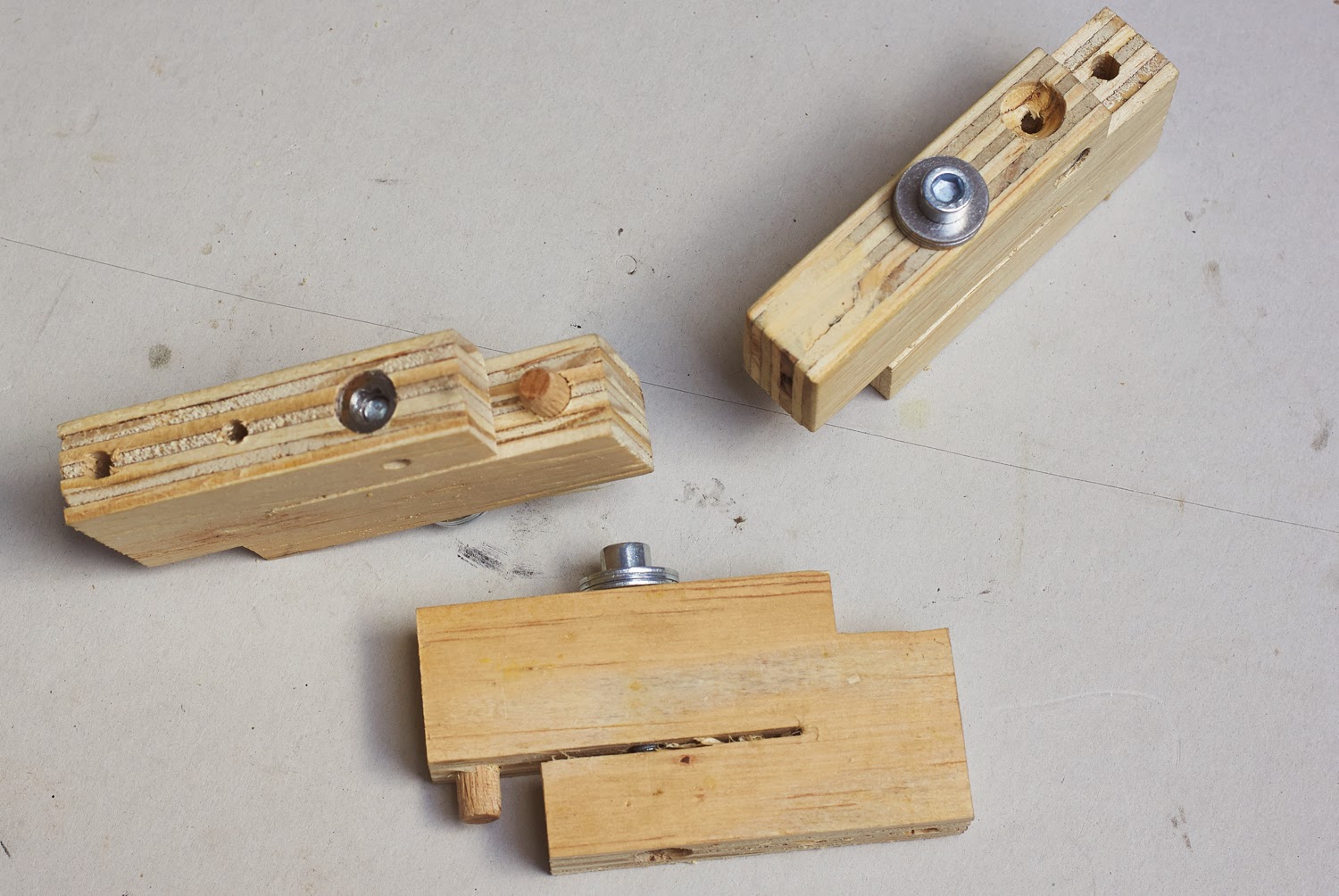
My next idea was to design wooden holders which will resemble the nuts in the baffle board. For that reason I made some wooden clamps, which will press the speaker from the back side to the funnel (i.e. baffle board). This construction will have the option to adjust the tightening power precisely and distribute it by a wooden lever to the chassis. The wooden design makes a much refined transition point between speaker resonances and cabinet possible. Were the classic bolts are more or less tight or not, here a wider variation of tightness and as result of the wooden material, a improved distribution of the introduced resonances will be obtainable.


Specially designed wooden clamps to improve and control the pressure and therefore the resonance introduction coming from the chassis into the baffle.

With the clamps installed the general sound relaxes a lot, the medium frequencies get back into a perfectly refined performance and as well the hf-response improves remarkably. "…at the cost of other properties…", I did say. Yes, the lf-response suffered here, it lost precision, got wooly and overloaded in power. For the first sight it was acceptable, but I did realize immediately, it needed another idea to get all the resonances better distributed, but I had no idea yet were to search. With the building of the clamps, I did already feel like a classic instrument maker, since such introductions are "everyday bread" in this job. It looks, that it is all is a play of tightening and less tightening; to get both directions of energy into the right balance of control with contradictive effects.

I did improve the design of the clamps with the second made generation so, that they will be able to have a better distribution of energy. I did introduce the wooden dowels in order to bring the pressing right into the mounting holes of the chassis. I fixed the clamps whis double wood screws to the baffle board. With the effect, that the all around performance improved the right way, but still the named problems stayed in reduced stage. So it needed another try to get the cabinets forward to sing.
I came back to my originally used bolts and nuts. I bought rubber washers of 2mm thickness and introduces these to decouple the metal bolts from the chassis. Now everything turned back, the lf-response got bettered with fastness and tightness, the medium frequencies rounded up, but the hf-response was again a bit to prominent. Now I had the opportunity to adjust the power of tightening by turning the screws a half turn forward or back. No way, no position got out a acceptable performance, it always sounded prominent and shrill.

The perfect sounding solution, the simple and technically poor mounting with felt damped wood screws

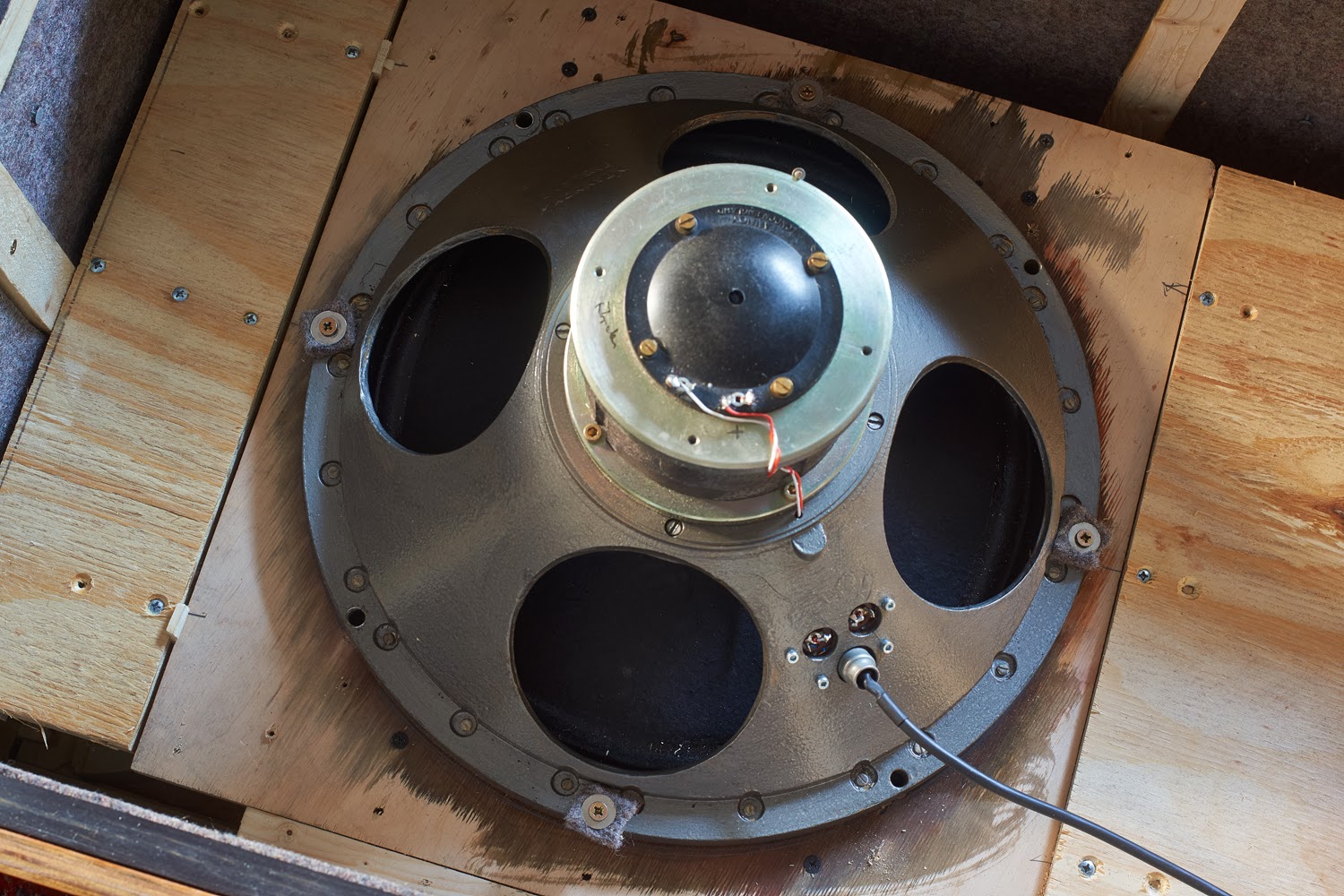
So I made a very easy try. I did cut out washers from my 12mm felt. These got combined with iron washers and simple wood drilling screws. This sandwich got screwed tight till the felt compressed into the holes, there were four empty ones with each chassis. So I only had to remove the other bolts with rubber washers and could listen directly to the new mounting principle.

Unbelievable, a fundamental change came up. A completely improved performance of all frequencies was immediate, with a fast and airy, well extended lf-response, all other frequencies improved to a so far unknown state. A three dimensional holographic performance was suddenly present with best dynamics and a perfect sensitivity, without any particular prominence. Just homogenous refined musicality containing a wide scale of harmonies and without any offensive touch. I did listen to a lot of my analogue records this evening, as well I did stream digitally stored material from the hard drive. I did both with a good loudness (always a good sign) and completely pleasured with my new speakers. Now I need to be prevented from myself, not to change this "winning team" again. Even, when I do know that this mounting is technically a less educated solution…

The lesson from this new experience is, to take more than care about this constructive detail, if you are building a cabinet for full range speakers, in particular in the heavy weight class. The mounting of the speaker to the baffle has the same importance the materials for the enclosures itself have, as well the speaker type and finally the principle of enclosure are on par. If a felted washer can make such a difference, – a difference which in the hifi business sometimes will be paid with 1000 or more dollars (for one interconnection for example), than almost any speaker enclosure can be adjusted or improved in a fundamental state, when taking care about this detail.

If you are interested about more results from our music instrument research department read on soon,Volker


Wednesday, 22 January 2014

A Tannoy 15'' Enclosure for the Enthusiast – The Realisation III


                  "Never change a winning team!"


Hi to everybody interested to follow on. Today I am writing from the position of complete frustration about the first audible results. Before I was absolutely save about my knowledge and new ideas which lead to the realizing of my new enclosures. As I already said, I have realized in the past several other enclosure projects for two decades, so I was absolutely safe about the most constructive details evolving with loudspeaker cabinet making. I did not expect to end my first listening evaluation last week with a complete disaster, the new enclosures did not work at all! These cabinets were not able to show any low frequency response at all. I had the impression below 300 hz all tonality has lost any lower support, below 100 hz it seemed to be like cut off. It sounded like with a low frequency control knob in contradictive position. The former evaluation cases performed very well in this discipline, otherwise I never would have been convinced to overtake the open baffle principle for the new enclosures. One more time it can be said: "never change a winning team…!"It was again one of the moments in life were I was absolutely stroked back from a unexpected effect…!

The new enclosure

For more than a half of a year I did use my former evaluation enclosures to work out almost any option for the final design. How can it be, that the perfectly made new cabinets didn't work almost in a similar way, when all constructive detail have been tested before with the dummies? All? I made some basic new experiences during the evaluation, first time in my life I did use a 15'' Tannoy Dual Concentric speaker in a open baffle cabinet. As the attentive might remember, my first impression was as well a  bit thin sound structure, which I needed to accommodate, when coming from a former reflex cabinet with big boost in the 100 hz area. After a while I learned to assess the faster, leaner and undistorted bass response of the open baffle to be superior to any other principle I had used with 15'' Tannoy speakers. With a good horn or in the open baffle the bass response can reach almost natural accuracy and timing, were other principles mostly suffer from a wooly and always slow thick bellied lf-extension, typical for ported designs. A lot of people do prefer this unnatural sound and get confused meaning the attribute of "warmth" and "rounded".

During evaluation I tested the mechanic extending of the cabinets in order to improve the lf-response with longing boards. These thin boards had been screwed to the back frame. This sort of simplest extension showed me the effect how such a extension will influence the lower frequency response. As a result I decided to built a extendable cabinet. Second I had already evaluated the front loaded horn with other cabinets and did know about its big advantage. So I have realized two wooden funnels and just screwed these in front of my evaluation cabinets. In the past I did learn to fear massive thick double walled baffle boards, they will not work well with a fullrange speaker of the heavy weight class of the Tannoy. The middle frequency response get hardened and does not sound very refined and musical. But here now the double baffle did do quite well, even when the evaluating design was almost 40mm of plywood with both layers in sandwich. I did not know why? The drivers had been mounted very tight from behind the original baffle boards, which were a solid part of the open box type construction, the funnels just added up as a additional front part.

The evaluation enclosure with double baffle boards

The implementation of this horn funnels into the  final enclosures made several changes in the construction of their mounting necessary in respect to the free sides for the sliding inside cases. At the end I did use a mitered frame design to incorporate the funnel into the housing. The completed object got screwed from the back using the strengthening frames at the front. The heavy driver is mounted directly to the end board of the funnel. Only the funnel itself supports the 10 kg of the driver and conducts as well its energy input to the whole system (resonances). My former experiences with Tannoy drivers have always made the baffle board construction, its material choice and its dimension to a delicate decision in order to find the best resonant voice for the full tonal spectrum.

Special constuction to keep the space free for the sliding cases

For two days I tried almost everything possible to make a change. I did seal the speaker to the funnel with mod rubber stripes. I did seal the interior cases with felt lips to the main frame, both in order to prevent any early unwanted shortcut of the lowest radiated waves. I did check my electronics for any defects, particular in the regulation of several power supplies (In the past a defective regulator tube did drive me crazy by its compromising sound). I did check tubes and tried very different first changes with the enclosures itself. The slideable interior frames did not show any positive effect at all (how could they do without lf-response). So I just made a quick reflex conversion, I did close and seal them and I did fill them with wool. All changes showed the same result, no low frequency response! I did run desperate not knowing what to do.

Normally driving a car for some hours is the perfect situation for me to let my brain play and find the clearest thoughts. Since I did not have any traveling at my timetable at the moment, I had to find other states of concentration. Waking up early in the morning and lying in bed is another excellent option to find deeper ideas. Here I realized some days ago, that the mechanical support of the driver, i.e. funnel might bring the problem. I did know from former realizations that the strong stiffening of an enclosure is a absolute basic to get good tight bass response. If you bring the conjuncted construction even further under tension (like instruments are made), it can even improve in this competence.
So I did know that the sliding mechanism does prevent any rigid inside constructions since its needs to keep all four side walls free of space. I decided to take the inner enclosures out and instead to introduce  massive panels to connect the holding backboard of the funnel to all sides of the cabinet. Additionally  to the precisely adjusted boards I did use wooden cotters to bring the whole construction into controlled tension and used some more massive screws to hold the boards into tight position. The revised construction has tightened up the whole design with a main attention to avoid the suspending effect of the funnel to the driver mounting. The classic knocking test with the finger at the outer case showed immediately a completely different resonant ability.

Wooden cotters bring the interconnected boards with the outer frame into controlled tension

Stiffening board underneath the backboard of the funnel
Two hours later I started again to listen to this enclosures. I remember the first moment last week. I just placed the diamond in the first groove and even without any music I did directly realize, that there was something going wrong. But now the inlet groove test sounded promising. From the first moment everything was better than right. The sound was completely different now. The tonal spectrum was very well supported with perfect balanced lower frequencies and all other frequencies seemed so much better integrated, that from the first moment on pure relaxing was on set. The lower frequencies have got fast, tight and deep, with a wonderful creaky ability to reproduce the best wooden instruments from the "Cremona School". Some records of Benjamin Britten with Rostropovich at his cello, Jaqueline du Pré and Pablo Casals made me immediately to find home in the absolute "gourmet class" of music reproduction.


But as well brass instruments did profit a lot from the improved integrity of the low frequencies. My absolutely favorite record of modal jazz music "Kind of blue" is always a very good test. A highly improved soundstage without any compression, but with extra space and air as a result of the front loading mechanism. I was sitting in front of my new speakers and more than happy with the result. Now they did match my highest expectations and they are performing even better now. They are the best Tannoy speakers I have heard till now – by far, no exception.
They have the ability to perform in the best possible manner being a true natural music instrument with well balanced harmonies as foremost attitude. They can work free of the usual compression effects and typical electrical artifacts with a wide open soundstage of almost holographic depth. Even after four hours of intensive listening no signs of tiring occurs, which is always a result of well balanced homogenous refinement. The speaker is able to produce exceptional fine micro dynamics, which is a more common character of electrostatic speaker designs, than with heavy weight champions of the paper cone class. The dynamic abilities of such drivers form the attraction to use a 15'' speaker, the combination with the refined abilities give such combinations a highly addictive dimension.

Only a handful other systems are in competition with such elaborated audio transducers. But this question is a purely theoretical one, who is able to make a direct comparison between let's say a JBL-Paragon, -Hartsfield, -Everest to Jensen Imperials, to EV-Partricians, or to Tannoy Westminsters, to  Altec's A7, to Western Electric WE15a's with WE TA7331a's or to a Klangfilm Euronor?  Nobody (I know, Dr. Takeshi Mikami, he has them all) is able to do such a comparison and I do think it is as well not necessary. It is much more on demand for the most of us, to find a good match for the own preferences and our personal taste. Mine was and is the Tannoy Dual Concentric speaker and I have realized now a longtime captured idea, to design a very good set of audio enclosures to bring them in the foremost line.


Some horn funnels on delivery in Japan

Other people would do now a recording/movie with an iphone and upload it to youtube to show the properties of the new speakers. I have never understand for what reason this little films about high end equipment are made, may be I am to old to understand?
But right now, it needs to improve the craftsmanship of the new changes in the enclosures as next step, before the last function will be implemented, the variable blinds as back of the baffle. We will see, if other unexpected things will happen?

Read on soon, Volker


Sunday, 19 January 2014

A Tannoy 15'' Enclosure for the Enthusiast – The Realisation II

Hello to everybody interested to follow on my realisation designing new enclosures for the classic Tannoy Dual Concentric speakers. In short summarized the first part, I want to find a living room friendly size for the 15'' Tannoy speakers which will be a incomparable upgrade for the common aficionado not having a restored farmhouse in Cornwall for the second or third hifi setup.

"James Bond" like phantasies of Tannoy sales managers in a product catalogue, were the woman, the whiskey, the furniture, the car and the audio components will match the same decorative "taste" of empty chauvinistic representation.  Imagine a car outside? But there are definitely 200 better choices of malt whiskey in Scotland...

As ended in the last article my first listening to a Western Electric horn array extended completely my idea of audio representation to a new dimension. Their unfolded horn designs (foremost made to transduce the middle to high frequencies of the audio spectrum from 300 to 12000 hz) showed me a unknown dynamic spread scale of musical informations, –  its inherent captured air, speed and a true naturalism of representation.

A winter tale...

This particular experience brought me back to my long lived dream about a front loaded horn funnel as an improvement of the classic Tannoy speaker, knowing that such a feature will help the Tannoy a lot to overcome its typical "archilles' heel".  In the mid 1990ties I was interested to introduce it to a common sized cabinet and discarded the plan because of complications in the technical realization (bending wood). In theory I was always convinced that the funnel will open up the important medium frequencies with a widely improved response and now I wanted to practice this idea. I built a first pair in 2010 from card board and introduced them to my cabinets  –  I could not believe what acoustically happened even with a such simple design. I directly realized, that I had failed a absolute important feature for almost 20 years of use. In original it got introduced with the Autograph cabinet to bring the middle and high frequencies to the same level as the mechanical amplified low frequencies from the backloaded horn. As I now know myself, with the Autograph cabinet it is very difficult to find a almost invisible natural audio representation. The size and materials of the cabinets, so the position in the room corners make them…,  let's say, to prominent transducers, were the holographic presentation in the middle frequencies is not the foremost quality.

The new enclosure

In other applications the front loading horn can help very well to overcome Tannoys most problematic attribute, the frequency cut around the 1000 hz, where Tannoy married the low and the high frequency diaphragms. The 1000 hz point is the most problematic area in the whole audio spectrum. Almost every instrument and voice covers this part of the frequency, which means, in the audible reproduction any mistake will be shown with a tremendous general effect. With the support of the funnel the Tannoy "achilles' heel" gets highly improved. I would go as far to say, it completes the speakers to a new design, when the modified crossover will support that task.

and 2/3 out...
The interior cabinet almost complete in


The interior cabinet is sealed with a felt lip for tight and smooth extraction


The distribution of the medium frequencies are in a different class and remind me a lot to the qualities I did notice first time from a big Western Electric medium frequency horn. As well here now a dramatical improvement in the coherence of the middle frequency response is noticeable. A lot more air between every instrument is present as a result of mechanical improved high frequency dispersion. Together with much better transient response and a dramatically bettered homogeneity, the most significant benefits are shortlisted. The vintage Tannoy Monitor speakers are already known and valued for their homogenous refined sound quality as a single point source (mostly in Japan, to me it looks that more vintage Tannoy speakers are in use there, than ever been produced in the West Norwood factory). Being a 15'' driver of enormous dynamic abilities, it combines two almost contradictive properties hardly found with other drivers. With the customized front loaded horn it reaches new claims of extended natural musicality and tonal refinement.
But one thing needs to be said at this point about the amplifying electronics to be used with such a horn to everybody who is on a hunt for a cheap shortcut to the wonderlands of life. It needs the finest tube amplification at every stage of the chain, able to deliver the best refined musical signal without any sort of phase degradation or other typical electronic deformation in the response. When such improved signal quality will be obtainable, a front loaded horn can be a fortune (similarity with the huge WE horns). 
With some mediocre shop hifi products or even worse some chinese "bling bling tube amps" such a audio transducer of this ability will show straight the inherent limitations of the poor profit orientated designs and their inferior used parts like seen with a magnification glass. It needs a perfectly matched chain of single components built from well chosen parts to a higher order of quality. The necessary refinements will rarely be found in commercial made hifi components due to its limitations of cost cutting values and sale strategies. With highest grade parts built diy projects might be able trealize a different stage, even when the budget will limit the plans. Or similar concepts are consequently made and matched together by idealists like Shindo, Kondo, AN and some others. With superior DHT amplification today such a quality is realized like no other by Thomas Mayer.
The advantage of the open baffle principle for the cabinets combines the perfect conditions for a driver in a horn design (the decrease of the braking air cushion behind the diaphragm and therefor the increase in linearity and speed of its radiant ability) of a comprehensible sized cabinet. As well the open baffle adds the backward radiated energy to the common front radiation (in anti phase mode), which can be  noticeable as increase of the low frequency radiated energy. Here the position of the cabinets and the size of the surrounding room gets into account, since the lowest radiated frequency will be limited by the room itself and the total length of the from front rim of the lf-driver to the back rim.
A typical open baffle speaker radiates into both directions, which means that a fullrange driver radiates the same energy into both directions. The backward part will be reflected quite soon from the backing walls of the room. The distance between speaker and backing wall defines the time delay between both contra phasing signals. If they would reach the listener in time, a whole part of the audio spectrum will  distinguish itself. So its is quite important to find a ideal position for the speaker between wall and listening position in a given room. Generally it can be said that a position in the center of a room will give the best undistorted (longest delay of reflexions) radiation. But the most people don't want to sit in the middle of a room with the huge speakers 1.5 m distance in front of their face. Here a compromizing position has to be evaluated. I have my speakers positioned with 1 m distance from the back walls and sit with three meters distance in front of their 3 meter base.


With 1 m behind it starts that the backside signal adds with a positive effect and enough delay comparing to the frontside radiation. The funnel directs the front radiation to the listener, so the typical negative effect of all fullrange baffle speakers, namely a decrease of space illusion in the soundstage by wandering reflections is not audible. The reflections in the room normally decrease the precise definition of the stage, thanks to the physical benefits of the funnel the illusion of space is extremely good. At this point all goodies come together. The unique Tannoy Dual Concentric principle works acoustically like a precisely defined point source for both frequency units. The funnel completes this design to a wider overlapping of both parts, operating the enclosure similar like a full range instrument of defined position. As result the speakers are able to produce a perfect illusion of space (like a lot of small drivers are known for this habit), a holographic dimension were other duplex designs of this weight class are showing limitations and produce some problems (phase and time delays between their units) to be corrected. Ask the most people driving a huge WE installation about time delay (some of them can write books about these facts), you will be astonished how much technic will be needed to get it  corrected. A integration of a analogue to digital conversion, digital time delay shift, followed by a digital to analogue converter before power amplification, is one of the simple operations to get it corrected. This is one reason, which protects me against such highly complicated systems, even if they are massive virulent sound wise.

Read on soon about the variable options with the inner cabinets, Volker


footnote: the image from the Tannoy product catalogue is shown with respect to the original intended use