Thursday, 29 August 2013

A Tannoy 15'' Enclosure for the Enthusiast – Part I


Hello to all interested people into Tannoy enclosures,

after I've already reported about the Autographs and even when the final contribution unfortunately is still pending, I would like to start a multi-part series on DIY Tannoy enclosures. For twenty years I have been building housings for these great vintage speakers, i.e. for 12'' and 15'' chassis. Such speakers with its powerful drive moments, their large mass and their strong magnetic drives need other housing parameters than most speakers today or what haunts the so-called literature since the speaker DIY boom of the 1970s. La Maison L'Audiophile, Auditorium 23, and many people from that circles, recently such as the Wolf von Langa have been busy about cabinet design principles of historic professional designs. It can not be said enough how important the conservation of the historic proofed knowledge is, if you want a quality product with exceptional abilities. Todays consumers don't need anymore loudspeakers, they are happy with earphones as lifestyle accessories.

So today, even internationally, the small group of people with high quality demands and exceptional high quality tube amplification chains concentrate on Western Electric products or its later successors of good availability from the Altec era. Asian copies of WE equipment give this incomparable products a wider availability again. One of my major interest was, when I did start this blog, to give the classic Tannoy speakers a auditorium of interests and exchange of informations. These speakers are unique in their design and quality, their typical sound is different from any other coaxial speaker made. The older vintage 16 ohm hard edge chassis are exquisite in terms of finesse and listenability, I think better than any other duplex speaker made. So they are much sought after in the asian markets (alone in Japan there are three companies existing with a huge production line of enclosures for Tannoy), but Tannoy don't have a wide acceptance in Europe, where they came from. One reason might be that the most people only have real practice with the latest models, the HPD line, which which was the worst incarnation of this speaker line. The typical Tannoy enclosures are made for private home use, since the company Lockwood made the professional cabinets for the use in recording studios, which was the main business profile and success. Since the death of Tannoys founder in 1977, when the company has been sold, japanese customers have bought Tannoy speakers in Europe for the export to Japan. A edition of 500 Autograph speakers have been made solely for the japanese market in the late 1970ties.

The most people I know with this speakers use standard original hifi-cabinets, which are generally not ideal. They are furniture products to fit the british home, instead of being serious music reproducers. They are made from particle wood boards with nice verneers, nothing to take care about. So it makes sense to improve on cabinet designs to work out the full potential of this exceptional speakers.


A lot Tannoy users are in search of optimized cabinets for years and try to do it themselves, mainly with the wrong concepts based on theories of small scale highly filtered loudspeaker concepts of the 1970ties or the diagrams published by Tannoy itself in this period. But big chassis with hard edged cones need completely different concepts work best. It does not matter wether this search is for the 12-inch or 15-inch chassis, the starting point is for most people the original cabinets to be modernized. The early cabinets from the 1950ties are so called vented port designs, but they are made from quite good materials, since they were developed through listening tests. The later ones from the 1970ties followed the reflex philosophy of Thiele&Small and are extremely rigid, damped to dead in terms of resonances and made from mdf-boards. Often due to their dissemination you will see Lancasters or their successors the Berkley cabinets, both generations have a rough volume of 120 liters. Many have chosen this cabinets because of their size as compromise for their living rooms. Both generations have had a bigger cabinet as brother, so the Lancaster had the Amesbury and the Berkley had the quite common Arden (image). Both had a rough calculated volume around 220 liters, a much better value than the smaller versions. But if you look at the qt-parameters for hard edged paper surrounded 15'' Tannoy chassis like the Golds, Reds or Silvers, you will see a closed 360 liter cabinet will do the job of a quite more linear low frequency response much better. Anything smaller sets compromises as a major fact, but who wants really such big cabinets?The Onken cabinets from Japan published in the 1970ties are a first step forward, but are still quit big. Or it needs to look for other ideas of compromise like open baffle?

A modern cabinet is more an instrument than a dead piece of furniture


A good cabinet is made from grown wooden materials, which will have a tremendous influence on the sound qualities, in particular if you handle such big motor units. For Altec users with separated HF-horns the "Voice of the theater A7" is a enclosure, which is a very good base of size to frequency response ratio (roughly 410 liters volume). These cabinets are known to be working very well, but are still a lot to big for the most of us and will not match the HF-horn opening for the Tannoy. The most of us would go further to accept some restrictions to shrink the volumes of a speakers to match their living room aesthetics. The well known wife acceptance factor WAF is the most compromising aspect to match a speaker to a living room as furniture. The most people I know want cabinets for their Altec/Tannoy/Vitavox/Stephens/University/etc. 15'' speakers, which will fit to such preferences, ideally not bigger than 200 liters with a furniture friendly design. Since we are not the typical aficionados or are living in Japan and accept rooms to be filled with hifi equipment, were you cannot open the window anymore. All others seem to have enough space/money to incorporate special listening rooms for their WE15 setups with two 18'' field coil in a suited baffle per side. I do not.


In this series I will try to show the detailed development of a 200 liter enclosure with integrated front loaded horn from the very beginning. Lot of the construction aspects are based on informations coming from the traditional music instrument designs. Uncountable tests about energy transmission of wood types, their resonant properties and construction secrets from guitars or violins, as well pianos, different conditions of dryness of the wood have been taken into account before the final wood will be ordered. 
For the beginning a test set up will be very helpful. From earlier tests with WE-compatible speaker designs I had a so called "dipole-enclosure" for a 15-inch chassis lying around with a quite suitable size for the first tests. It has ugly proportions with a 0,75x0,85m baffle size. Since its two identical parts were originally faced to each other before to form the H-dipole, one half is now only 0,30m deep. It is made from perfect materials, 25mm northern hemisphere coniferous plywood for the boards and stripes as strives from the same boards for the reinforcements. This enclosure has been originally made to act like a low frequency sub-200hz-cabinet with a 15'' speaker. For a hefty full range unit of the same size, I rather would use thinner materials like 16 mm plywood of the same type. From my experience the thinner plywood works better with the important transmitted 1000 hz frequencies, so later on I would do the real enclosure with thin materials. Other people tell me the same experience from the original "VOT A2-cabinets", which are made as well from 16mm plywood comparing these with modern versions.


I definitely wanted a front loaded horn to extend the lower end of the high frequency unit, like it is used in the Westminster enclosure or similar at the Autograph. I did use such a front loaded horn since two years in in front of my berkley enclosures. When I started to test the effect, I did make the funnels from gray card board of 2mm thickness. Since almost 20 years I wanted to test the loading effect at my speakers, but I never did that. When I realized the funnels two years ago, I realized that this was my biggest mistake I made with Tannoy speakers during all that time not to go for "front loaded". It has an amazing positive effect and completes the unique design principle of the Tannoy speakers in a perfect way.


Berkley cabinet made from medium density particle boards with card board funnel for testing.
On top the new made wooden funnels for the new cabinets to be made soon.
at the cut out for the crossover the little switch can be seen were it can be switched to full range mode.

Were the cone completes the HF-horn, the funnel completes the cone further on. But this construction needs the customizing of the crossover, otherwise the effect does not do the trick. The funnel works like a mechanical amplifier for the distributed frequencies and it extends the high frequency horn for a lower cut off. I have never made measurements, but it is clearly noticeable, that the frequency between 400 hz to 1000 hz will be distributed. The speaker sounds  a whole lot more naturally detailed with a much better HF-dispersion. The illusion of space is wider and deeper, so the amount of listenable air in the recording grows dramatic. For me this effect is always a sign for a remarkable quality upgrade. I copied the funnel of the Westminster design. Both, the Westminster as well the Autograph have customized crossover designs in order to integrate the extra energy of the middle frequencies. Both designs open up the frequency cut off around 1000 hz to higher cross over points. 

Test cabinets with 220 liter volume for a 15'' Tannoy speaker with front loaded horn extension just screwed to the baffle
I did work out through the years something completely different. Coming from my personal preference of the smaller 12'' units of the Monitor Red and Silvers, where Tannoy coupled the cone as full range units, I tried to do the same with the 15'' Red recently. In combination with a front loaded horn the speaker just did struck me down by its shear energy distribution and much more colorful tonal spectrum of the middle frequencies. I use my 15'' Monitor Red as full range unit, while the HF-unit gets cut below 1000 hz with a soft 6db filter. This filter is made with oil paper caps and copper foil inductors with wax isolation. I still have the classic 1000 hz filter for the LF-unit built in, I did it switchable, so I can test it always in different enclosures, but for me the full range set up beats all other options. At least my favorable sound option of the 12''-chassis was just the full range option of the cone and did not have anything to do with the size of it or any better sound qualities arising.

Read on soon about my first impressions, Volker

Wednesday, 28 August 2013

Jaqueline du Prè – A Cellist Without the Same


Hello everybody,

I would like today, different from my previous practice to present classical music. As well in the classic music genre examples can be found which are for me incomparable musical moments. So I've always been interested in the different interpretations of the cello play. In particular, but it is the supreme joy of incomparable Jaqueline du Pré, which I would like to present here with some essential records today. Due to her early tragic life end, the list of original recordings on vinyl is short, all first releases were published with EMI or Angel label for the US-market. The Edward Elgar's Cello Concerto with Sir John Barbirolli and the London Symphony Orchestra was her first recording in 1965, which established her fame arose (LP record can be seen lying in the back).
Other recordings of the major cello concerts and an extensive concert career followed on. As well a lot of chamber music was recorded in the first years. One of my favored records is the exceptional take with Stephen Bishop for the Beethoven cello sonatas (LP lying in front). Very typical for du Prés play is the incomparable vitality and the playing pleasure, which is in this case more than exceptional. The recording gives a deep intimate insight into the music and delivers a exquisite conserve in terms of dynamics, presence and energy of both performers. With good play back equipment it will give a reasonable illusion of the live event in your listening room. Something which is almost impossible with greater orchestrated pieces like a symphony. The sheer mass of the instruments, i.e. amount of moved air and the size of the location is impossible to capture with hifi.


Through du Prés friendship with Daniel Barenboim, Itzhak Perlman, Zubin Mehta and Pinchas Zukerman, the famous film by Christopher Nupen on Franz Schubert's Trout Quintet was formed. In 1967, Jacqueline du Pré married the pianist and conductor Daniel Barenboim. Their marriage was the basis for a fruitful musical collaboration that can be proven as a pianist or conductor through many recordings with Barenboim.

Jacqueline du Pré was born at the 26th January of 1945  and died at the 19th October of 1987 in London. She grew up in a musical family - her mother was a pianist and piano teacher - and at the age of five years showed interest in the cello. At the age of ten she studied with William Pleeth as her main mentor. She studied as well in the following years with Pablo Casals, Paul Tortelier and Mstislav Rostropovich. In 1961 she received a Stradivari cello of 1673, which is now called "Du Pré Stradivarius". Since 1964 she played on the "Davidov Stradivarius" of 1712. Both instruments were gifts from her godmother Ismena Holland.

In the fall of 1973 she was diagnosed with multiple sclerosis. Then she occasionally worked as a teacher until her health deteriorated so that she could no longer perform and died at the age of 42 years. Only a few records were published in that decade, but some of these are some of the best interpretations of the 20th century.

Read on soon about other soloists, Volker

Wednesday, 14 August 2013

Yma Sumac – Exotica on Vinyl


Yma Sumac was born as Zoila Augusta Emperatriz Chávarri del Castillo on September the 13th 1922 and died November 1st 2008. She was a Peruvian soprano. In the 1950s, she was one of the most famous proponents of exotica music. She became an international success based on her extreme vocal range, which was said to be well over four octaves and was sometimes claimed to span even five octaves at her peak. Yma Sumac recorded an vocal range of slightly over four octaves from B2 to C♯7 (approximately 123 to 2270 Hz).
Stories published in the 1950s claimed that she was an Incan princess, directly descended from Atahualpa. Her New York Times obituary reported that "the largest and most persistent fabrication about Ms. Sumac was that she was actually a housewife from Brooklyn named Amy Camus, her name spelled backward. The fact is that the government of Peru in 1946 formally supported her claim to be descended from Atahualpa, the last Incan emperor.
Chávarri adopted the stage name of Imma Sumack before she left South America. Yma Sumac first appeared on radio in 1942. Sumac and orchestra and bandleader Moisés Vivanco were married that year. She recorded at least 18 tracks of Peruvian folk songs in Argentina in 1943. These early recordings for the Odeon label featured Moisés Vivanco's group, Compañía Peruana de Arte, a group of 46 Indian dancers, singers, and musicians. In 1946 Sumack and Vivanco moved to New York City, where they performed as the Inka Taky Trio, Sumack singing soprano, Vivanco on guitar, and her cousin Cholita Rivero singing contralto and dancing. She was signed by Capitol Records in 1950, at which time her stage name became Yma Sumac.

A variety of Yma Sumac's first releases from the Capitol range in the 1950ties

During the 1950s, Yma Sumac produced a series of lounge music recordings featuring Hollywood-style versions of Incan and South American folk songs, working with the likes of Les Baxter and Billy May. The combination of her extraordinary voice, exotic looks, and stage personality made her a hit with American audiences. Sumac appeared in a Broadway musical, Flahooley, in 1951, as a foreign princess who brings Aladdin's lamp to an American toy factory to have it repaired. Capitol Records, Sumac's label, recorded the show. During the height of Sumac's popularity at the peak point she released "Mambo!" in 1954 as 10 inch album with Capitol. From todays point of view her most eccentric album of all her carrier, so it does not wonder that it is used to represent her web page today. Its mixture of south american folk elements with popular band arrangements typical for that period and a intonation style of the classic opera songs make her unique voice at this album a true legend. If you want to own a Yma Sumac album, this is the one which goes beyond all others and the must to have. Later she appeared in the films Secret of the Incas (1954) and Omar Khayyam (1957). She became a U.S. citizen on July 22, 1955. In 1959 she performed Jorge Bravo de Rueda's classic song "Vírgenes del Sol" on her album Fuego del Ande.


Apparently due to financial difficulties, Yma Sumac and the original Inka Taky Trio went on a world tour in 1961, which lasted for five years. They performed in 40 cities in the Soviet Union, and afterward throughout Europe, Asia, and Latin America. Their performance in Bucharest, Romania, was recorded as the album Recital, her only "live in concert" record. Yma Sumac spent the rest of her life performing sporadically. As well later record releases had been rare and can be summarized as exotica in a strongly commercially classified music business. 1998 her music was part of a feature film by the Coen brothers, The Big Lebowski and the Cirque du Soleil show Quidam. In May 2006, Yma Sumac was awarded the main peruvian medal for El Sol del Perú. The same year, her song "Xtabay" became soundtrack of the German film The Austrian Method.


Read on soon, Volker


notes: most informations are from wikipedia and her web page.

Wednesday, 7 August 2013

Mazda TM2 – A French Military DHT

Military or post tubes are generally designed for long life service, independent from country of origin or dedication of use. So the early direct heated triodes for different professional applications, mainly for wireless systems were designed for long term flawless operation, compared with their standard consumer replacement types. Today I want to present a quite rare tube type manufactured for the early french military amplifiers (Télégraphie Militaire), the TM2. Made by Mazda this tube is technically almost identical to several civil types, like Phillips A409, A410N or the German RE 084 from Telefunken. Different to these equivalents the TM2 has a solid fixed metal shielding and a isolation made from foam underneath. The typical sensitivity for shock or electromagnetic stray fields of the direct heated tubes is minimized a lot. Together with its low heater consumption heating system of 0.08 ampere at 4.0 volts heater power, these special parameters make this tubes a wonderful device for preamplifier concepts. Comparing this tube with other DHT-Tubes like the 26 or 801, the low heater consumption makes the TM2 a very good alternative, because the heater power supply can be designed a lot simpler with several improvements in the daily use. The tubes are equipped with the typical european 4-pin socket B4 and their quite low Plate resistance make the tubes a very good alternative to other DHT's, because they can be implemented very well with output transformers available from the standard catalogue of the most brands like Lundahl, Tango, Tamura.


For people who are interested to see the inner construction of the TM2 here at Jogis Röhrenbude you can see it stripped down.

Keep on reading, Volker

Tuesday, 30 July 2013

The Siemens Aa Weitverkehrsröhre – DHT Tubes for the Connoisseur


I would like to bring together some posts that rarely come together normally. So I already started the summer brake some weeks ago with a series of portraits of my major female singers, I will certainly continue this series in the upcoming time. Today I would like begin to address the posts about tubes. Before I introduce design concepts of amplifiers in the coming months, I want to begin to present individual tubes in functional groups. I want to start with my beloved directly heated triodes, briefly called DHT. I will start with those types to be useful in preamp circuits.

For the past 10 years, accelerated by the communication in the internet, some forerunners like Kevin Kennedy, Jim de Kort and also in this country Thomas Mayer widened existing limitations in preamp circuits with this sort of preamp designs. In many cases early U.S. types as the UX-type 26, 45 or 801 are used and these concepts have now made school and have been copied countless times by diy builders. Formerly used in radio receivers mostly in the 1930ties to 1940ties, these tubes have been once widely common. Today, specially in Europe these tubes are hard to find in good qualities.

German Post tubes are originally called "Weitverkehrsröhren" or "Behördenröhren".
From left the original Siemens Aa with tip, in the middle the Valvo Aa and at right the Neuhaus Aa with metal socket.

I would like to present some less common implemented German tube types. The so called "Weitverkehrsröhren" or "Behördenröhren" are normally known as post tubes. The are very early first generation tube designs made by Siemens in the 1920ties called A, B, C, etc. The second generation of this tubes added a second a to the name, so they were called Aa, Ba, Ca, etc.. These tubes have been produced from the late 1920ties over all the wartime into the early 1950ties for official use in telephone applications in both German countries. In the 1950ties the German Post developed the C3-type tubes as indirect heated multi grid successors, more about these phenomenal tubes in some weeks time. The post tubes have been always produced to match extremely high specifications of the German post administration. Best materials were used by companies like Siemens, Valvo, Neuhaus and others to fulfill a general service lifetime of 10000 hours professional use, a very high standard in DHT times, compared with any other brands. The tubes have a specially designed five pin post socket. They were equipped with a thoriated tungsten filaments of different voltages (3,5 to 3,8 V) acting as cathode. This old design of tubes is known for its sonic advantages, in particular their better linearity and their more natural soundstage. The most people do know directly heated triodes mainly as power tubes in modern retro single ended power amplifiers. Here the WE300b and its copies are a very well known DHTs, widely accepted in the hifi community for its unique sound capabilities.

Today I want to concentrate on the Aa tube as one of the best sounding line amplifier devices, when well implanted. For this reason I would suggest a amplifier design with anode chokes instead of a matching output transformer (the first choice with lots of other DHT's). With a nominal impedance of 30 kilo ohms, it is almost impossible to find a output transformer matching the tube for low impedance output of around 600 ohms. I did use the Aa with Lundahl LL1667 anode chokes, configured with a air gap for 5mA anode draw (the tube draws 3mA). In this configuration it will have an inductance of 600 henries, exactly the amount which makes a flawless low frequency response down till 30 hz possible. Together with very good coupling caps like copper or silver foil paper types, this constellation is truly amazing in every respect and outperforms everything I have heard. 
For the anode supply I use a Parmeko mains transformer with tube rectified output, followed by a double choke/oil capacitor filter rail and finished with a three tube regulated output stage. For the heater supply I use Rod Colemans modules. Thomas Mayer here sets the pace with completely passive filtered heater supplies. I am sure this might give another further improvement, if you have the space and money.
This Aa preamplifier gives the most open soundstage I have ever heard from a line preamp. The gap to classic amplifier designs (even to well named and established makes like AN, AR or similar well designed preamps) with indirectly heated tubes is tremendous. The Aa-preamp is so much more refined, with a lot better and wider, almost three-dimensional soundstage, meticulously spread harmonies and finest dynamic details, that I personally will not find back to later IDH-Tubes. It is a perfect solution for mainly line sourced amplifier chains, like digital streaming or digital discs. It brings a unbelievable naturalness back to digital sources, that they can par with very good analogue players. For professional marketed products these designs are not manageable, since the outlay is to expensive to make real profit and good tubes in countable amounts are not in the market for the same reason. So this delicacy is reserved for a solely market of handmade luxury or for the crafted diy aficionado. A parable which covers sooner or later any quality mass product in our globalized world.

On top the Neuhaus Aa with ceramic spacer, underneath the Valvo with ordinary mica spacer.
The Aa has been made by Siemens, Valvo and later on after wartime as well by East German Neuhaus tube factory for their telephone system. All these tubes sound quite different in some aspects, but all will show very similar characteristics. All Aa's are quite microphonic, the internal construction will show a big influence on its sensitivity to mechanical movement. The original Siemens tubes are very complex designed and are very rigid made, so they are favored by some people like DHTRob. They have a glass arm as inside support which carries the heater, the plate and the grid. If you look inside these tubes you will notice that they are made like art pieces. Today they are quite rare and therefor expensive. The more common variant is the weaker Valvo type, I like this tubes a lot as my standard type, but it needs mechanical decoupling from the chassis of the amp. As well very rare is the Neuhaus type, with ceramic supports and metal socket. Where the Valvo shows already the typical mica spacers, which became standard with the most later made tubes. Both tubes are very similar in fidelity.

The masterpiece of all Aa's, the tip-type Siemens Aa with glass support.

Read on soon about line amps using these tubes and their exquisite successors as later IDH-Tubes for hifi, Volker

Saturday, 20 July 2013

Nina Simone – The First Decade on Vinyl

Nina Simone is born as Eunice Kathleen Waymon in February 21st 1933 and died at April 21st in 2003 in France. She was an american singer, songwriter, pianist, arranger, and civil rights activist widely associated with jazz music. Simone aspired to become a classical pianist while working in a broad range of styles including classicaljazzbluesfolkR&Bgospel, and pop.

Her musical style arose from a fusion of gospel and blues songs with classical music, in particular with influences from her first inspiration, Johann Sebastian Bach. 
She injected as much of her classical background into her music as possible to give it more depth and quality and accompanied with her expressive jazz-like singing in her characteristic contralto. Her intuitive grasp on the audience–performer relationship was gained from a unique background of playing piano accompaniment for church revivals and sermons regularly from the early age of six years old.
To fund her private lessons, Simone performed at the Midtown Bar & Grill on Pacific Avenue in Atlantic City, whose owner insisted that she sing as well as play the piano. In 1954 she adopted the stage name Nina Simone. "Nina" (from niña, meaning 'little girl' in Spanish) was a nickname a boyfriend had given to her, and "Simone" was taken from the French actress Simone Signoret, whom she had seen in the movie Casque d'or. Simone's mixture of jazz, blues, and classical music in her performances at the bar earned her a small, but loyal, fan base.

In 1958 she befriended and married Don Ross, a beatnik who worked as a fairground barker, but quickly regretted their marriage. Playing in small clubs in the same year she recorded George Gershwin's "I Loves You, Porgy", which she learned from a Billie Holiday album and performed as a favor to a friend. It became her only Billboard top 20 success in the United States, and her debut album Little Girl Blue soon followed on Bethlehem Records. Simone lost more than $1 million in royalties (notably for the 1980s re-release of "My Baby Just Cares for Me") and never benefited financially from the album's sales because she had sold her rights outright for $3,000.


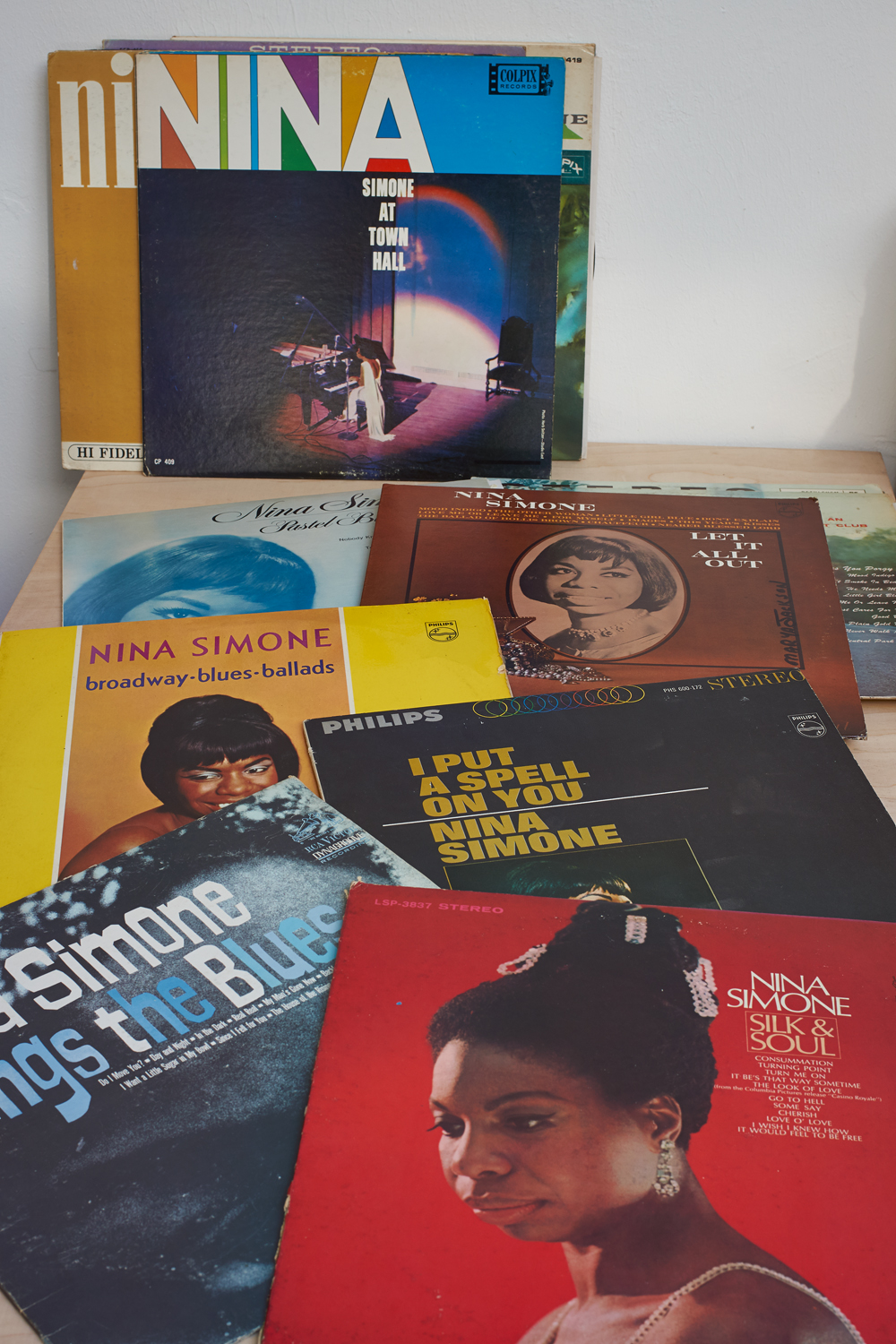
Early vinyl records almost  in chronological order. In the background the first three releases with Bethehem Records, the mono version of "Little Girl Blue" at right, the stereo version in the middle and a sampler with other female singers under Bethlehem contract at left.
In the foreground several first releases of the Colpix era in stereo as well in mono.

Despite this terrible facts the album is by far the best album of all her career. It explodes from energy, intensity and musical input. I think she did know very well about the importance of that first recording. If there is one Nina Simone record to own, that it is this one. It is as well a very good recording in terms of fidelity. This is said about both versions, the stereo and the mono version, even if I do like the mono record better that the stereo one.


Nina Simones first recording "Little Girl Blue", released by Bethlehem Records in 1958


After the success of Little Girl Blue, Simone signed a contract with Colpix Records (a subsidary of Columbia records), and recorded a string of studio and live albums. Colpix relinquished all creative control to her, including the choice of material that would be recorded, in exchange for her signing the contract with them. At this point, Simone only performed music to make money to continue her classical music studies, and was indifferent about having a recording contract. She kept this attitude toward the record industry for most of her career. 
The half of the colpix albums are recorded live at different public concert houses. So these early recordings give a very well insight into the atmosphere of the concerts and Nina Simones presence at stage. Here mostly a unique opportunity is given to get part of a extremely intimate moment of performance, as to listen to a very present singer in the other event. Even if the recorded fidelity of the most of the colpix albums is not very good, I like these recordings together with following phillips and rca recordings as her major work. I believe that colpix did not use not own recording equipment like other companies in these days (famous Mercury living presence), instead they seem to have used the inhouse installed equipment of the concert halls.


A typical Colpix record of that time with golden label. The company changed in the early 1960ties several times the color of the labes.

In 1964, she changed record distributors, from the American Colpix to the Dutch Philips, which also meant a change in the contents of her recordings. Simone had always included songs in her repertoire that drew upon her African-American origins (such as "Brown Baby" and "Zungo" on Nina at the Village Gate in 1962). On her debut album for Philips, Nina Simone in Concert (live recording, 1964), however, Simone for the first time openly addressed the racial inequality that was prevalent in the United States with the song "Mississippi Goddam", her response to the murder of Medgar Evers and the bombing of a church in Birmingham, Alabama that killed four black children. 


A typical Philips deep groove first release with rainbow stripe. This records are generally a lot better recorded than the earlier Colpix records.

From then on, a civil rights message was standard in Simone's recording repertoire, becoming a part of her live performances. Simone performed and spoke at many civil rights meetings, such as at the Selma to Montgomery marches. Simone advocated violent revolution during the civil rights period, rather than Martin Luther King's non-violent approach, and she hoped that African Americans could, by armed combat, form a separate state. Nevertheless, she wrote in her autobiography that she and her family regarded all races as equal.

Some of the Philips first releases and two early RCA releases in front.

She covered Billie Holiday's "Strange Fruit", a song about the lynching of black men in the South, on Pastel Blues (1965). She also sang the William Waring Cuney poem "Images" on Let It All Out (1966), about the absence of pride she saw among African-American women. Simone wrote "Four Women", a song about four different stereotypes of African-American women, and included the recording on her 1966 album Wild Is the Wind.
Simone moved from Philips to RCA Victor during 1967. She sang "Backlash Blues", written by her friend Langston Hughes on her first RCA album, Nina Simone Sings the Blues (1967). On Silk & Soul (1967), she recorded Billy Taylor's "I Wish I Knew How It Would Feel to Be Free" and "Turning Point". The album 'Nuff Said! (1968) contains live recordings from the Westbury Music Fair, April 7, 1968, three days after the murder of Martin Luther King, Jr.. She dedicated the whole performance to him and sang "Why? (The King Of Love Is Dead)", a song written by her bass player, Gene Taylor, directly after the news of King's death had reached them. In the summer of 1969 she performed at the Harlem Cultural Festival in Harlem's Mount Morris Park.

I did take care about her first decade of album releases between 1958 and 1968. From everything I know, I think it was her most productive time in her live. She continued on with record releases, but she never could build on the same level of intensity comparing her first years. 
Nina Simone died in 2003 in Carry-le-Roue in southern France. She was one of the absolute most  soulfull and remarkable singers in the 20th century despite of genre and as well a brilliant piano player. A real solitaire.

Read on soon about other lady singers, Volker

For further informations on records from Nina Simone visit her illustrated discography:

notes:
Simone & Cleary 2003, Nina Simones personal web page and wikipedia


Saturday, 13 July 2013

The Giant Loudspeaker Housing...

Hi to everybody,

today I would like to tell you about a never ending running rivalry in the hifi-world. Probably everyone who reads here knows he competition about the most efficient loudspeaker designs in history. All these well known speaker designs are huge space occupying concepts, enclosures as big as furniture. Everybody who knows about the facts knowns, only big cabinets, mostly horns speaker designs, will do the best efficiency. This article is not meant to serious and more dedicated to entertain owners of large volume Altec, Western Electric or Tannoy enclosures.


Owners of these classic speakers will learn now, there are some much bigger professional concepts existing, than they did know. And even when not well known at all, they are made for highly professional demands.


Two HF-horn units per opening in the first four rows and one MF-horn driver in the middle three rows, combined with LF-drivers of 15'' size in the lower four rows, all with funnels made from concrete.
The HF-units share one caving

For many of us such speakers have to score as a one to the models from the "Voice of the Cinema " range, or the huge WE Cinema Systems like the WE 15 and similar types. Even the described "Tannoy Autograph" speakers use cabinets of such dimensions for a competition. But all named examples are "small-scale" transducer for home use, when compared against the speakers I want to present here now.

Each HF-unit is connected to three drivers

In a tv documentary I recently saw a reportage about Taiwan. In this film it was shown how the politicians tried to liberate from the historic guardian of the People's Republic of China. To get rid off the electronic eavesdropping from the mainland they installed giant loudspeaker enclosures along the coast to China in order to drown Chinas directional installed surveillance microphones.

The enclosures are house sized concrete buildings with almost 100 different drivers installed in a multiplied molded horn funnel design. I do not know anything about real efficiency and the used amplifying systems, but taking the time into account, it must have been fed by tube amplifiers in the 1950ties.

So this is an invitation to collectors in the asian pacific area to get hold of  these installations, they are still intact. And there a lots of these housings around the western coast line. Maybe it will be a very exotic extension for your hifi collection to get the biggest speakers of all time, may be for the outdoor summer season in your park...?!

Read on soon, Volker