Sunday, 19 January 2014

A Tannoy 15'' Enclosure for the Enthusiast – The Realisation II

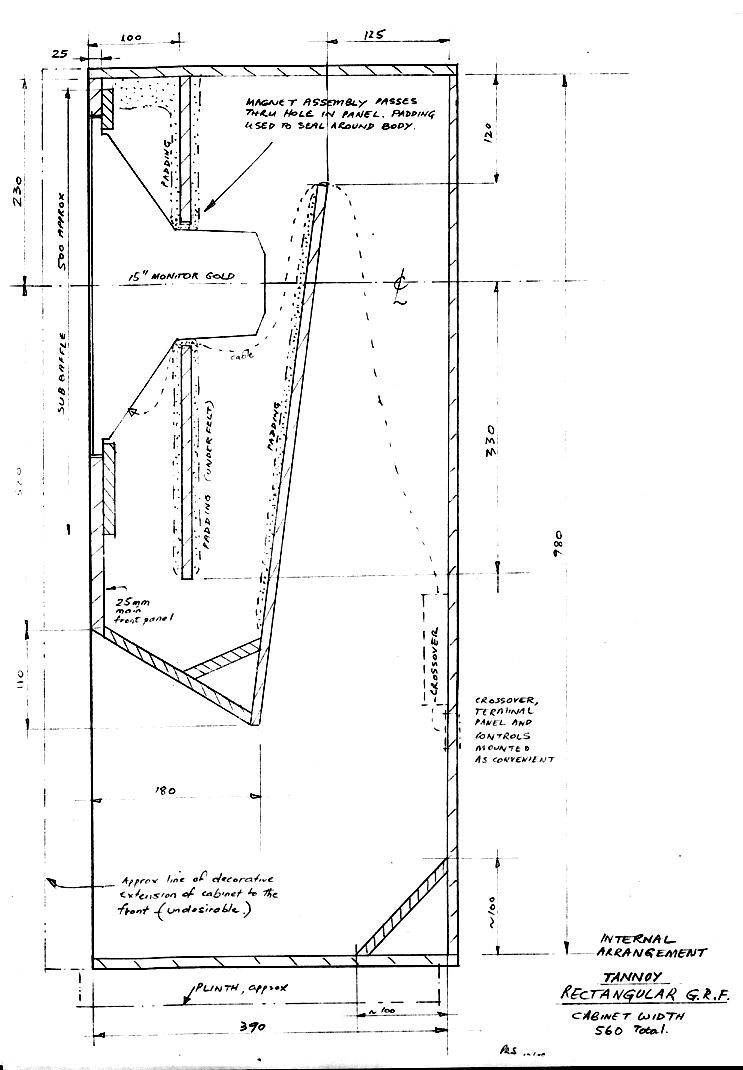
Hello to everybody interested to follow on my realisation designing new enclosures for the classic Tannoy Dual Concentric speakers. In short summarized the first part, I want to find a living room friendly size for the 15'' Tannoy speakers which will be a incomparable upgrade for the common aficionado not having a restored farmhouse in Cornwall for the second or third hifi setup.

"James Bond" like phantasies of Tannoy sales managers in a product catalogue, were the woman, the whiskey, the furniture, the car and the audio components will match the same decorative "taste" of empty chauvinistic representation.  Imagine a car outside? But there are definitely 200 better choices of malt whiskey in Scotland...

As ended in the last article my first listening to a Western Electric horn array extended completely my idea of audio representation to a new dimension. Their unfolded horn designs (foremost made to transduce the middle to high frequencies of the audio spectrum from 300 to 12000 hz) showed me a unknown dynamic spread scale of musical informations, –  its inherent captured air, speed and a true naturalism of representation.

A winter tale...

This particular experience brought me back to my long lived dream about a front loaded horn funnel as an improvement of the classic Tannoy speaker, knowing that such a feature will help the Tannoy a lot to overcome its typical "archilles' heel".  In the mid 1990ties I was interested to introduce it to a common sized cabinet and discarded the plan because of complications in the technical realization (bending wood). In theory I was always convinced that the funnel will open up the important medium frequencies with a widely improved response and now I wanted to practice this idea. I built a first pair in 2010 from card board and introduced them to my cabinets  –  I could not believe what acoustically happened even with a such simple design. I directly realized, that I had failed a absolute important feature for almost 20 years of use. In original it got introduced with the Autograph cabinet to bring the middle and high frequencies to the same level as the mechanical amplified low frequencies from the backloaded horn. As I now know myself, with the Autograph cabinet it is very difficult to find a almost invisible natural audio representation. The size and materials of the cabinets, so the position in the room corners make them…,  let's say, to prominent transducers, were the holographic presentation in the middle frequencies is not the foremost quality.

The new enclosure

In other applications the front loading horn can help very well to overcome Tannoys most problematic attribute, the frequency cut around the 1000 hz, where Tannoy married the low and the high frequency diaphragms. The 1000 hz point is the most problematic area in the whole audio spectrum. Almost every instrument and voice covers this part of the frequency, which means, in the audible reproduction any mistake will be shown with a tremendous general effect. With the support of the funnel the Tannoy "achilles' heel" gets highly improved. I would go as far to say, it completes the speakers to a new design, when the modified crossover will support that task.

and 2/3 out...
The interior cabinet almost complete in


The interior cabinet is sealed with a felt lip for tight and smooth extraction


The distribution of the medium frequencies are in a different class and remind me a lot to the qualities I did notice first time from a big Western Electric medium frequency horn. As well here now a dramatical improvement in the coherence of the middle frequency response is noticeable. A lot more air between every instrument is present as a result of mechanical improved high frequency dispersion. Together with much better transient response and a dramatically bettered homogeneity, the most significant benefits are shortlisted. The vintage Tannoy Monitor speakers are already known and valued for their homogenous refined sound quality as a single point source (mostly in Japan, to me it looks that more vintage Tannoy speakers are in use there, than ever been produced in the West Norwood factory). Being a 15'' driver of enormous dynamic abilities, it combines two almost contradictive properties hardly found with other drivers. With the customized front loaded horn it reaches new claims of extended natural musicality and tonal refinement.
But one thing needs to be said at this point about the amplifying electronics to be used with such a horn to everybody who is on a hunt for a cheap shortcut to the wonderlands of life. It needs the finest tube amplification at every stage of the chain, able to deliver the best refined musical signal without any sort of phase degradation or other typical electronic deformation in the response. When such improved signal quality will be obtainable, a front loaded horn can be a fortune (similarity with the huge WE horns). 
With some mediocre shop hifi products or even worse some chinese "bling bling tube amps" such a audio transducer of this ability will show straight the inherent limitations of the poor profit orientated designs and their inferior used parts like seen with a magnification glass. It needs a perfectly matched chain of single components built from well chosen parts to a higher order of quality. The necessary refinements will rarely be found in commercial made hifi components due to its limitations of cost cutting values and sale strategies. With highest grade parts built diy projects might be able to realize a different stage, even when the budget will limit the plans. Or similar concepts are consequently made and matched together by idealists like Shindo, Kondo, AN and some others. With superior DHT amplification today such a quality is realized like no other by Thomas Mayer.
The advantage of the open baffle principle for the cabinets combines the perfect conditions for a driver in a horn design (the decrease of the braking air cushion behind the diaphragm and therefor the increase in linearity and speed of its radiant ability) of a comprehensible sized cabinet. As well the open baffle adds the backward radiated energy to the common front radiation (in anti phase mode), which can be  noticeable as increase of the low frequency radiated energy. Here the position of the cabinets and the size of the surrounding room gets into account, since the lowest radiated frequency will be limited by the room itself and the total length of the from front rim of the lf-driver to the back rim.
A typical open baffle speaker radiates into both directions, which means that a fullrange driver radiates the same energy into both directions. The backward part will be reflected quite soon from the backing walls of the room. The distance between speaker and backing wall defines the time delay between both contra phasing signals. If they would reach the listener in time, a whole part of the audio spectrum will  distinguish itself. So its is quite important to find a ideal position for the speaker between wall and listening position in a given room. Generally it can be said that a position in the center of a room will give the best undistorted (longest delay of reflexions) radiation. But the most people don't want to sit in the middle of a room with the huge speakers 1.5 m distance in front of their face. Here a compromizing position has to be evaluated. I have my speakers positioned with 1 m distance from the back walls and sit with three meters distance in front of their 3 meter base.


With 1 m behind it starts that the backside signal adds with a positive effect and enough delay comparing to the frontside radiation. The funnel directs the front radiation to the listener, so the typical negative effect of all fullrange baffle speakers, namely a decrease of space illusion in the soundstage by wandering reflections is not audible. The reflections in the room normally decrease the precise definition of the stage, thanks to the physical benefits of the funnel the illusion of space is extremely good. At this point all goodies come together. The unique Tannoy Dual Concentric principle works acoustically like a precisely defined point source for both frequency units. The funnel completes this design to a wider overlapping of both parts, operating the enclosure similar like a full range instrument of defined position. As result the speakers are able to produce a perfect illusion of space (like a lot of small drivers are known for this habit), a holographic dimension were other duplex designs of this weight class are showing limitations and produce some problems (phase and time delays between their units) to be corrected. Ask the most people driving a huge WE installation about time delay (some of them can write books about these facts), you will be astonished how much technic will be needed to get it  corrected. A integration of a analogue to digital conversion, digital time delay shift, followed by a digital to analogue converter before power amplification, is one of the simple operations to get it corrected. This is one reason, which protects me against such highly complicated systems, even if they are massive virulent sound wise.

Read on soon about the variable options with the inner cabinets, Volker


footnote: the image from the Tannoy product catalogue is shown with respect to the original intended use

Monday, 6 January 2014

A Tannoy 15'' Enclosure for the Enthusiast – The Realisation I

I hope everybody has had a good start into the new year. As a perfect beginning I am very happy to present my new design of enclosures for the Tannoy 15'' Dual Concentric Monitor speakers to all interested enthusiasts. My cabinet is made in foremost stage to match my personal high expectations as an musical instrument on its own, but as well to match the universal preference list of the common Tannoy aficionado. For those were the size as room dominating furniture will not be a foremost feature, the Westminster might be the perfect match, plans to built them are existing in the web. But when size does matter, it needs a more compact designed cabinet as to be a ideal typic replacement for the classic 120-200 liter volume bass reflex cabinets (Berkley / Arden / Lancaster / Canterbury / Amesbury / York Rt and similar types like the Onkens / EV, etc.).

Guy R. Fountain at his wood workshop assembling a Canterbury corner cabinet made from lumber core plywood. A excellent material for loudspeaker enclosures, but only seen with the most manufacturers till the early 1960ties.

I wanted to find a fairly improved cabinet design, which works in every respect superior to all the vintage designs and will be able to embed the Tannoy speaker as incomparable audio transducer. My found solution combines the open baffle principle with a sealed enclosure type, additionally a possible variable extension of its volume will give extra options of adjustments. This variable extension adapts a wide range of room preferences and customizes the best low frequency response in a given room. With its selected materials several improvements and refinements in almost all acoustical terms are audible. A more natural response is a result of the extensive use of solid coniferous wood sorts and traditional wooden connections instead of screws. The whole audio spectrum is a lot better defined with finer harmonic structures and improved tonal ability as result. Quite thin walled boards of northern plywood (15mm) are used throughout the whole design (instead of thick walled boards), instead plenty of solid strutting has been applied in combination to natural woolen felt in order to control interior reflections and resonant damping. The strutting overtakes experiences from Western Electric baffle designs to structure the boards into unregulary units in order prevent resonant additions arising. The verneer is a long fibered solid 3 mm thick mahagony wood type to add another solid wood layer. The common use of finer layered multiplex boards with loads of compound glue should be avoided, the thicker layers of the plywood have a enormous advantage in natural tonal harmony of the finished speaker.


Strutting with solid wood to structure the panels into unregular sized parts, damped with woolen felt of 13mm thickness to prevent unwanted reflections.

 Sliding mechanism for the internal cabinets made from damping boards to extract the absolute distance between front and backside rim of the speaker.

This particular cabinet design summarizes my experience of 25 years of building enclosures for Tannoy speakers to a certain stage of improvement. I have built sealed, ported, vented designs of almost every useful size from lots of different wooden materials, as I did built different types and sizes of horn enclosures. Every design has had its own special physical advantage, but in almost every case at the expense of other qualities in its ability to support musical harmonies of certain orders. Over the years I have met lots of other users with Tannoy speakers, where I could complete my knowledge about unknown types.


As described already, I never could accommodate one of the classic backloaded horn designs (i.e. York, GRF, Autograph, etc.) for myself, because I don't like the always present uneven frequency (roughness) below 500 hz, arising from the not ideally formed backloaded horns. The shortening of the development, the reflections inside (turning corners), the unavoidable resonances of the huge enclosure surfaces and their much to small openings, support this effect in a amplified manner. It is always more or less effective, independent if we talk about the small GRF Rt or the biggest design the Autograph, – all these designs have a collective presence with expressive dynamics, but they are far the opposite from being a holographic transducer. The only original design I never had a chance to listen to, is the Westminster Royal. But as well here the enclosure offers infinitive foldings with huge surfaces inside, with a quite long horn development, but still far away from a ideal design. Some version have as well the "Girdacoustic" strengthened cone which is a lot to heavy, but is able to dissipate 100 watts of power. Here the given name states the foremost claim of the venture: "prestige series".

To make them sing a lot of traditional wood work is necessary...
The crossover housing needs to be placed out of direct radiation from the speaker
Loose assembling of some parts of the internal enclosure.

I was convinced for all the years that the vintage 15 ohm Dual Concentic Tannoy driver is one of the best speaker designs of all time to be used with tube amplification and in a horn design enclosure. I have tried out several other duplex options from Altec, Vitavox, Stephens, Lorenz, Jensen and others without getting really involved. All the speakers I did try, have enormous potentials when well implemented, but did not attract me to be some sort of a lifetime companion. The Tannoy shows some extra qualities all the others don't match, as a result of its unique seamless integration if the hf-unit. As one of the foremost vintage enclosures I do like the Altec Voice of the Theatre A7, but unfortunatly it does not perfectly match the Tannoy preferences. Generally it can be said, all speaker designs haves beside their qualities as well some sort of disadvantages. When we decide, we are always looking to find the best compromise to our individual preferences and to our taste. Mine was and is the classic Tannoy.
My all time statement  –  till I had the chance to listen to a Western Electric horn array with refined tube equipment. This performance was absolutely unique, a completely different physical presentation of audio acoustics, which I had not heard before, impossible to be realized with a dual concentric speaker. The wide band medium frequency performed by one single driver unit (WE 555 with WE 15a horn, i.e. transmitted frequency from 100 to 4000 hz, with WE20 horn from 300 to 8000 hz), amplified through one ideal long horn development without compromise, is a audible class of its own, a true majestic musical instrument of highest ability.

WE 15a replica Mf-horn front ends in delivery in Japan. It just needs a tiny bit of a good will and such a installation will match almost any living room. Thanks god that the necessary additional Lf-speaker is not a horn design...?!

These wide range operated horn systems are exceptional designs in a true class of their own. The WE transducer systems have been designed for cinema installations with a ultimate possible quality in mind, in a time when the later cost cutting preferences were still out of sight, which got standard in almost every case of all modern mass production in the second half of the 20th century. I will cover a complete series of articles about these speaker designs and its modern derivates made by Line Magnetics in practise for early spring time.

Read on next week for the finishing of the cabinets, Volker

Thursday, 26 December 2013

Tannoy Autograph III – The Implementation into the System

Yesterday I visited my friend Klaus in order to have a very nice christmas evening with good food and nice conversation, acompanied by wonderful Brunello wine and of course listening to jazz music. For some month I did not have any chance to listen to the finished Autograph enclosures, which have settled down in their final room position. For the perfect accommodation Klaus has reorganized some furniture and the shelves around the speakers in his listening room. Now the corner enclosures are positioned in the corners of his listening room. In former listenings when the speakers have been in evaluation, they were positioned in front of his shelves. Not ideal, this design needs the extension of the flanking walls for the best support of the low frequency response. Now in the customized position, the backloaded horn developments are functioning as been designed. Now, to make a short cut, the LF-response performs a new level of response quality, fast, deep and with natural dynamics.
To remember some month ago back, Klaus experimented with different stages of internal damping of the backloaded horn. The compression chamber was main part of this tests, but as well the beginning of the horn development. He did experiment with damping of its openings, which did find its final damping with the dedicated covers (i.e. grill cloth, decoration bars and the holding panels). To me unbelievable, he worked out that the enclosures need the side covers installed, otherwise the Lf-part of the spectrum was more than prominent.

In final position, the Tannoy Autograph enclosures driven from Maihak V53 EL11 PP amplifier
View into the uncovered side openings of the horn development,
all damping materials have been removed. 

Our Christmas audition started at the first glance with a optimized overall neutral tonality, which I had not heard before in Klaus system with these speakers. For this neutrality several improvements have been made, some did take place in the amplifying chain in order to optimize the signal quality. Others came from further improvements with the damping of the compression chamber of the enclosures.

In the late afternoon of Christmas evening we had started to listen with Chico Freemans Spirit Sensitive, reissued from Analogue Production in perfect quality some years ago, like always the reissues of that early time are better than perfect and top always the original releases. We switched after a while to Chet Bakers Let's get lost, a mid 1980ties recording with extremely well preserved fine modulation of the tonal dynamics. Both records I do use regulary within my own setup, so I know them extremely well. The latter one is known to me as almost invisible holographic presentation, showing not even the smallest remnant of electronic errors like phase shifts or typical hardening of some frequency edges. Today it presents a extended low frequency response, with fast, deep transient response. But as well a mild softening of the upper mids was audible, the overall tonality showed some little woolliness in this region. All records we did listened to, did show this same tonal effect. So it was obvious, that this was a characteristic which had taken place. A quick switch to digital sources showed a much more linear response here, without any woolliness, two more Cds did confirm the impression. So it was quite obvious that the found deviation was not a inlinearity of the Autograph speakers, it must be something coming from his analogue deemphasis and amplification chain.

Some records used within our audition at Christmas Evening 2013

In the last month Klaus has made some service at his RIAA equalizer. He uses a double mono set of customized Telefunken V87 studio modules original used for tape recorders, modified after Neumann WV2a design for his RIAA equalization. The Neumann units are designed with similar tubes, output transformers and PSU, but have selectable deemphasis curves. Klaus implemented only the Neumann RIAA filter for his use. Here some electrolytics and resistors had run out tolerance and were in the need of exchange. He selected some pio caps and carbon resistors to close as possible tolerances and for stereo matching.  He had to replace  almost all components within the filter unit. He did measure the final result with his oscilloscope and further measurement equipment and stated that the equalizer now is back to closest tolerances of the ideal RIAA curve. From my personal experience pio caps sound inferior to any other capacitor made, even within passive RIAA equalization filters, but they add a very typical fingerprint to the sound. Together with the preferred natural smoothness, they lower the audible effect the hf-deempasis. Even with perfect measurements, the sound of the correction seems to low. A lot of users would replace the capacitors for compound foil types, I never did like these and would suggest to keep the positive advantages of the pio caps, instead I would adwise a readjustment of the filter to get rid of the unwanted effect.


Telefunken V87 amplifiers, here customized to Neumann WV2a design with RIAA deemphasis curve,
since the original offers switchable alternative equalizing curves.

Platine Verdier derivate magnet bearing record player with SME 3012/II and Ortofon SPU Gold

A second task of the day was the collective cooking of the Christmas dinner with three courses and a lot of communication. Klaus had prepared some dear goulash some days ago, he had marinated the meat with several herbs and spices, oranges and lots of red wine for the main coarse in advance. Since I had marinated and cooked for hours the red cabbage with typical herbal ingredients like cinnamon and laurel as perfect christmas flavor. As well I did prepare some dumplings from fresh potatoes and dried bread for the main course and a creme brûlée as final end.
Together we started our cooking with some fine cut air dried spanish ham and some salad with a first glass of Brunello di Montalcino wine.
One of the first records of Brunello was a red wine that was made in the Montalcino area in the early 14th century. In 1831, marchese Cosimo Ridolfi (who was later appointed Prime Minister of Tuscany by the Grand Duke Leopold II) praised the merits of the red wines of Montalcino above all others in Tuscany. In 1865, an agricultural fair in Montalcino noted that the prize winning wine of the event was a "select red wine" known as a Brunello. In the mid-19th century, a local farmer named Clemente Santi isolated certain plantings of Sangiovese vines in order to produce a 100% varietal wine that could be aged for a considerable period of time. In 1888, his grandson Ferruccio Biondi-Santi-a veteran soldier who fought underGiuseppe Garibaldi during the Risorgimento-released the first "modern version" of Brunello di Montalcino that was aged for over a decade in large wood barrels.
By the end of World War II, Brunello di Montalcino had developed a reputation as one of Italy's rarest wines. The only commercial producer recorded in government documents was the Biondi-Santi firm who had declared only four vintages up to that point-1888, 1891, 1925 and 1945. The high price and prestige of these wines soon encouraged other producers to emulate Biondi-Santi's success. By the 1960s there were 11 producers making Brunello, and in 1968 the region was granted Denominazione di Origine Controllata (DOC) status. By 1970 the number of producers had more than doubled to 25, and by 1980 there were 53 producers. In 1980, the Montalcino region was the first Italian wine region to be awarded Denominazione di Origine Controllata e Garantita (DOCG) designation. By the turn of the 21st century, there were nearly 200 producers of Brunello di Montalcino, mostly small farmers and family estates, producing nearly 330,000 cases a year.
When the dear goulash was set into the oven, we had time again to combine our enjoyments upstairs for further listening to other records. When the meat had roasted to finished stage in the oven (2 hours), we completed it with my side dishes for main course. We were eating and talking for more than two hours before we continued listening to music with another bottle of the Brunello. We completed the evening (and the most of the night) with further music and talks. I demonstrated Klaus my headshell tests and we used two SPU pick ups beside his own SPU Gold for evaluation of the differences in materials. We finished very late (or lets say early) with the agreement, that the Autograph speakers now have lost their former problems and are working nicely beyond any other Tannoy enclosure Klaus has owned before. At 4h o'clock in the night I did fall almost asleep in the listening room, so I realized that I will need some sleep soon.

Frontloaded Horn opening with 15'' Tannoy Monitor Gold Speakers, a unique and
tremendously important design feature for the Tannoy Dual Concentric principle.

I am sure Klaus will refine the last problems in his analogue rail and afterwards he has found after 30 years his final loudspeaker. Thanks to the powerful attributes of the horn loading principle, here with respect to a front loading funnel and a long folded back loading horn enclosure, extended by flanking room walls, the speakers convince with a rare quality of response. They are a tremendous efficient system, able to transmit almost natural dynamics of real instruments with low power tube amplification.
Of course these "instruments" are not every bodies "cup of tea", they are expensive and their room preferences will limit the club of owners with a natural choice. Which means, the listening room must have a ideal geometry and size to make this particular design work. If you are willing to match such conditions, the Autograph enclosures may be the best vintage speaker enclosure for the imcomparable dual concentric loudspeaker from the Tannoy line. And they will work even very well without the wine from Montalcino....

Read on next week for my new enclosures for the Tannoy line, Volker


Thursday, 19 December 2013

A Tannoy 15'' Enclosure for the Enthusiast – Part IV

In the last couple of month I have tried to find a solution for the incomparable 15'' Tannoy driver to be used in a sort of universal enclosure. I concentrated on two nested main questions, the best possible response coming from a living room friendly sized cabinet. My main aim in this process was, independant from any technical design principle (i.e. reflex, open baffle, sealed, horn development), to archive a foremost natural tonal response. It is best described as a transformation of the electrical signal into a acoustic representation of music, lacking any typical electrical significance or sort of common compressions arising. My ideal response is orientated as close as possible to live performances of small scale chamber music or small jazz ensembles in limited scaled room conditions. Here the acoustical resonant corpus of the performing instruments (i.e. cello, brass horns, piano, etc.) is quite similiar to the resonant corpus of the performing transducers (loudspeakers). My definition and further undertakings can be understood by the most of yours within this model in mind.

Typical Tannoy Lancaster cabinet (sealed version for the 12'' driver),
these generation cabinets are well made from lumber core plywood, excellent material.
Some month ago at the beginning of the design process I did not know, with what sort of cabinet I will come out at the end. I did play through in my mind many possibilties, a combined back/front loaded horn design, a vented port cabinet with 200 liters volume or even a bigger sealed enclosure, working as a resonant chamber. I definetly wanted to leave behind the limitations of the common known vintage cabinets. Instead I was very energetic to find new ways to the naturalness arising from a newer understanding of the loudspeaker to be a resonant musical "instrument". In the last decades my understanding of "true fidelity" in conjunction with single audio components has been widened by a general respect of each components resonant properties, where the speakers show the most suggestible influence of all of them as to be the final transducers.

There are the well known designs of similar speaker cabinets made in the past: some Altec designs like the VotT-line, the japanese Onkens, JBL, EV, Jensen and some other professional small scale pa-addressed designs for 15'' diaphragm sizes. They all have one thing in common, to be originally designed for a different speaker type in mind than the Tannoy Dual Concentric. The uncomparable design of the Tannoy offers opportunities other speakers don't show and these should be respected to find a perfect matching solution. And finally I did want to share my experiences with other Tannoy addicts, because those don't have a lot of choices of cabinets in our culture (may be in Asia, foremostly in Japan there are options for after market enclosures).

Tannoy Amesbury with 15'' Monitor Golds
I think nearly 90% of all vintage Tannoy 15'' Dual Concentric speakers are installed in the typical 120 liter volume ported box. In history it all started with corner cabinets for monophonic reproduction, the huge ones were horn designs the smaller acted like vented port enclosures. Both types used the backward radiated energy of the cone to be conducted as a supplementary part to the air. The horn used the flanking walls to extend  its development. Bot design principles are made to reduce the inherent limitations for the lower frequency response of a boxes loudspeaker. With the need for stereo pairs, the range of enclosures was expanded to rectangular versions like the GRF, York and the Chatsworth. These could be better placed in the room for a improved stereo illusion. Additionally Tannoy started in the 1950ties a small universal cabinet line to fulfill the needs of their customers to smaller cabinet sizes, used for the 12'' and 15" units simultaneously. This design got widely sold for decades as Lancaster and ended up in the mid 1970ties as strengthened Berkeley of the same size. A vented port in the beginning and a true reflex after Thiele&Small at the end was the most well sold cabinet design for Tannoy of all times. With a size of 85cm height to 52cm width and and a depth of 28cm, the success of this enclosures represents for lots of people already a huge speaker. This size seem to be as well a maximum dimension accepted as a piece of furniture in living rooms from its users. This enclosure limits the performance of a 15'' chassis a lot, in particular with the hard edged versions (Gold, Red and Silver) the backwarded compressed air cushion show a extremely limitation of possible dynamics. A few of us have got luck, their partners do even accept the little bit bigger versions, the Rectangular York, i.e. Amesbury which ended in the late Arden enclosure. With a useful volume of 180 liters, this cabinets support the technical conditions of the chassis much better, but are still more a compromise than a solution for listening pleasure. The hard edged drivers have a theoretical Qt which will lead to a ideal volume of 350 liter for a 30 Hz response with -3 db fall. With this parameters it starts that the speakers are getting almost invisible in acoustic terms and show a good dynamic performance down to a low end with fast transients. The most users cannot accept two wardrobe sized cabinets in their living room in order to match these ideal conditions for the drivers.

The biggest enclosure of all vintage Tannoy back loaded horn designs, the Tannoy Autograph Professional with two 15'' drivers in parallel, very poor material choice: chipboard
Mr. Ronnie H. Rackham followed another theoretical ideal for optimized sensitivity and improvement in  response of loudspeaker cabinets. Horn designs use the backside radiated energy from the cone in order to transmit it through its development to an opening as addition to the complementary other half from the front side. It acts like a mechanical amplifier for the conducted frequencies and adds on the second half of the wave, so the sensitivity will be increased. The very early variants have been designed for the corner position in the room in order to use the flanking walls for the horn extension. Only the GRF Rectangular and the Autograph Professional were made for the plain wall position. The Rectangular was a quite small sized cabinet. Here the ideal horn development (around a lenght of 3 m with a continous opening to 2 x 2 m for 40 Hz) has been cut to be anymore unrecognizable sizes. With a length of 1,50 cm and a opening of 40 x 60 cm the horn acts like a lower middle frequency horn, with a cut off end around 400 Hz. This was my first 15'' Tannoy speaker and I never liked its response. With its hefty frequency belly around 400-500 Hz, this cabinet has set a fundamental dubiousness about horn designs in my very early experience with 15'' Tannoy speakers.

Inside the Tannoy Autograph, the complex development of a back loaded corner horn shown at a set of japanese after market copies (plywood).
The today operation of the less compromised horn designs (Westminster, Autograph, GRF Professional) makes a dramatically increased acceptance necessary, as to be the speaker a room dominant piece of furniture. Beside the Westminster I do know almost all vintage Tannoy enclosures very well, since I have or had the most of them myself, or some of them are installed at close friends audio set ups. To be honest, not one of the bespoken designs matches my current expectations about a natural sounding music transducer. They all show a unacceptable part in the lower frequencies were folded horn brings a quite uneven response. The positve benefit of all horn designs is the undistorted way the driver can act like in free air resonance, without limiting air cushion and its fast transient response.
Ideally I want a performance with realistic and fast dynamic transients, a huge and holographic soundstage, with refined and detailed smooth Hf-response (without any phase shifts and resonant knots), a similiar performance like a natural wooden instrument of comparable size. A horn design at it best comes very close but will be extremely huge and room dominant. The other possibilty to leave the limitations off a boxed speaker is the folded baffle principle. To make it work, it needs a lot of acceptance as new approach of understanding of the role of cabinet (new was meant to be connected with Tannoy speakers – Western Electric and Klangfilm did incorporate such design principles about 70 to 80 years ago).

Chinese copies of the Westminster for 12'' and 15" drivers. They do copy everything.

I definitely search a solution to use with the superior hard edged chassis from the Monitor Gold, Red or Silver line in conjunction with low power tube amplification. These hard edged drivers need naturally a bigger enclosure to work superior to their later derivates from the HPD line. The limitations of the early cones depend hardly to the physical parameters shown at their low Qt of 0,26, but their sonic advantages are a close mirror of these facts. The nominal 15 ohm (at 1000 Hz) voice coil (Red, Silver and Black) was the preferred VC-impedance when tube amplification was the standard. This impedance matches the plate resistance preference of a pair of tubes and even more of a DHT-Triode better, the different coild at the output transformer to match are only a little help, since impedance shifts over the total frequency spectrum of the speaker can not be covered here. In particular in the lower frequencies the hard edge surrounds have helped tube amps a lot to control the cone movement. All this results is a increase of fine dynamic details and a better resolution of finest overtone harmonies. The light weight paper cones have a much lower mass to be driven and can therefor much better controlled by a given tube power amp, resulting in a improved sensitivity. The heavy HPD cone (double weight through the stiffing back support brackets and the three layer high power voice coil 85W) does not only make the double power output possible, it needs it it to be adequately driven.When the Monitor Gold was changed already for the establishing transistor amplifiers, the highly maneouvrable HPD cones are a clear reminiscence of the adaption to the high power output transistor amplifiers of their time. When used with tube power amplification, in particular with low power DHT tubes, the HPD drivers show mirrored characterics of the former chassis. All the live, color and speed in lower mid frequencies is gone, to me it sounds quite uninspiring and retarded comparing it with the earlier drivers. Within this drivers the front loaded funnel cannot add any extra quality to the soundstage.

The well known front loaded funnels from the Autograph and Westminster cabinets are a perfect extension for the 15'' dual concentric driver. Such a design helps fundamentally to conduct the cone radiation to the air of the listening room. In theory it works like a pantograph with a adjusted transmission ratio. The finer physical resolution of the stiff light weight cones completes the full potential of this design feature. A clearly listenable quality advantage of wider spread tonality and much improved micro dynamic response are the obvious benefits. In a horn design principle the cone almost works at its physical optimum, since it is not retarded by the air cushion of a closed cabinet. A further fine adjustment of the crossover design will complete this positive effects.
My personal experience was once initialised by the classic 12'' chassis (Monitor Red and Silver), where Ronnie H. Rackham set the Lf-cone as a fullrange unit. Later with the Monitor Gold line (1966) Tannoy limited the 12'' inch chassis performance with a 12 dB filter cutting above 1500 Hz. This intervention brought a flat measured response in the 1000 Hz region, but it can be easily approved, that it takes out a lot of micro dynamic detail. To my taste it sounds slower and a bit uninspiring, so I do like the more lively presentation in full range mode a lot better, even if there might be some little uneven inaccuracies in the measured response. Starting from this experiences and accustomed over the years with every day use, I missed the benefits of the full range driver when I restarted to listen to the 15'' chassis (Gold, Red and Silver) some years ago. Together with my first test of the front loaded funnel I changed here the crossover into full range mode. This intervention is a basic principle for the following incorporation of the front loaded funnel with greatly improved success. The Westminster and Autograph have as well verified (lower) crossover points in conjunction to the front horn opening. I tested both filters as well in my set up and decided to stay with the unfiltered full range mode for my 15'' Monitor Red drivers as to be a superior solution.

With the rejection of the filter for the Lf-cone even with the bigger 15'' units, two important advantages come together. First the sensitivity gets a better ratio. I am sure that the cone gets into trouble at the upper end of its physical ability. It will show a good portion of deformation in the measured response curve, this starts around 4000 Hz and peaks around 8000 hertz with already 6 db or even more loss, so it does not have a fundamental effect to the overall sound. On the other hand the uncontrolled cone plays so much better in terms of dynamics and speed in the important 1000-2000 Hz area, that I can accept the effect as almost completely positive.
As already said in other articles, the concentric high frequency horn is cut at 1000 hz with a 6db filter in the ordinary crossovers. Listening with the front loaded horn funnel shows a dramatic better distribution and dispersion of fine detail and micro dynamics in this most important tonal range around 1000 Hz, due to its acoustic coupling from 400 Hz on to the higher frequencies. It gives a 100% better front radiation of the cone and helps the high frequencies to be supported into the lower registers. Here almost every instrument or any voice will be covered with finer micro dynamic abilities. The overall soundstage is dramatically improved in its illusion of width and depts and the impression of air is noticeably extended, so this change has a fundamental impact with extremely positive effects for my new design.
Another word about measurements. They can help to find some problems, they can shorten evaluation proceeds, but their graphics doesn't say anything fundamental about sound qualities and their harmonic structure. If you look to graphs of measured natural instruments, they show a tremendous deviation from the idealized flat response. It is almost a opposite fact, the most colorful tonal presentation with the best harmonics in overtones, show the most degraded graphs. I don't think that the publishing of graphs shows any content about musical response, so I don't show them.

"Copy and Paste" in China. I do not know what these copies will cost, nor do I know where to get them. I do not know if they will even match my high expectations for tonality and natural musical response...but they are made from plywood.  I wish to have a chance to listen to a pair of these?!
The original two versions don't differ in size but in material choice of their boards and used drivers. The Royal (with HPD derivate driver) is made from plywood, since the TW (Tulip Waveguide, speakers with horn exposed dome tweeter and with ferrite magnet) is poorly made from chipboard. 
I would state, that without the support of the front loaded horn the Tannoy does only do half the job and is a different speaker. After two years of implantation in my set up, I don't find back to the plain ordinary response with typical turning point filter at 1000 hz in the classic crossover. I have tried several times to switch back (with different cabinet designs), for me it is very easy to do, I have built a switch into my network to be operated from the outside of the enclosure. I tried again and again with different equipment and in different rooms – I always tried with and without the funnel – no way, I cannot accept anymore the classic approach.
It is now a different loudspeaker to go. Try yourself, the intervention into the network, its easy to be done, just bridge the capacitor and the coil at the Lf-rail with a crocodile clip wire, – done. For the funnel to test, I can recommend a simple version made from 2mm grey card board as a first stage. This will show almost all the benefits with your existing speaker enclosure. If you have Lancaster cabinets, remove additionally the back panels and position the speakers almost 1 m (4 ft) as minimum distance in front of the backing wall. I swear, you never have heard such a good sound from your Tannoy speakers, if your chain is able to supports it. Don't fear this step, it will be reversible in 5 minutes... And if you do, please ... let me know what you think about!

Read on soon about constructing the new open baffle enclosures in the Christmas holidays, Volker


All photographs shown from Google with respect to their  unknown original resource.

Saturday, 7 December 2013

Musical Instruments in Audio – The Headshell

Everybody who has driven down the hifi road for several years knows immediately what I mean if I talk about the sound influence of different materials. In analog audio components mechanical energy is stored and as a result the ability to damp this energy has a profound influence to its sound character. In the earliest stages of a analog amplifying chain this influence is a lot more obvious and listenable, because the signal is very small and the proportion to the resonances can be quite big. In later stages the ratio gets better in favor of the signal strength. In reversal to this fact it means that materials with different resonant abilities will have at the beginning a more massive influence than in later stages.
The earliest stage of a analog audio chain is the pickup cartridge and its mounting to the tonearm, the component were the electrical signal is created. Any sort of cartridge will be exposed to tremendous mechanical energies arising from the excursioned grooves, a process which inserts energy through the diamond to the cantilever to be introduced it into the arm wand, together seen as a complex compound. In an article published in the early 1990ties in the Swiss magazine Hifiscene the energy at the cantilever was figured with almost 5G at a 33 speed and a 30 Hz peak. I do not know if this is right, but if you have listened to a diamond in the groove without any electrical amplification, just the mechanical resonances, I believe the energy must be enormous. At this point it starts to be understand, that a higher mass (of the arm) and a lower compliance might have positive benefits to handle this energies. A pick up cartridge with low compliance of 8x10⁻⁶cm or lower handles naturally the bigger mass of a stainless steel tone arm wand better than a high compliance cartridge can do, since the whole systems has much more damping mass. Therefore the resonant energies are a lot better controlled than a low mass system can do. In the 1970ties it was understood that a lower mass does not support such resonances thoughout. This misinterpretation have created thousands of high compliance cartridges and high tech light weight tonearms in order to bypass that handicap with a lower mass (and less dynamic soundstage as result).
Today we know better, this handicap is as well a big chance towards a more natural response. A wider spread tonality, by far better dynamics and a deeper and wider soundstage are the benefits of a good implementation of a low compliance cartridge into an a heavy mass tonearm with controlled resonances.

A range of headshells I did evaluate within the last years, from top left: Denon original broadcast headshell (plastic); 2nd row: Ortofon Gold aluminium G-headshell; Diy thick-walled headshell zebrawood; standard lw-headshell; 3rd row: vintage Ortofon bakelite G-headshell; diy zebrawood A-headshell;solid lightweight headshell;  4th row: diy G-headshell zebrawood; casted zinc Lenco headshell.

Outgoing from these facts I would like to talk about my experiences with different headshells and their materials in combination with such a converted SME 3012 high mass version. The heavy and stiff stainless steel arm wand will bring cartridges with less than 8x10⁻⁶cm compliance into perfect physical balance and its internal balsa wood damping helps further on to prevent ringing which is always obvious in tubes. So these cartridges can produce their best possible fine and coarse dynamic soundstage combined with the highest stage of musicality. Cartridges like the Ortofon SPU, the Denon DL103, the EMT, the Fidelity Researchs, the Koetsus and the Ikedas will profit enormous from the heaviness for damping the arising resonances. So far – so good. I started decades ago to evaluate several of these cartridges and decided like a lot of other people to use a classic Ortofon SPU (with sperical stylus tip) as my standartd pick up cartridge. At these times Decca FFRS and Denon DL103 were in competition in my home system. A lot of my friends did use as well Platine Verdier turntables as I do till today, but in these times they all did use the Shindo modified Ortofon tonearms, which have a slightly different geometry than the classic SMEs. They used the SPU in the shorter dedicated A-type headshell, I did use of course the classic G-type headshell with my standard 3012/II. My friends always stated the A-type to sound better. I could not compare both versions in these days in my set up. To me it always arised a main question: will a square shaped closed box design, like the Ortofons have a principal advantage to the open standard light weight shapes (or its perfect derivate Orsonic)?

Typical vintage Ortofon G-shells, left (hardly corroded aluminum), right bakelite

In the middle 1990ties I got a first vintage SPU with elliptical stylus tip which I did like better than my quite new one with spherical tip. The all around warmer character of the older cartridge I preferred in almost every aspect of presentation of sound. Some years later a friend of mine brought a SPU gold (limited edition from 1980ties with elliptical tip and silver coiled generator instead of the ordinary copper version) to my house. I tried it and I liked it as well a lot, it had a bit better resolution of the higher frequencies than any other SPU-version I did know. I thought it must have been due to its silver coils of the generator. With ebay in the middle of the 1990ties it got very easy to find used SPUs online, mostly in the UK. So I got the next vintage one with elliptical tip. I tried it out and indeed it was very nice in a different way, very warm and with fine resolution and with perfectly integrated extended higher frequencies.

Very untypical, the SPU Gold in the bakelite shell on top, and the standard SPU in the Gold shell. I added a extra weight into the bakelite shell to compensate different total weight for direct exchange.

I compared both vintage cartridges to each other and I realized a good portion of differences. Looking at both cartridges in my hand, I realized one had the typical casted metal G-headshell and the other came in a earlier version made from bakelite. To make it safe, I switched both cartridges in their headshells. It was absolutely obvious, that the bakelite headshell made the difference of a smoother presentation. We made the same test with the A-type cartridge of my friend (the A-type headshells are always made from bakelite), he had now as well the adapter to compensate the length difference for the SME arm. The same result, the differences between both types of bakelite headshells was to negligible. It is not the smaller size, i.e. stiffer design, it is just the material itself, which creates the difference. Now I did understand why the A-type is so much higher rated. I would go as far as to state, the headshell material has a bigger influence to the final soundstage of a SPU than the shape of its diamond.

But this experience brought me to the next question about other materials to be used as headshell instead the bakelite. Obviously the bakelite material and its stronger wall size did damp the resonances of the cartridge better than the casted metal type. It seemed to resonate in the higher frequencies parts and creates a all around lighter and a bit harsher soundstage. My arising question was: How would wood change the sound of such a headshell? For the widely spread Denon DL103s there were already some after market products available made from ebony wood. For the SPU in these days there was nothing made from wood, just the original three types from Ortofon. I decided to make my own headshell from wood to test it. Best material would be some northern coniferous wood sorts, but the long fibers with lots of resin is mechanically not a good material to be milled to that fine wall sizes. Instead I did use a long fiber tropical wood to test it out, african zebra wood. I would have liked ebony, but I could not get rough sticks of that size. So I milled almost three headshells which I ruined by doing. The fourth was the first one with thin enough walls (almost 1mm thickness). I started with the classic G-type design. When finished, I was trained enough to make as well a shorter A-type shell in order to compare both types with their bakelite equivalent. As in the original Ortofon design I used for connection details inside brass parts and screws.


The first impression was quite good, but by far not that good as I did expect before. I tested the G-type first. It produced hefty resonances in the important middle frequencies, I would appreciate around 1000 Hz. This is the by far the most difficult part of the tonal audio spectrum. It is the region were almost every instrument and voice will be covered. I did stop very soon and decided to make a second try with a approved design. This time I milled the shorter A-type design in the hope that the shorter body will not give the same resonances than the long bodied one. I did understand that typical Ortofon design to work like an wooden boxed instrument with its four sided walls. So I tried to mill out the inside more than the first one and with respect to thinner wall sizes of 1mm. I thought as well about constructing a chamber from 0.8mm panels instead of milling a massive piece out, but decided for a increased connection design. For me it was a real mechanical challenge to get it made.

But the new shorter type did showed almost the same resonances. To be honest the difference to the thicker longer version was not listenable. I was really sad, because I did like the look and feel of the wooden headshells a lot. But my ears did tell me a total different story. By far the bakelite headshell was my favourite one, a lot smoother, refined and still more dynamic than anything else.
I did do another series of competions with the original professional plastic headshell from Denon, the heavy casted metal headshell from vintage Lencos and finally the very solid open frame types from the 1970ties. To make it short, the bakelite headshell from Ortofon is the thing to go for. It is in every respect a lot better than anything else. The box type design is stiffer than any later design (skeleton, light weight, etc.). I missed out any tests with C-37 laquer, as I did not set a golden clamp at the arm wand for further improvement... ;-).

Because I like the SPU Gold with its smooth fine extended resolution of the higher frequencies as best SPU pick up, I transfered it into a vintage bakelite headshell for my everyday use. I have owned almost every classic low compliance moving coil cartridge in history (as well the rare early Grados), I did try several moving iron types (Neumann DST, Decca FFRS), as well the early low compliance moving magnet types from Fairchild and Elac, but I have settled down with a SPU Gold in bakelite case. I have stopped thinking about other pick up cartridges, even if I would like to listen to a selection of different cased Koetsu cartridges made by the passed away master Sugano himself. He must have made very extensive experiences, otherwise I cannot explain to myself all the different materials he did use with his cartridges? Or was it just a japanese sort of attracting people with some bling bling? I might survive without knowing exactly...?!

Read on soon, Volker

Thursday, 21 November 2013

Sony PUA-114 Tonearm converted to 12''

Hello to everybody. My speakers are still in work, so they are not ready for the public viewing. Instead I want to show a conversion of a unknown high quality japanese 9 inch tonearm into a 12 inch version. For this conversion I did use one of the arm wands from my SME conversion kit.


I had this japanese Sony tonearm lying around for years. I did buy it once because it has a mechanism to adjust the vertical tracking angle on the fly, it can be made during the pick up process. There is a knurled round plate just under the bearing to operate a thread, which will rise the whole bearing shaft up and down. Only a few very expensive tonearms give this luxury extra as option. So, what is the idea behind such a mechanism? If you use different moving coil cartridges, each needs to be exactly mounted into its perfect position to give its best result. Perfect geometry of arm and cartridge is the one thing to reduce errors of the pick up process. But the vertical angle varies the angle of the diamond tip in the vinyl groove. This angle has some influence into the ability of the best high frequency response which is obtainable with a given angle. So a changeable angle will result in more or less a perfect position of the diamond, i.e. in a more or less better defined high frequency response of a cartridge.  All cartridges are normed for a 15° angle in relation to the record surface. So this option gives some extra opportunity for adjustment of the response of each cartridge. If a tonearm has this option it will be very easy to match a pick up into a system just by listening evaluation. The classic heavy arms from SME, Ortofon, Fidelity Research and Ikeda do not offer this option.


This extra was my basic interest when I bought this arm some 10 years ago. But I never tried it with my turntable. Since I have the conversion kit to offer, I was thinking I should try this tonearm once. But first of all it needed to be converted into a 12 inch length.
For that reason the original s-shaped 9 inch aluminum arm wand got detached. The most japanese tonearms do fix the arm wand to the bearing house with one or two screw, here it is made with two worm screws from underneath. The SME armwand has a outer diameter of 9.5mm, almost all tonearms did follow more ore less this size, only a few tonearms use thinner tubes of 8 to 9 mm size. As well here the 9.5mm did perfectly fit into the bearing house. This is milled from solid aluminum with more than 2mm material surrounding the tube fixing.
When I dissembled the bearing house, I was surprised about the built quality of this arm. A lot of japanese mass arms incorporate the two tipped bearing principle with steel tips. Here the tips are counter positioned into micro ball bearings with stainless steel end caps. These little bearings (2mm outer diameter) are precisely positioned in caves, which are milled into the center shaft. So the depths of the tips need to be fine adjusted with a tension tool. The tips itself are made from chrome plated polished steel. This mechanical principle is only found in fine crafted tonearms, other than ordinary tonearms mounted on turntables from the typical mass suppliers.


The headshell connector on the other side of the arm wand is fixed with a little screw from underneath, similar like the typical SME arms from the 1970ties, but the screw is positioned some millimeters closer to rim of the tube. This made a cut necessary to adjust the difference, which will result in a 3mm shorter arm geometry, comparing the SME 3012 size. The effective length between center of the shaft and pick up diamond is now 302mm instead of 305mm of the 3012. I think it can be lived with that loss...

Another problem might be the new heavier weight of the arm tube. So the counterweights are a bit underrated for that tube, but if necessary, it is possible to add extra weights for compensation (Sony did offer a additional weight in the 1970ties). Of course I did use the balsa inlay to damp any ringing in the tube and I did use silvered copper litz for the signal connections inside. For a propper set up it would be necessary to make a solid base, where the shaft will be clamped in and were the whole arm will be mounted to the player. If made from a round bronze bar, like used for heavy metal shaft bearings would be the ideal choice.
I did some test without this stage of perfection, just to figure out were this arm will find its ideal use. It was no surprise that it would give a extremely precise imaging of the music, comparing it with more simple designs (like the knive edge of the SME). The other side of this medal is always a bit of the lack of sheer dynamics other arms can show. This arm might improve in this discipline with a better base construction. But never less, it is a 12 inch tonearm. It has a wide stereo image and a giant depth of stage illusion, 9 inch arms don't come by. Together with its possibility of VTA adjustment on the fly, it is the perfect tonearm for people which want to evaluate several different cartridges in their system. To find something similar in terms of comfort and in this range of quality, you need to spend some more thousand dollars.


If there is somebody out there, who might have an interest into that rare tonearm, I will be open for any reasonable offer to sell it, of course without the nice bakelite headshell and the pickup.

Stay tuned, Volker

Saturday, 2 November 2013

Trio EM – Eva Kruse, Michael Wollny, Eric Schaefer – Jazz for the Next Generation

Last year in February a friend of mine asked me if I would like to come over and visit a small jazz festival in the city of Essen. He was set into interest because of his trumpet teacher, who did act with a band there and he had recommended this little jazz festival. Without being personally involved I was in the first stage a bit reserved about going there. But I got persuaded to visit and at some saturday night in February the event did take place. The concert was opened up by a very young quartett of musicians who all had found together after finishing the quite well known Folkwang Music School. They played some moderate "resumee-jazz", a bit from all directions without any real emphasis. I started already to regret being there, in particular when I realized to see another two songs of this young band.
The next band was a quintet (here my friends trumpet trainer played himself the horn) with typically well known influences from the 1970ties as some sort of rock-jazz-crossover. I never was a real fan of rock music, nor did I like this sort of typical mixture with classic jazz elements from the bop era. I noticed after the second song that my interest did fall against zero and I would have fallen asleep, if the pa would have been not so loud. My friend told me in the meanwhile, that the third band of this evening, a young trio from Berlin, has a very good reputation already and that his trumpet teacher does not only know them well, but likes their music a lot. Ok I said to myself, I hope I will survive till the end of this evening, it already had got 22:30h. A good half hour later the last act of the evening started and on stage were three young people in their end twenties setting up a classic trio with piano, contra bass and drums. When they started it did not take longer than 10 seconds for me to be back completely alive and able to immidiate that there something extremely good and very exiting new happened. There was a presence of energy with all three, which did overcome me completely. Now I did feel very well again, my feet snapped and my brain started to relax, I could enter into the mood for the first time at that day. Trio EMs music has a very intense energetic drive as a typical component. This energetic drive is a result of a deep percussive understanding of each musicians instrument. Eva Kruses bass is often setting the pace, were Eric Schaeffers percussions add rhytmic structures and Michael Wollny often turns the piano into a giant percussion instrumentation. I have never seen a pianist sitting so agile and limber at the keyboards, he is extremely nimble and shifts from explosive maneuvers into sedative passages back almost lying completly in the inside of his piano plucking the strings with his fingers and beating them with the his underarms.

A small selection of CDs from the last couple of years, but there is a lot more to find out.
This music was some of the best jazz music I have heard in my live due to the incomparable performance all three are acting. At this evening they played four or five acts and I went home completely satisfied from what I saw. I was so convinced that I would rate the trio as one of the best jazz acts for years. Immediatly it did buy all existing recordings and went to three further live acts. When I did "google" them I found out that they had been rated in 2011 as best young jazz act since 25 years by the Süddeutsche Zeitung. This is the first time in my blog that I show work released on digital media, if you are looking for contemporary music, there is no other chance. At youtube you might get a good impression about their phantastic work.

In the meanwhile Michael Wollny is a rising star in the jazz world, he brings out lots of records were he  acts together with other musicians, and it is not allways jazz, he is trying some unusual crossovers to new music and other conceptual ideas. For example the work with Heinz Sauer and Wolfgang Kühn is exceptional as well the CD shown called "Wunderkammer XXL". I think he is one of the most interesting musicians of todays music scene without any category.

Stay tuned, Volker