Sunday, 29 June 2014

The Tannoy 15'' Dipole Enclosure – The Evaluation of the Known I

Hello to everybody,

interested into my Tannoy enclosures. In the last three to four month I did cover several articles about different Line Magnetic sets, assembled from LM22A, LM555W and LM597. I started the successful line from my conviction, that this horn array completed with dipole enclosure for the low frequency support, is one of the best speakers I have ever listened to.  I will cover more articles in future about similar audio chains, but it depends as well on the occasion of access to them. Through the evaluation of Mikes and Hans sets, it got manifested that the electronic components carry a remarkable part at the final aural result, in a way of execution, the owners didn't believe before. As already extensively reported, such a horn array, driven by a Shindo tube amplification chain, together with dedicated transformers, generators and other components, can work in a stage of harmonic holographic audio transparency, which I do not know a second time. It can, – it is not a inevitable result with such components or a result of other possibles recipes, it needs the educated ear of the holder to make it real.


In the past three years the described carefull setting up of both chains had a tremendous influence to the decisions about the design features of my enclosures. This decisions have been made about the acoustic principle of the enclosure type (dipole), the radiated wave front (front loading) and the general audible preferences (materials used). As already widely covered in my former articles about the enclosures, without the experience of the LM-set up, I never would have been able to realize the cabinets with such a incredible success. The physical performance of such huge medium frequency horns like the LM22A, covering a tremendous part of the frequency range (300 to 6000 hz) in combination with a dipole for the low frequency support, have given me a true new perspective what a loudspeaker is able to perform at its best. So I accepted some major changes during realization of my 15'' Tannoy enclosures and got rewarded with the by far best response I have ever listened to with Tannoy speakers.

But it has to be said as well that under permanent real impression of the LMs, with such advanced perfection of a almost holographic sound stage, together with all other favored properties, like harmonic micro detail, fastness and general naturalness, the Line Magnetic horns have created in a sustained way my precisely defined sense for the performance of such a audio transducer. Every time back home the listening to my Tannoys was a quite difficult experience with lots of aftermath work. It came several times to a point where it was hard for me still to believe into the unique properties of a 15'' paper cone speaker, covering the important frequency range of 1000 hz, like my Tannoy Monitor Red. I did hardly question the listenable results and the staging of my personal chain and its ability to follow on the described route in direction to a similar result close to the LMs. At the beginning I made the mistake to require the absolute same physical performance from my speakers and their driving chain. In the early stage of comparison I was not able to admit my set a own physical performance, with own peculiarities and unique individual qualities. I wanted it to perform similar to the bespoke LM set up. Of course I do know that this is in fact absolutely impossible, but my ear forced me to follow on… Comparing a 2'' aluminum diaphragm with a 15'' paper cone at the execution of middle frequency response is like comparing a truck with a sports car. This comparison would get better, if the mass of the cone will be reduced, may be to a third like with a Altec 755 full range speaker. Still this mass of the cone is several times higher, comparing it with the 2' aluminum diaphragm. Both cone masses create their individual conditions, which need to be featured and compensated by the driving electronics. Both cones create their own typical fluent rich tonality in particular with the important medium frequency response. Since the small mass of the aluminum diaphragm needs less driving energy and control, but it can tend to sound to thin or very technical, since the large heavy cones need some sort of the opposite compensation. One reason why the typical full bodied sound of the direct heated Western Electric 300b tube matches perfectly the demands of the Line Magnetic 22A metal horn. A perfect team mate.

For me it was as well a chance for perfect evaluation of my own components, their particular abilities and their competence to operate in a foremost natural inconspicuously way. Since I never could work out the level of experience like the ingenious mastermind of a Ken Shindo, who was able to conduct every audio component to a perfect match of his personally favored attitudes. I have to proof and readjust every amplification stage for its individual input of peculiarities. All my components got verified over decades and matched together to work in a good evaluated balanced mode. With my new speakers everything needed to be checked again, their new profound abilities made a advanced sort of coupling to a higher degree of definition necessary. During that time it came to a point where somebody offered my a LM22A/555W set as part of a attractive deal. It was a really hard test mode for me at that time, but I decided to stay on with my Tannoys, even if I did know that the final result can not be the same. I still believe into the unique properties of my enclosure design as a rare alternative option for the few Tannoy users, which want to get a speaker of highest expectation and refined expression. A speaker which can leave classic original Tannoy concepts far beyond, if naturalness, musical involvement and perfect refinement are the most sought qualities instead of superficial hifi attitudes.

My phono stage works on its own with extremely liquid naturalness, lots of harmonic detail and very refined overall tonality with quite good outer dynamics are the major qualities. I do use this design (5691 SRPP to 5691 OP, tube rectified and regulated PSU), since 10 years. It works in every respect and discipline better than anything I could compare it with, and this was a whole lot of commercially made tube phono stages. Big names, tremendous amounts of money, clever designs have been in comparison, I decided always sound wise, – but I did it with different sets and rooms with different speakers! Sometimes if one of the surrounding parameters is in minimal change, it might be necessary to check such decisions again. This phono amplifier had always some sort of a more self evident attitude than other options, – rounder with deeper insight into the musical fluid – with one word more natural sounding than others. I did built this type in the late 1990ties as a typical test approach after lots of discarded designs. It is very ugly realized from a US-military speech amp for the enclosure, the PSU transformers and the sockets, the amplification design is built up on a Kondo M7, but I did incorporate my beloved 5691 RCA red base tubes, a high mu equivalent to 6SL7 designs with unbelievable better sound properties, as a result of their sturdy mechanical construction. Till today I do not know a better sounding tube in the first stage of amplification of phono equalizers, the prices for them always have been very high, but with the web they have skyrocketed to the top of their range.


After this phono amp I did try again several other concepts, with inductive elements for equalization, different tubes in completely different arranged concepts, I always came back to that provisionally built sample shown in the image with the idea in mind: one day I will do a perfect made phono stage. Till today it did not happen.
For my actual evaluation the RIAA filter of my phono amp needed to be checked at a professional work bench, I never did that before, but I had the feeling that my low frequency filter gave me a bit to much punch. The filter was realized completely with paper-in-oil-caps and everybody with some experience in RIAA designs knows exactly what I want to say. High tolerances versus unique sound properties are in question with oil caps of such small values, in former years the exactness of the RIAA was not my foremost trial, I spend much more energy to get it singing in general, to difference out, if it is more tenor than baritone was not my major aim. But now it needed to be evaluated a bit more precisely. My friend Klaus has well equipped test bench with uncountable W&G components for every reason, so it came out that I had a good mismatch in my RIAA filter by typical 10% variants of caps. After selecting pio caps for better matched values, I got my filter into a less than 1% tolerance, which is very good comparing it to the variations pressed into the vintage records. The first active amplifying stage in a chain has a tremendous impact to the final result, every little detail which gets here included in perfect shape will bpassed through the coming stages with audible success. So I still cannot accept anything else than oil caps for the RIAA filter, even if its getting really difficult to match.

My line stage pushes the general performance towards a highly transparent holographic audio image. In combination with a unknown spectrum of musical harmonies and rich open dynamics it shows all the very typical attributes of Directly Heated Triodes. The holographic attributes of my line stage make it a perfect companion for compensation assignments in the important medium frequencies, when a huge paper cone speakers will be the transducing element. Directly Heated Triodes with thoriated tungsten filaments are in small signal amplification stages a unbelievable formng element. By far more important than incorporated as power tubes. It can not be said enough, in earlier stages their same aural benefits are much more effective shown. My line stage uses the Aa Weitverkehrsröhre, one of the most holographic sounding tubes money can buy. But…, if there will be not their "archilles heel", the high internal impedance (Ri), which makes the use of this tube a bit tricky. As a result its output impedance is quite high and it will not be a universal match for any tube amplifier at planet earth, transformer coupling is impossible, shortest connections are a must to get them work best.


Finally I do use the well known Leak TL12 Point One power amplifiers, since these a simply one of the best tube amplifiers made ever. They are early push pull designs, with all positive and negative attributes such a (Williamson derivate) principle offers. Push pull designs emphasize at the frequency extremes, but as well are characterized to have by far a better control about speakers, with 15'' paper cones this can be a very sophisticated property smaller speakers don't need. More common push pull  examples from other brands are mainly characterized with thin tonality and limited middle frequency response. Leak did a time typical oversizing of their transformer designs, together with a relying on oil caps in all sections make this mono amp a major design in history and they are as well highly sought after. These early Leak models (1949) cover the rare and important skill to keep the musical content in a comprehensible flow, a attitude which only a handful of brands have been able to perform, – independent of the virtues of push pull or other design strategies. Their extremely complex output transformer design (Haddon) with 8 independent inlayed coils at the secondary, typical (2, 4, 8, 16, 32 ohms) for all early Williamson designs, may be as well responsible for their elaborated and refined performance, which any other later Leak model could not hold. A complex extra benefit which has been given up first in the early 1950ties as a result of already cost cutting issues tamed to growing productions figures of a beginning audio market.


I do know my chain very well, after readjustment of my RIAA the whole set works with a remarkable similarity to both described Line Magnetic sets. It works with minimal lower resolution in the important frequency range between 500 to 1500 hz. Of course the resolution of a 15'' paper cone can not show the same attitudes like a big horn development driven by a small diaphragm of minimal mass. But the overall insight into the music, the dynamic abilities, as well the eminent importance of micro dynamic detail of higher frequencies is extremely similar throughout the front loading and the dipole principle. Listening to them just leads to forget about other sets like Line Magnetic, they can induct their listener in a way only a few speakers are able to. A benefit of the 15'' Tannoy Monitor Red Dual Concentric speaker is its perfectly match of high and low frequency timing, as a result of physical perfectly arranged coupled units. Here the long horn development of the LM22A creates a profound difficulty, but it can be perfectly reached and even better without digital support.

Read on soon about my future tries of integration of completely different amplification concepts like a 300b amp, which will change completely the sound structure again,
Volker


Friday, 6 June 2014

Incredible close to music V – The Ear of the Holder

Hello to everybody,

after the series of articles about the Line Magnetic products which are made to resemble modern equivalents of the extremely rare vintage Western Electric products from the 1930ties, like the WE555 receiver, the WE 22A horn unit, the WE 597A telephone, extended with the TA7331 dipole like enclosure, the feedback to this articles was more than resonant. I have got some requests from interested people worldwide into such setups, but as well from users of similar equipment. My series of articles was introduced to take care about the incredible rareness of such fine performing chains in the audio world and to find bases why it is so difficult. Within these first articles I did try to describe an aural rarity, were natural tonality, refined resolution of detailed micro dynamics together with almost realistic dynamics, form the base for listening ease as a sort of harmonic presentation. Reading the feedbacks on the one hand and my own long time experience with audio sets at the other hand, it seems to be extremely difficult for others to find such a level of performance. Almost every mail which reached me during that time, described difficulties or even a real lot of problems with similar sets to the far extreme impossibility to make it work in a reasonable way. How can this be?


The Line Magnetic LM22A/555W/597 with dipole enclosure here shown is the speaker combination which has impressed me most within my 30 years with audio, by far. How can it be, that a similar set up somewhere in the world does not seem to work at all? How can it be, that this combination of the most transparent audio response, with the fastest and most harmonic medium frequency response I personally do know, will not work together with some of the best triode amplifiers available today? How can it be that a similar set with digital dsp and active amplification is not able to show any harmonic content, being far away from musical insight, even with such a technical implementation will allow so much more "advantages"? Only a few questions are quoted here to show the catalogue of contradictions, but they all point to the same basic problems. It is a damned task to bring a highly complex audio chain into advanced mode.


Platine Verdier Turntable with Shindo Merseult tonearm and dedicated Shindo pickup


In todays audio world we are looking back to almost 80 years of technical "advancement". A actual professional studio monitor with integrated dsp and 800 watts power amp can perform with a tremendous advancement, just by its own. The audible difference to the former named Line Magnetic set driven by extremely refined tube gear in terms of quality difference is small, if namable. Of course tubes and such ha huge medium frequency horn adds some extras to the final performance, due to their special physical forming of the signal.
I know that I will open a new "barrel" with that thesis, but some sort of discussion seem to be on need about compability. It looks that for the most people the actual active studio monitor might be the better solution, it is a lot smaller, cheaper and causes less responsibility to set it up with a decisive ear. With a highly variable chain of different components and accessories, in particular with vintage or similar tube gear, the mismatch is a inevitable program, but it guarantees a good cash flow for this business. Widely varying impedances, highly different sound performances of varying brands, components and accessories, create a infinitive wide field of scopes. So almost everybody well experienced with the variety of such mismatches, keeps on running to plug components by "try and error", sometimes for years, decades or even a whole lifetime.

Double page spread from japanese audio magazine showing a installation with two WE16a/WE597 and two LF-baffles


Another typical and inevitable problem is the abstraction, generated by the human brain in comparison with audible impressions. Since generations the typical "blind listening test" brings out surprising results, showing that a lot of people do hear what they expect from what they see. The same trick happens with what they believe to know. I only have met a very few people, which are able to trust their listening impression and are able to difference out what they hear and how they feel with it. Another problem is the high rate of forgetfulness of the human ear in order to transcribe impressions and emotions from one set to another for comparing reasons.
A continuous experience with natural music performance with nonamplified performed instruments, like world-, jazz- or classical-music is a perfect school for the ear to internalize the fine differences. If you just rely to electrical amplified, mixed and performed music program, it will be difficult to work out the character of natural tonality. The regular experience will create a sense for the finer details and the atmosphere of micro dynamics, as they are a important part of a natural impression.

The rare gift or skill of true listening ability is absolutely necessary to bring a complex audio chain into  improved stage of performance, since the educated human ear can be the most refined instrument for detecting any errors in a final sound stage of audio performance. 

Since three or more decades some payable measuring equipment is available to support the listening impressions with technical evaluated data and printed graphs as visual equivalent. To my understanding such a equipment just can help to confirm the subjectiveness of impressions, but true relying to such technologies brings the most people out of the track. Furthermore digital DSP with its virtual cockpit of possibilities will add extra options to be disguised and finally spoil any remnants of naturalness. Of course the proponents of such technology will reply that aural coherence without measurement is just some sort of illusion ...
It might be fact that the foremost crowd of audio aficionados will cut into two contradictive groups, the one relying to the logic interning of technology and the other group hardly believing to the superiority of the human senses. Manifested knowledge vs. "fishing in the dark", the jin and jang of mankind.

I think the most people reading here do know what I want to explain. I have spend almost 10 years till I found my first real anchor in my audio chain. In my case it was the Platine Verdier turntable, from were almost everything else in my chain got evaluated further on. Now after 25 years I have found some components (or made them) which might work out together in a improved way. I never have counted all the energy, money and time to find out about and even today I am far from save within every component I do use. But independent from components I did learn within that 25 years to listen – it was a expensive lesson.


LM22A/555W/597 on top of a TA7331 influenced dipole enclosure


So if you are interested to get one of the most expressive speakers ever, a Western Electric original like WE13/15/16, a Line Magnetic replica or a Sato horn array, you need to be save that you will be able to tame these exceptional magnifying glasses into musical performance. They can be "hell or heaven"at once, just another component can be responsible either or. These horns can show a tremendous perfect insight into the music with naturalness and perfectly refined harmony, as they can dramatically explain any imperfection with impertinence and sustainability.

When Mike did start his journey with his LM set he did absolutely not know where the train will stop or how long the trip will be. With his own words he did state, that he was several times at a point within this four years to give up and sell the set. He did not know anymore further or even back, he luckily had his close friend Hans, who tried on his own and could push him back into lane. Today both are absolutely happy with what they did work out: "the first time in 30 years that we have got a system working".

The most relevant findings from this process were:

1. The Shindo chain takes a tremendous part of such incomparable matching qualities. It is the perfect impedance matching of the different amplifying stages, their exceptional tonal coherence from the pick up trough the arm, over the matching input transformer, followed by the RIAA stage and perfectly conducted from the line stage (output transformer coupled) to the power amplifier. Here the typical warm, refined and full bodied sound of the WE 300b directly heated triode in perfect implementation is a significant part of the final result.

2. The Line Magnetic LM22 horn is set with a 6 db crossover to the range from 300 hz to 6000 hz, the LM597 is set with a 6db filter above till its physical limit. The dipole enclosure uses two Siemens KL405 units in parallel to get a better efficiency with 4 ohms comparing the horns, this makes the autoformer redundant. The crossover is set with 6 db filter at 300 hz. This is another most important feature for the aural superiority, since it will let the woofers play beyond the 1000 hz range. Even if they are not very loud here, they do bring a important subliminal support of the LM22a into business. I did listen to them separate and it is fascinating that they act almost a bit like a full range speaker, as a result of the property that the KL405 is normally used as full range unit as solely speaker for the tone of a film projector.

3. The room treatment brings out a very musical damped room with conducted reflections to make such a degree of performance possible. Even when the horns do peak the radiation in direction of their mouse, the treatment helps a lot to keep the wandering reflections in control and make therefore a foremost listening of the directly radiated waves possible.

4. It is Mikes and Hans ability to work out the complete panel of properties combined with a true sense to avoid almost all deformations coming by, created by the rare opportunity to tune such a set for improved demands. They restless tried to question every aspect again and again. So he shortly did reevaluate again a DSP with active amplifying devices for each unit, just to make sure, that the decision from 2011 to ban this technic from his setup, was the right one. He did come back to analogue filtering with 6 db crossover a second time, now completely convinced that a DSP might create perfect measurements, but is no solution if harmonic audible structures and homogenousity are the requested values for the final sound. As Mike tried to resemble the Shindo 300b amps with other tube amps of exceptional quality to find alternatives for rocketing tube costs. As well here he has to complain, that there is no real alternative for him in sight. He relies completely to the typical aural skills of the original WE 300b tubes and exceptional abilities of his Shindo amps. In some restless sort both guys always try to find better solutions, at the moment they will not be happy since they have tried the last big mystery for such a installation, a selenium rectified or a historical tungar power supply for the field coils of the LM speakers. Since the beginning of this year I do tell them, that there might be other options to spend time, energy and money with than some further audio tweaks, like sailing, food …

Passive crosser for the medium-high frequency path show impressive simplicity


Dipole enclosure with Siemens Kl405 woofers underneath the LM597 telephone


I now have had several chances over short period of time to inspect Mikes set in almost every detail. I can agree that there is no part or component to be changed without impunity. The receipt follows on the foot with some sort of deformation if you try. This audio set impresses with a absolute uniqueness of balance, a incomparable performance with tube audio components and horn speakers. I would be interested to learn about another set at the same degree somewhere realized, but with different components to widen my horizon. ...


Read on soon, Volker


Friday, 30 May 2014

The Perfect Ensemble – A Bronze Body for the Denon DL103 to match my SME Tonearm Kit


Hello to everybody. After a longer period of entries about complete audio sets and about the making of my Tannoy enclosures, I will continue with another entry about my SME tonearm conversion kit and its extension with a matching cartridge. Several customers do have confirmed my statement, that the converted SME 3012 with its heavy stainless steel tube outperforms almost any other available 12'' tonearm, when equipped with a low compliance pick up cartridge. The range of typical cartridges bringing out the highly improved dynamic abilities of such a mass-spring-system are today the Ortofon SPUs, the Denon DL103s, the Koetsus and some exotic brands from Japan. In this group the Denons are in a outstanding position, since these cartridges are by far the cheapest alternative.

The LignoLab bronze case, the only housing at the market which is closed from the underneath generator side. It features real bronze and not brass in a perfect matte blasted finish as optimized material.


The DL103 was once designed and exclusively made for professional broadcast use in 1962, right in the past time when stereo recordings with Long Play Albums did take the market. Several other brands tried to introduce competive cartridges (Fairchild, General Electric, Grado, EMT) in these days to follow the Ortofon SPU been the first stereo moving coil cartridge in history and dedicated first for this professional use, introduced in 1958. Four years later the Denon was exclusively handmade for the Japanese broadcast industry NHK, to be identifiable by its black bakelite body. Since 30 years it is machine assembled with a thin plastic body for common distribution to a general audio market. Denon produced the commercial DL103 series like its european paragon without technical change till today, but with several variations over the years to keep the interest up.


Denon DL103 Technical Specifications
  • Stylus: 16.5 µm diamond spherical tip
  • Cantilever: Aluminum
  • Frequency Response: 20 ~ 45 kHz
  • Output: 0.3 mV at 50 mm/s
  • Output Impedance: 40 Ω
  • Load Impedance: 100 Ω
  • Channel Separation: Over 25 dB at 1 kHz
  • Compliance: 5 x 10⁻⁶ cm/dyne (100 Hz)
  • Tracking Force: 2.3 ~ 2.7g (± 0.3g)
  • Weight 8.5 grams
  • Stylus: 16.5 µm diamond spherical tip
  • Cantilever: Aluminum
  • Frequency Response: 20 ~ 45 kHz
  • Output: 0.3 mV at 50 mm/s
  • Output Impedance: 40 Ω
  • Load Impedance: 100 Ω
  • Channel Separation: Over 25 dB at 1 kHz
  • Compliance: 5 x 10⁻⁶ cm/dyne (100 Hz)
  • Tracking Force: 2.3 ~ 2.7g (± 0.3g)
  • Weight 8.5 grams
The perfect moulding of the housing with thick walls to conduct resonances and their harmonic proportions within the pick up process


The Denon DL103 always had a extremely economical pricing, a important attitude for this worldwide longtime success. But as well its unbelievable good performance and its unique technical standards made this cartridge to one of the foremost values today to be used with twelve inch tonearms and broadcast transcription turntables by the vintage hifi scene. I would estimate that 70 % of all Garrards, Thorens 124, EMTs, Rek-O-Cuts, Commonwealths, Fairchilds and similar type of players use a Denon DL103 moving coil cartridge. So it is no wonder that in 50 years of production a broad aftermarket product range has been established. So several case modifications are offered by audio dealers and are worldwide sold at Ebay, made from wood, stone, aluminum, brass and composite materials. All these mods follow a very early modification schematic, published by Maison de L'Audiophile in the late 1970ties, showing a lead trimming of the enclosure to minimize the ringing of the thin plastic type. Together with a heavy cabling mounted outside of the arm tube, the mass of the unit did grow so high, that there was almost no alternative other low compliance cartridge available beside the SPU, to balance such increased masses. With a compliance of 5 x 10⁻⁶ cm/dyne (100 Hz) the DL103 is some sort of  extreme. I do remember my own making of such a lead case in 1992 for my first DL103, mounted with a SME 3012/II at a Garrard 401 on a 30 kg plinth. In these days I did not have the advanced experience with heavy arm tube materials, which I have today. I did not know that a silly light weight aluminum tube like the SME SII was a less than a perfect solution for such a modification. Even the later thin steel wand ( 0.25mm material thickness) of the stainless tube from the last series R, was made to allow the time typical high compliance cartridges to be driven, but it was not a optimized solution for a cartridges like the SPU or the Denon DL103.

My following years have been in a way a research time about the perfect matches of compliance to tonearm combinations. At the end of this research I had the reason to make my conclusions affordable to other users of such systems with my conversion kit. Now with the LignoLab bronze housing the kit has got a perfect extension with a modified DL103, excessively well made by Norbert Gütte and his company. In difference to all the other after market bodies, his case is a perfectly exact copy of the original. This means it features as unique and important technical difference to any other metal housing,  –  a closed underneath side. Near the generator almost all resonances have their origin and this means to be the most delicate region of the body in terms of resonances. The cubic closed form creates really a tremendous difference by its resonant absorbent abilities. The case is by far more stiff, with remarkable thicker walls comparing it with other cases, to prevent the ringing abilities to a unknown level with highly improved harmonic anticipation by real bronze as material. Since all other aftermarket products are open frame designs, which are a lot easier and cheaper to make, will have a more decorative intention than technical improvement in mind. These are mainly meant to be a optical revaluation of the outer appearance as material and design issue of the common and ordinary thin plastic case. They create a nicer and more expensive look, much more than to be meant a mechanical improvement of audible properties.

The cartridge slips in a perfect sucking manner into the housing, a effect of its advanced CNC moulding and manufacturing process. This perfection is a typical feature of all LignoLab products.


With the Lignolab body the Denon gets into another stage of refinement and dynamic property, where the standard cartridge is not able to follow. Unmodified it is a simple basic construction, a piece of thin moulded plastic holding the generator in place with two drops of glue. This detail is the "achilles heel"  of its basic design. With the new bronze housing the Denon playes in a new league, where only the very best phono cartridges gather. With a smooth but extremely dynamic extension to both ends and a highly integrated harmonic presentation of the middle frequency response, the Denon is now a unique cartridge. And even independent of its pricing, it is a top class moving coil cartridge for long broadcast tonearms. For myself it is grown to be real a alternative to my longtime favorite, the Ortofon SPU Gold. At the beginning of the making of my conversion kit, I had the very first SME 3012 tonearm in mind with its heavy weights (220 g) for the SPU. So I produced a good amount of this balancing weights, but subsequently it happened that the most cartridge/headshell combinations of my customers appeared to be to lightweight, so I needed to produce a second weight (160 g) exactly like SME did in 1959. The LignoLab housing with its extra weight of 25 g is a perfect match to my kit in combination with the heavy balancing weight. This extra high mass of this combination makes a extra sturdy armwand necessary to perform in a highly improved state. All other twelve inch arms beside the rare original SME 3012 MK1 are generally to lightweight built for such a mass and work much better with lower masses. No version of the standard SME 3012 weights will be able to balance this extra weight. As well here my heavy weight is a welcome extension for technical improvement and higher aesthetic claims at classic SME tonearms. Otherwise a typical additional rider weight with very unoriginal look will be necessary to make it work. With the 3012/R version the vinyl saddle will create additional problems and can be worn out soon. But as well the aftermarket brass versions of this saddle, as a typical replacement for the vinyl type, are acting far beyond their physical limits, when used with a extra weight of 150 grams. It definetly needs to be a steel saddle to prevent excessive wear at the fine blades with such a high mass and to take the advantage of a wide improvement of dynamic abilities.


The Denon with bronze housing mounted in Ortofon bakelite headshell balanced free to zero  in a converted SME tonearm with the large 220 g balancing weight.


As a conclusion of my evaluation of the LignoLab housing I did decide to dedicate my last 30 weights of 220 g solely for the use with this combination. Either the weights can be bought with LignoLab together with a bronze housing for additional 100 EUR (fitting physically to any SME 30XX tonearm).  Or the complete kit can be ordered together with the bronze housing and the 220 g weight for a limited special offer here. Both offers will be strictly limited to altogether 30 pieces, either or! Just inquire here at the mail template beneath or at the LignoLab web page


Read on soon, Volker

Tuesday, 6 May 2014

Incredible close to music IV – The Evaluation in a Different Set Up and Room

Mikes audio set up is by far the best sounding audio chain I do personally know. Since I do report about it, I wonder how the quality portions in his chain are shared? How much influence to the final stage of naturalness and finesse will each component have and if, are really the big horns with their wide frequency range are doing the main job for this refinement? How much influence does the tube amplifying components have here? How much quality will be inserted by the WE300B tubes, its enveloping exceptional power amplifiers, the driving preamplifier and finally at the beginning of the early signal, the Platine Verdier with its Shindo-tonearm, -cartridge and dedicated step up transformer? Or is this captured perfect harmony mainly formed with Mikes room and with its extremely treated surfaces, or what else might do such a coherent presentation possible? To find definitive answers to these questions, I made a visit to Mikes close friend Hans. He is owner of a very similar installation with the same LM22A/LM555 and LM597 horn array, identical dipole enclosures for the low frequency path, but different equipped with four RFT 15'' woofers, were Mike uses the Siemens Klangfilm KL405 units. Hans uses almost the same preamp and with his Platine Verdier as well a Shindo cartridge, but in difference a curved banana EMT tonearm and A23 step up transformer.


Hans room is some sort of extreme, with a reflective length of 6 meters (roughly 19 to 8 feet) and a width of 2,50 meters it is shaped more like a tunnel than a ordinary proportioned room. I know Hans struggling with these room parameters since I know him and that might be as well for the last 25 years. Like Mike he did use a baffle boarded PHY Salabert speaker set up before the Line Magnetic decision changed his audio life. As Mike, he did order his LM22/555W set with the very first delivery coming to Germany.
I still admire these guys for their 'coolness' to set a binding order with a five digit amount of Euros to some horn and driver parts made as replica in China, without having heard or seen anything in real. Maybe sometimes in life it needs such adventurous decisions to get highly rewarded with before unbelieved presents, to get luckily the best audio, the best house or even a lifetime partner? And such a unbelievable decision shows in a tremendous manner their confidence to their "drug dealer"! Whom of yours would do after 25 years experience with audio products, do a blind order for a unheard and -seen chinese speaker replica? Ok, no more questions for now…


When Hans used the PHY-Salabert speakers with full range baffle boards, he needed a lot of room treatment to make it work to a refined stage. The baffled units disperse the waves in almost any direction of the room, so the reflective wandering parts are quite dominant and needed a complex treatment. Hans covered complete parts of his room, the half were the speakers are positioned got covered with a second layer of wood panels, which are again covered with a layer of thick cloth. Such panels got mounted to the side walls, the ceiling and got unregulary dispersed in the other half around the listening position. Hans said: "since I got the horns, it is the first time that it works perfectly in my difficult listening position with a before unknown ease."
I could not imagine such big horns in his narrow room to work well when I heard some years ago about his investment to go for such a set up, the distance between the two unit is some 50 cm or two feet, – just unbelievable. I thought a single unit set up would do the same job…


Crossover update, after extension with two parallel woofers the auto former  is not anymore
necessary and the crossover for  mf/hf frequencies reduces to tempting simplicity.


But now, after I did hear it in his room, I have to say that it works almost perfect, even in such a wrong space. All these medium frequency horns, like the LM22A, the Satohorn, the Western Electric WE13/15/16As, and the modern japanese Gotos do focus their waveform a lot. They beam a tremendous part of their radiated frequencies so much, that the hot spot of the perfect listening position is extremely narrow, rarely more than the width of a head, sometimes some 60 cm, depending a bit on the distance to the array. This limitation in the stereo impression is so far my only known restriction using such horn transducers. But in the same way their unique forwarded projection reduce the typical amount of wandering room reflections almost completely, comparing it to ordinary cone speakers. This effect helps Hans now a lot in his less than ideally shaped room.
Such a narrow space makes audio life easy in other respects. To the left of his listening position he has big shelves for his record collection, on his right he has installed a wooden support system for the components, as well decoupled with air compressed feet. He is able to select his records and operate his components from his seat in the central listening position without standing up and with perfect ease. Sitting in front his laptop with its digital music library and the web, this position makes the perfect cockpit for the "aficionado".

Different woofers for evaluation, left a Isophon 15" mounted in dedicated baffle board, next to a pair of Altec Biflex 420 mounted against each other.


In difference to Mike, Hans uses RFT 15'' speakers for the low frequency support, as well in double stacked array to improve the energy output. This RFT speakers have been used in former East Germany for pa dedication. These units are quite easy to obtain and can be found for small money in four or eight ohm versions, both with hard edged paper roll. Listening to Hans installation I would not be able to define any difference in performance to Mikes a lot more rare and expensive Siemens Klangfilm KL405 units.

We did listen first to some digitally stored music and after a while of familiarization we switched to some vinyl records of mine to get myself into a real evaluation mode. From the first moment I was impressed that the set up did show almost 95% of the same qualities, which I did only know from Mike. It was really amazing for me to hear that this extreme room proportions not really to degrade the perfect harmonies with bouncing reflexions. I definitely did not expect such a high degree of similarity before. Even the chain is a bit different, were Mike uses the famous Shindo 300b mono blocks, Hans uses the much smaller Shindo Concertino 300b stereo amplifier. Almost the rest of the signal chain can be described as the same. The room and the power amplifier are the major differences, and both together might be responsible for a minimal difference in the naturalness of the presentation. I think it might be the sovereignty of the mono amps in the foremost stage which creates the main difference. But here as well the harmonic portions are present, the dynamic abilities and a indescribable refinement captured with lots of air is almost the same. Nothing superficial or conspicuous spoils the enjoyment. A absolutely amazing performance, which I only know from Mikes set up, all other hifi sets I do know, and believe me or not, I do know a few, are playing in a completely different league. A difference were in the most cases the technical perfection represents the aspects of music reproduction as a sort of superficial statement in contrast to a much more simple natural sounding approach here.

A pair of rare Shindou 1970ties 6bg6g-Mono-Amplifiers with doubled rectifiers tubes


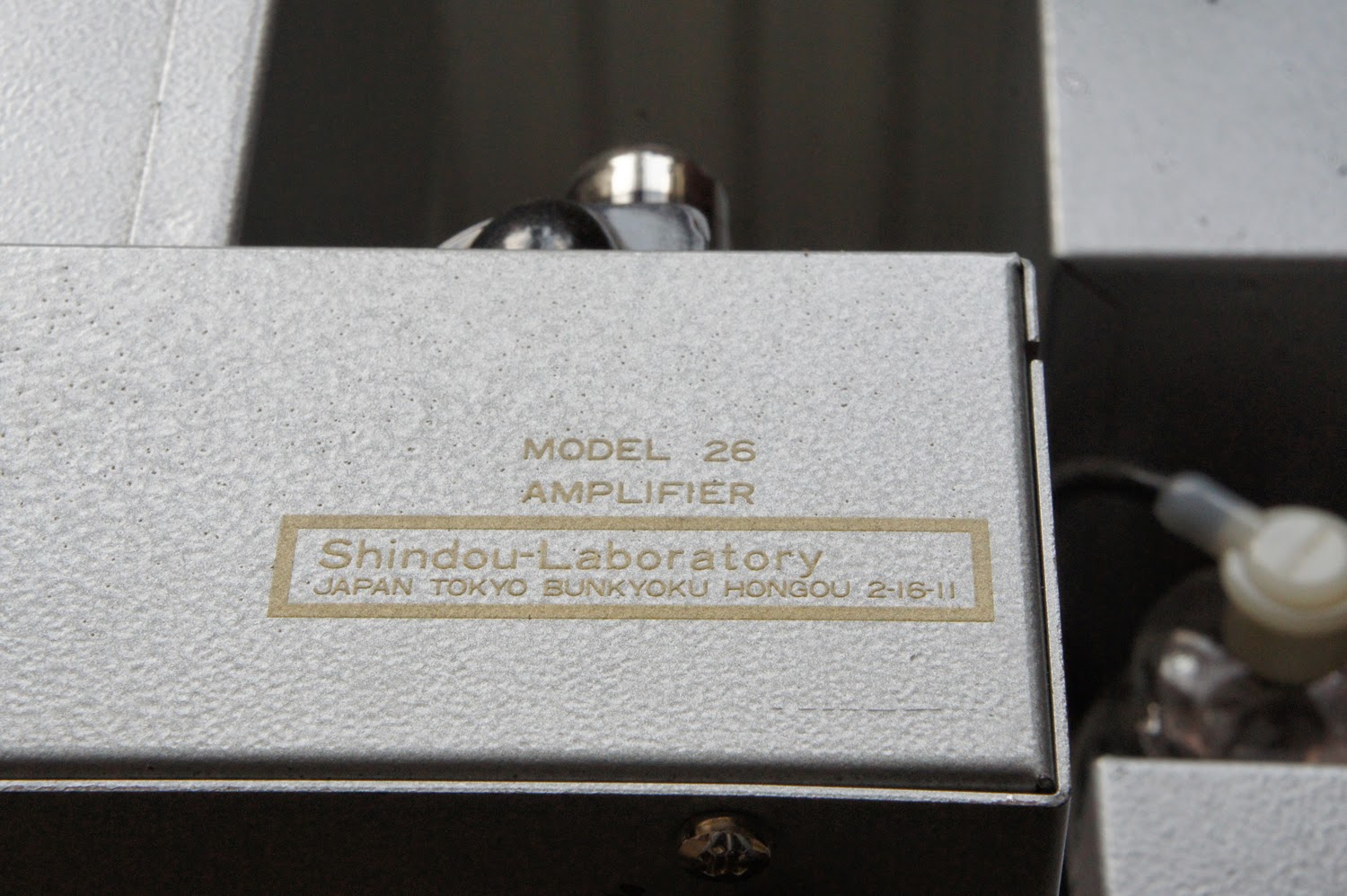
Shindou-Laboratory Model 26 Amps


But I am here today to work out the reasons for such superiority? I do mind the Shindo tube amplified chain and the analogue filtered crossover as main reasons for such a harmony, but who knows? Hans owns another set of vintage Shindo power amplifiers, called Shindou-Laboratory Model 26 Amplifier (they seem to be early models Pavillon Rouge). This mono blocks do incorporate the 6bg6g-tube, a late tv-penthode, easy and cheap to optain. Untypically these early amps from the 1970ties are silver hamerite coated, since the better known Shindo amps are always appear with green metalized laquer and golden inscription. I do like the more purist approach of the early amps a lot better, but we do not discuss design issues here. These Shindo power amps give a good option to evaluate the portion of harmonic properties of the 300b tube in the final soundstage, since they are built as doubled mono set, with improved double power supply. Seen from this point of view they might have an advantage again the small Concertino stereo amplifier. We did set these amps up and to be honest, the difference is big, the 6bg6g-tube do sound very different. It must be these power tubes creating the major difference, since there are less than ten components inside the amp, the transformers look just by appearance a lot more refined than the ones from the Concertino. The marvelous homogeneity seems to be a part of the typical soundstage of the 300B directly heated triodes. Wasn't it at the early beginning in Japan and Paris that the 300B was described as a major component, a time when we were to young to really know? May be, we switched back to the Concertino amp and the major portion of harmonies immediately where back on stage. A well balanced transducer, like the LM22A/555W/597 with dipole low frequency extension, is able to show such a little detail with tremendous effect and insight into the overall performance. I would go as far, that the set up without the famous direct heated triode is something very different. But at this point I would rate the Shindo power amplifier as another causal major component for this stage of refinement, were other amplifiers will do a difference.

We did follow on with a blasphemic approach. A little class-d-amp from Hans, which he uses for television purposes, was set into service instead the Shindo tube amps. A so called digital amp with 10 watts of power and one RCA-input in size of two cigarette boxes. We did set it up with digital source as input and truly were impressed from this little "junk box". It did play with a good portion of harmonies in the foremost manner. So it showed a bit to present bass with little superficial highs, but with unbelievable refined mids it did astonish both of us. But who will spend a good 15k EUR on speakers and will set it up with a 50 EUR digital amp?


RFT 15'' speaker on the table, right the little class-d-amp in evaluation, weighted down to compensate the torsion of the cabling on top of two generations of Shindo(u) power amplifiers
Conclusion... Such a horn installation like the Line Magnetic, but as well with a Sato or some Western Elelectric originals, will mark a unsurpassed approach to music with properties no other speaker design can obtain. They offer a whole lot qualities other transducing principles are not able to match, but they need as well to be fed with the best refined signal quality. Only than they might be able to match some place in audio heaven. In reverse, they will dramatically show any roughness or impurities of the incorporated electronic components with emphasis. To my current knowledge the analogue crossover with mild 6db path has a widely underrated importance to the overall harmonic presentation, as a refined 300b-tube amp carries a tremendous part of the wonder. The extension with a dipole for the lower frequencies marks as well a exceptional statement in the lower registers and is a important contribution to the final harmony. To my taste such a installation betters any digitally filtered, corrected and delayed approach with length. But it needs a educated ear with a clear direction to naturalness to understand the differences, the most people rely to some more sensational performance.


Read on soon, Volker


Thursday, 1 May 2014

The End 2014 in Munich from 15th to 18th of May

Hello to everybody,

thirteen times we will wake up and than again is time for the "High End Munich",  "the high end show for excellent home entertainment" so the subtitle of the organizer. I am curious if this fair will survive within the next five coming years. Founded in 1982, with a first event in Düsseldorf, its current successor in Munich marks a end of a cultural development. The most people do not use anymore specialized audio components to listen to their favorite music, they stream now their songs from web resources or clouds or they do use their universal remote for all options, their smart phone for their personal audio entertainment. (Attention dear public broadcast companies, it is just some years of advance, when a similar development will match your business, youtube is watching you.)


So, if we know that music reproduction does not anymore rely to dedicated hardware or a particular storage medium, what the hell will be exhibited in Munich 2014 and for whom? And what kind of people are going there? To my estimation the first, second and third generations, the audio aficionados, the hifi nuts and the audio users, must now have been died of age, or must be already deaf, or have shifted to other interests with better prestige factor or better entertainment factor. Or they might have been sustainable impoverished as third typical option of this age. The few exceptions which prove the rule, cannot carry this event into long time business?!
At the fair some extraordinary events will entertain some public interest. As in the last years, Silbatone will do a show (no, nothing to sell, just proud korean ownership on sale) again with rare historic vintage Western Electric Equipment, yeah, a must to be seen,  – really? If you want to listen to such rare installation with authentic Western Electric Horns, drivers and dedicated extensions in a less than optimal prepared room, but instead with superficial loudness to impress the audience, than this might be yours.
But it shows as well the poor constitution of the hifi business itself. Endless presentations of repetitive loudspeaker designs, amplifiers, oil rig designed record players and streaming clients with million-megacycle-oversampling in 248bit mode do not carry any ingenious content or idea, nor do they offer any audible fascination. In direct competition the Western Electric collection offers a unusual, unique and outstanding sensational approach to catch even the interest of the flaneur. This 80 year old equipment outperforms almost everything modern with length, and might be able to shows a way of high efficiency with a low energy consumption foot print. If you want to take care about your ecological behavior, the acoustic mechanical amplifier principle of the horn coupler is a ideal device for audio even tomorrow. If you don't want end up with electrical class M devices or if you are to old to have wearables all the time as fashion accessoir, such a transducer has a lot to offer for the coming future. This horn principle of acoustic audio wave coupling with its inherent mechanical amplification harbors lots of possibilities even for the coming age of restricted energy consumption. In short such a well designed horn can perform mechanically very similar to a gramophone from the old days with extremely improved amplification factor to a unbelievable degree of audio performance just without electricity. But even with lowest powered tube amplification concepts, it is possible to maintain perfect audio harmonies and dynamics at a relatively low power consumption level. We need a well working DAC with optical input to match a device like tablet, phone ore computer, a 20 bit non oversampling dac with a tube output stage, working into DHT driver stage together with a 3 watts DHT output stage for amplification. This might couple to the driver of a horn like the WE15A/WE597A combo. Such a set up can outperform almost any stereo set built up to highest standards, just with a 10th of its electrical energy input. I am working on such ideas, as long it is not realized, there are some cheap options already available to bridge the time (image). But even for such a solution you don't need to go to Munich.

Read on soon, Volker


Wednesday, 23 April 2014

Incredible close to music III – The Horn and its Extension into Both Ends


The LM22A/597/Siemens KL405 installation. If we weren't used to the look of such horn installations from Western Electric set ups, these transducers look more common to a professional music instrument than as being loudspeaking units.

When I did listen to Mikes Line Magnetic LM22-A horns the first time, some good three years ago, he just had begun to evaluate the complex issues of driving such a horn together with low frequency coupled woofers. At this very first trials he did perform them for me as well as full range units, just limited by their physical abilities. He just had got the LM-22A-horns with the dedicated LM555 receiver units in very late 2010 from Keith Aschenbrenner. His set up was part of the very first delivery of a handful of Line Magnetic horns ordered to Germany. At this time the LM 597 high frequency horn was not already produced, so the hf-extension needed evaluations for alternative solutions.
In the first step Mike did experimented with Altec stage monitors (15'' biflex drivers) as low end of his installation, later he tried several other speakers in baffles and different enclosure types. At this early stage I do remember listening to the setup, without any HF-extension. Of course it would need some extend into the higher frequencies, but it was with its reduction already better than the most other speakers I had heard in my live.
Original drawing from Western Electric in the 1930ties showing two alternative necks, the single and the double pathed for two receiver units to double the output energy.

In the last couple of years before Mikes interest shifted to such medium frequency horn types, he had already started to listen with modern active studio monitors instead of his Phy salabert baffle speakers. He as well switched from his Shindo amplifying chain to modern professional integrated preamps with RIAA equalization with the words: "I need to get something more neutral, I cannot stay anymore with the tasty colored tube electronics and the limitations of the Phy Salabert full range speakers". I do remember very well, when he showed me his completely new bought set up of studio equipment with these spoken words, – and to be honest, I did not understand his decision. Neutrallity is ok, I thought, but for what reason, when the result is a clean unemotional, uninvolving sound presentation, the typical professional sound. I could not follow on with his ideas and was really irritated about this development. For quite a long time, may be a year or so, he followed on with this concept. Finally his friendship with Norbert Gütte from LignoLab brought him back to the carpets of "tasty audio". He, the famous carpenter of such well known loudspeaker enclosures from A23, like the Rondo, did work out the templates for a double walled, sand filled Sato horn design. He combined it with large Double Onken enclosures, as well double layered and sand filled for the woofers. Mikes auditions at Norberts workshop showed him the tremendous properties of such medium frequency horns. In these days, around early 2010 several people were into such Sato horn concepts and a lively discussion about these set ups took place in a German web community. Mikes experience with Norbert Gütte's set up did lead directly into the decision to build up a similar concept for himself. It was right the time when Keith Aschenbrenner came up with the distribution of the Line Magnetic speakers, so it matched well prepared ground...

Schematic of the Sato horn published in the magazine L'Audiophile in 1983

In difference to the original designs from Western Electric (WE12A, WE13A, WE15A), the Sato horn is made completely from ply wood, even the neck is made from wood, which makes the build a little bit easier, if you are planning to do it as project. I am sure this difference will have a not unimportant effect on its general sound attitude, where the Western Electric originals incorporate casted metal necks (mostly made of bronze) in combination with wooden mouse openings. Only the WE22A and The WE16A are made from welded sheet metal and with casted metal necks.
The Line Magnetic horn replica offers two different casted aluminum necks, one for the LM555W receiver  (of course as well the original WE555A) and a another one to adapt other drivers like common Altec types or, if money does not matter, modern japanese equivalents like the Goto range. There are not so many alternatives, which will be able to cover the same wide frequency range, in particular at the lower end of the 22A's physical design (around 250 hz), so you either extend to four or more paths or you stay with a handful drivers to cover the medium frequencies. Here the very first compression driver design from Western Electric, the WE555A sets the pace, even by todays standards. Since this unit was designed as a universal receiver unit for even bigger horn types like the WE12A, but as well for a lot smaller types like the WE14A, used it in these days. Where the big horn designs do start around 100 hz and the the smaller designs will end up at 6000-7000 hz, the WE555A had cover them all. The most of the later designed compression drivers do not cover the half of this range, in particular at the lower end. I have been told, this is a result of the damped chamber behind the diaphragm, other drivers don't have, I do not know.


Of course there are drivers made today, which can even perform lower frequencies (Goto). Isn't it remarkable, that the very first design of the early 1930ties outperforms almost anything made with improved knowledge today? Is there no alternative way than to accept the rifts as a result of a advanced stage of mass production and profit expectation? – Again, a next example for the formerly in several of my articles named "staircase of technical progression" which always leads down.

When I did visit Mike the next time, he had made several improvements in his set up. After testing other hf-drivers from Siemens and other brands, he introduced the common known JBL 075 driver, together with different woofers to his horns. He now did accept the use a frequency dividing crossovers with three paths. The man who told me for almost 20 years about the advantages of crossover less homogenous full range drivers, the merits resulting from the absence of any phase degradation or time delays, was now using a three way separated signal. His experience with Norbert Güttes set up made this change possible. And now it even comes better, he did use a digitally delayed crossover unit and active amplification. Now all signals got converted into digital in order to be digitally separated, equalized, room customized, time aligned, even the already digital ones!  Again, and a bit slower,  c o n v e r t e d  i n t o  d i g i t a l  t o  b e  d i g i t a l l y  p r o c e s s e d  t o  b e  r e c o n v e r t e d  i n t o  a n a l o g u e!
I could not imagine a higher category of worst case scenario than this decision, when I heard about it the first time. At this point I did spend almost eight years to incorporate the wonderful merrits of transformer coupling and directly heated triodes into any of my pre- and amplification stages, and now this!? I had stored away my cd-player around 1995, when I got my Verdier and never missed it again. I do remember years of endless evaluations when Mike started with Shindos pre and power amplifiers, I do remember bronze parts around the tonearms and in combination with his Verdier, silver connections, every step was done after clear evaluation with good money. And now all signal got processed through a 300 EUR unit as a 'jack of all trades' solution with the words: "it is not listenable, may be almost not, – I think, but its hard to compare really…"? And: "electronic components are highly overrated within audio. The most important component is the speaker. If this will do right, electronics have to do the job?"I was more than skeptical about all this new "perspectives", since my experience of 20 years did tell me a different story.


He did in this early beginning, what lots of people were doing with their Sato horn's, they correct all frequency deformation and time delays together with additional room alignments to shape the sound stage to an ideal form in a tremendous matter. The three active channels are forwarded to three separate power amplifier stages per side, all were modern smps amps. Wit this set up Mike found a best possible solution in his room and if you would have asked him, he would have said: "I cannot get it any better at this stage". With digital correction systems you always have a toy to play out several curve shapes, as a result you will have ten or twenty curves, were each seem to better the next one, if you don't get lost on the way.

I do remember in his history a never ending evaluation of preamplifiers like the Kaneda, but mainly tube amplified designs with lots of different design topologies like SRPP, standard triode cathode followers or vintage pentode circuits, before he settled down with a first Shindo preamplifier.  In the first step he got the classic beginner menu served as "Claret" somewhere in the early 1990ties, shortly afterwards extended with a Shindo Concertino stereo power amplifier. More complex designs from the Shindo line followed, since it ended up in the late 1990ties were it is today with the Monbrison preamp and the 300B Mono Amps. I do remember listening evaluations of original 300b tubes from the fifties (engraved base), from the 1960ties (yellow printed base), reissues from 1990ties, were the best tubes was heaven, all others went into the second choice spares box. But with the new verdict "electronics are overrated", all these experiences were obsolete! Really?


.
To look at it from a different angle: For more than 20 years Mike followed an idea, where audio representation was defined by physical sensation, other than ingenious superficiality. We did learn, that a acoustic instrument succeedes by its harmonic properties, rather than its measured frequency spectrum. We were able to transmit this experiences to audio components with some success. With this idea all components have been evaluated through their harmonic properties, finally choosen for their musical superiority.

My irritations and skepticism about his new philosophy did reduce my interest a bit in 2011, so it took a year that I came back to have a look at the new advantages. Mike had completed with the smps amps, instead he reinstalled his classic tube amplification chain from Shindo. The digital correction was rejected, were now passive crossovers had taken place. He did use a Isophon 15'' woofer in a dipole enclosure and he had the new Line Magnetic LM597 high frequency horn installed, were the JBL did work before. The only adjustment was now a auto former were the energy for both horns got reduced at -3db to match the woofers output.


Again we did listen to digital program material, but this time even without the typical familiarization process to his new chain the resolved sound quality struck my down. Almost pure warm music attracted me in a way I never had heard before. Almost a holographic soundstage of widest possible dynamics and pure harmonic refinement surrounded me in the listening position, a level of naturalness I could not imagine before. Completely overtaken and deeply impressed I did drive home, knowing that I did hear something today, which opened my eyes for the advantages from big horn developments. I did learn that such a horn can do somethings, other designs are just not physically able to perform. Outstanding!

Line Magnetic 15'' field coil bass LM-BA5


Since that experience a good year ago, the Isophon woofers got exchanged to other woofers, like the dedicated Line Magnetic 15'' field coil driver. But finally Mike did end up with a "historic matching" solution how he said. The Siemens Klangfilm KL405's are permanent magnet units and got integrated in a double stacked array within his new made dipole enclosure to match physically the width of the LM22A. With this doubling principle they can as well double their output level, so that the autofomer for the horns can can be set out of service. I would not be able to clarify between the Isophons and the Siemens by remembrance, but I can say it is the best low frequency performance I did hear so far, completely fast, deep and three-dimensional, in a perfect balance of energy and transparency. It was so good, that it changed my longtime evolved ideas for my Tannoy enclosures, were I did realize a similar design idea now with a before unbelieved success.

Mike told me about the LM597 Loud Speaking Telephone which he got as newest extension now, I did read a lot about the supposed qualities of the originals to be the best hf-frequency driver available. But now I could not say anything about it, I just did visually realize that they were there. Right, that is exactly the point. This high frequency driver has a rare attitude, it is unobtrusive, completely invisible in acoustic terms, almost all other designs are not. I am personally very sensitive with tweeters, in particular with horn tweeters. It does not take long, when more conspicuous drivers are on play, that their dominance bring me into a feeling of unease. I never did like to listen to the most Altec drivers in longer terms in the past, even when their performance is very attractive at the first glance. This is one reason I personally prefer the Tannoy Dual Concentric, its integrated hf-unit is one of the best horn tweeters ever made, it is very similar in character to the LM597, – invisible and perfectly refined. Is that driver the key to the perfection of harmonies in Mikes set up. Yes and no!


In difference to himself I would judge several things like the complete chain for that reason, with its perfectly matching components, in particular the majestic analog front end, has a enormous influence to this harmonic presentation. With other words: I believe about the influence of built quality of electronics and do rate them as important for audible harmonic qualities. I still believe in all these little adding inexplicable effects from several components, like paper-in-oil-capacitors throughout the signal, as well now the new analogue crossover. The absence of switched power supplies and integrated circuits towards selected elaborated tube amplification, as well the rely to wooden materials in corporation with physical resonances and all the little forgotten improvements, which were long term approved in order to harmonize the audio signals as a chain. I think at this actual state his chain has reached attributes of performance, were musical harmonies dominate the character of audio perception and make the technical process of its origin completely forgettable. I did warn Mike several times just to settle down now with what he has, after more than 30 years of expedition the nirvana of audio, but Mike would not be him, if he will not start the next stage of examination. I know already what it will be. There are still some white areas on the map of the 1930ties to go. I would fear to destroy the rare grown tender plant. I do not know another audio set up of this stage of refinements, were the illusion of naturalness in tonality and performed dynamics is so perfectly present…


Read on about the final part soon, Volker