Friday, 30 May 2014

The Perfect Ensemble – A Bronze Body for the Denon DL103 to match my SME Tonearm Kit


Hello to everybody. After a longer period of entries about complete audio sets and about the making of my Tannoy enclosures, I will continue with another entry about my SME tonearm conversion kit and its extension with a matching cartridge. Several customers do have confirmed my statement, that the converted SME 3012 with its heavy stainless steel tube outperforms almost any other available 12'' tonearm, when equipped with a low compliance pick up cartridge. The range of typical cartridges bringing out the highly improved dynamic abilities of such a mass-spring-system are today the Ortofon SPUs, the Denon DL103s, the Koetsus and some exotic brands from Japan. In this group the Denons are in a outstanding position, since these cartridges are by far the cheapest alternative.

The LignoLab bronze case, the only housing at the market which is closed from the underneath generator side. It features real bronze and not brass in a perfect matte blasted finish as optimized material.


The DL103 was once designed and exclusively made for professional broadcast use in 1962, right in the past time when stereo recordings with Long Play Albums did take the market. Several other brands tried to introduce competive cartridges (Fairchild, General Electric, Grado, EMT) in these days to follow the Ortofon SPU been the first stereo moving coil cartridge in history and dedicated first for this professional use, introduced in 1958. Four years later the Denon was exclusively handmade for the Japanese broadcast industry NHK, to be identifiable by its black bakelite body. Since 30 years it is machine assembled with a thin plastic body for common distribution to a general audio market. Denon produced the commercial DL103 series like its european paragon without technical change till today, but with several variations over the years to keep the interest up.


Denon DL103 Technical Specifications
  • Stylus: 16.5 µm diamond spherical tip
  • Cantilever: Aluminum
  • Frequency Response: 20 ~ 45 kHz
  • Output: 0.3 mV at 50 mm/s
  • Output Impedance: 40 Ω
  • Load Impedance: 100 Ω
  • Channel Separation: Over 25 dB at 1 kHz
  • Compliance: 5 x 10⁻⁶ cm/dyne (100 Hz)
  • Tracking Force: 2.3 ~ 2.7g (± 0.3g)
  • Weight 8.5 grams
  • Stylus: 16.5 µm diamond spherical tip
  • Cantilever: Aluminum
  • Frequency Response: 20 ~ 45 kHz
  • Output: 0.3 mV at 50 mm/s
  • Output Impedance: 40 Ω
  • Load Impedance: 100 Ω
  • Channel Separation: Over 25 dB at 1 kHz
  • Compliance: 5 x 10⁻⁶ cm/dyne (100 Hz)
  • Tracking Force: 2.3 ~ 2.7g (± 0.3g)
  • Weight 8.5 grams
The perfect moulding of the housing with thick walls to conduct resonances and their harmonic proportions within the pick up process


The Denon DL103 always had a extremely economical pricing, a important attitude for this worldwide longtime success. But as well its unbelievable good performance and its unique technical standards made this cartridge to one of the foremost values today to be used with twelve inch tonearms and broadcast transcription turntables by the vintage hifi scene. I would estimate that 70 % of all Garrards, Thorens 124, EMTs, Rek-O-Cuts, Commonwealths, Fairchilds and similar type of players use a Denon DL103 moving coil cartridge. So it is no wonder that in 50 years of production a broad aftermarket product range has been established. So several case modifications are offered by audio dealers and are worldwide sold at Ebay, made from wood, stone, aluminum, brass and composite materials. All these mods follow a very early modification schematic, published by Maison de L'Audiophile in the late 1970ties, showing a lead trimming of the enclosure to minimize the ringing of the thin plastic type. Together with a heavy cabling mounted outside of the arm tube, the mass of the unit did grow so high, that there was almost no alternative other low compliance cartridge available beside the SPU, to balance such increased masses. With a compliance of 5 x 10⁻⁶ cm/dyne (100 Hz) the DL103 is some sort of  extreme. I do remember my own making of such a lead case in 1992 for my first DL103, mounted with a SME 3012/II at a Garrard 401 on a 30 kg plinth. In these days I did not have the advanced experience with heavy arm tube materials, which I have today. I did not know that a silly light weight aluminum tube like the SME SII was a less than a perfect solution for such a modification. Even the later thin steel wand ( 0.25mm material thickness) of the stainless tube from the last series R, was made to allow the time typical high compliance cartridges to be driven, but it was not a optimized solution for a cartridges like the SPU or the Denon DL103.

My following years have been in a way a research time about the perfect matches of compliance to tonearm combinations. At the end of this research I had the reason to make my conclusions affordable to other users of such systems with my conversion kit. Now with the LignoLab bronze housing the kit has got a perfect extension with a modified DL103, excessively well made by Norbert Gütte and his company. In difference to all the other after market bodies, his case is a perfectly exact copy of the original. This means it features as unique and important technical difference to any other metal housing,  –  a closed underneath side. Near the generator almost all resonances have their origin and this means to be the most delicate region of the body in terms of resonances. The cubic closed form creates really a tremendous difference by its resonant absorbent abilities. The case is by far more stiff, with remarkable thicker walls comparing it with other cases, to prevent the ringing abilities to a unknown level with highly improved harmonic anticipation by real bronze as material. Since all other aftermarket products are open frame designs, which are a lot easier and cheaper to make, will have a more decorative intention than technical improvement in mind. These are mainly meant to be a optical revaluation of the outer appearance as material and design issue of the common and ordinary thin plastic case. They create a nicer and more expensive look, much more than to be meant a mechanical improvement of audible properties.

The cartridge slips in a perfect sucking manner into the housing, a effect of its advanced CNC moulding and manufacturing process. This perfection is a typical feature of all LignoLab products.


With the Lignolab body the Denon gets into another stage of refinement and dynamic property, where the standard cartridge is not able to follow. Unmodified it is a simple basic construction, a piece of thin moulded plastic holding the generator in place with two drops of glue. This detail is the "achilles heel"  of its basic design. With the new bronze housing the Denon playes in a new league, where only the very best phono cartridges gather. With a smooth but extremely dynamic extension to both ends and a highly integrated harmonic presentation of the middle frequency response, the Denon is now a unique cartridge. And even independent of its pricing, it is a top class moving coil cartridge for long broadcast tonearms. For myself it is grown to be real a alternative to my longtime favorite, the Ortofon SPU Gold. At the beginning of the making of my conversion kit, I had the very first SME 3012 tonearm in mind with its heavy weights (220 g) for the SPU. So I produced a good amount of this balancing weights, but subsequently it happened that the most cartridge/headshell combinations of my customers appeared to be to lightweight, so I needed to produce a second weight (160 g) exactly like SME did in 1959. The LignoLab housing with its extra weight of 25 g is a perfect match to my kit in combination with the heavy balancing weight. This extra high mass of this combination makes a extra sturdy armwand necessary to perform in a highly improved state. All other twelve inch arms beside the rare original SME 3012 MK1 are generally to lightweight built for such a mass and work much better with lower masses. No version of the standard SME 3012 weights will be able to balance this extra weight. As well here my heavy weight is a welcome extension for technical improvement and higher aesthetic claims at classic SME tonearms. Otherwise a typical additional rider weight with very unoriginal look will be necessary to make it work. With the 3012/R version the vinyl saddle will create additional problems and can be worn out soon. But as well the aftermarket brass versions of this saddle, as a typical replacement for the vinyl type, are acting far beyond their physical limits, when used with a extra weight of 150 grams. It definetly needs to be a steel saddle to prevent excessive wear at the fine blades with such a high mass and to take the advantage of a wide improvement of dynamic abilities.


The Denon with bronze housing mounted in Ortofon bakelite headshell balanced free to zero  in a converted SME tonearm with the large 220 g balancing weight.


As a conclusion of my evaluation of the LignoLab housing I did decide to dedicate my last 30 weights of 220 g solely for the use with this combination. Either the weights can be bought with LignoLab together with a bronze housing for additional 100 EUR (fitting physically to any SME 30XX tonearm).  Or the complete kit can be ordered together with the bronze housing and the 220 g weight for a limited special offer here. Both offers will be strictly limited to altogether 30 pieces, either or! Just inquire here at the mail template beneath or at the LignoLab web page


Read on soon, Volker

Tuesday, 6 May 2014

Incredible close to music IV – The Evaluation in a Different Set Up and Room

Mikes audio set up is by far the best sounding audio chain I do personally know. Since I do report about it, I wonder how the quality portions in his chain are shared? How much influence to the final stage of naturalness and finesse will each component have and if, are really the big horns with their wide frequency range are doing the main job for this refinement? How much influence does the tube amplifying components have here? How much quality will be inserted by the WE300B tubes, its enveloping exceptional power amplifiers, the driving preamplifier and finally at the beginning of the early signal, the Platine Verdier with its Shindo-tonearm, -cartridge and dedicated step up transformer? Or is this captured perfect harmony mainly formed with Mikes room and with its extremely treated surfaces, or what else might do such a coherent presentation possible? To find definitive answers to these questions, I made a visit to Mikes close friend Hans. He is owner of a very similar installation with the same LM22A/LM555 and LM597 horn array, identical dipole enclosures for the low frequency path, but different equipped with four RFT 15'' woofers, were Mike uses the Siemens Klangfilm KL405 units. Hans uses almost the same preamp and with his Platine Verdier as well a Shindo cartridge, but in difference a curved banana EMT tonearm and A23 step up transformer.


Hans room is some sort of extreme, with a reflective length of 6 meters (roughly 19 to 8 feet) and a width of 2,50 meters it is shaped more like a tunnel than a ordinary proportioned room. I know Hans struggling with these room parameters since I know him and that might be as well for the last 25 years. Like Mike he did use a baffle boarded PHY Salabert speaker set up before the Line Magnetic decision changed his audio life. As Mike, he did order his LM22/555W set with the very first delivery coming to Germany.
I still admire these guys for their 'coolness' to set a binding order with a five digit amount of Euros to some horn and driver parts made as replica in China, without having heard or seen anything in real. Maybe sometimes in life it needs such adventurous decisions to get highly rewarded with before unbelieved presents, to get luckily the best audio, the best house or even a lifetime partner? And such a unbelievable decision shows in a tremendous manner their confidence to their "drug dealer"! Whom of yours would do after 25 years experience with audio products, do a blind order for a unheard and -seen chinese speaker replica? Ok, no more questions for now…


When Hans used the PHY-Salabert speakers with full range baffle boards, he needed a lot of room treatment to make it work to a refined stage. The baffled units disperse the waves in almost any direction of the room, so the reflective wandering parts are quite dominant and needed a complex treatment. Hans covered complete parts of his room, the half were the speakers are positioned got covered with a second layer of wood panels, which are again covered with a layer of thick cloth. Such panels got mounted to the side walls, the ceiling and got unregulary dispersed in the other half around the listening position. Hans said: "since I got the horns, it is the first time that it works perfectly in my difficult listening position with a before unknown ease."
I could not imagine such big horns in his narrow room to work well when I heard some years ago about his investment to go for such a set up, the distance between the two unit is some 50 cm or two feet, – just unbelievable. I thought a single unit set up would do the same job…


Crossover update, after extension with two parallel woofers the auto former  is not anymore
necessary and the crossover for  mf/hf frequencies reduces to tempting simplicity.


But now, after I did hear it in his room, I have to say that it works almost perfect, even in such a wrong space. All these medium frequency horns, like the LM22A, the Satohorn, the Western Electric WE13/15/16As, and the modern japanese Gotos do focus their waveform a lot. They beam a tremendous part of their radiated frequencies so much, that the hot spot of the perfect listening position is extremely narrow, rarely more than the width of a head, sometimes some 60 cm, depending a bit on the distance to the array. This limitation in the stereo impression is so far my only known restriction using such horn transducers. But in the same way their unique forwarded projection reduce the typical amount of wandering room reflections almost completely, comparing it to ordinary cone speakers. This effect helps Hans now a lot in his less than ideally shaped room.
Such a narrow space makes audio life easy in other respects. To the left of his listening position he has big shelves for his record collection, on his right he has installed a wooden support system for the components, as well decoupled with air compressed feet. He is able to select his records and operate his components from his seat in the central listening position without standing up and with perfect ease. Sitting in front his laptop with its digital music library and the web, this position makes the perfect cockpit for the "aficionado".

Different woofers for evaluation, left a Isophon 15" mounted in dedicated baffle board, next to a pair of Altec Biflex 420 mounted against each other.


In difference to Mike, Hans uses RFT 15'' speakers for the low frequency support, as well in double stacked array to improve the energy output. This RFT speakers have been used in former East Germany for pa dedication. These units are quite easy to obtain and can be found for small money in four or eight ohm versions, both with hard edged paper roll. Listening to Hans installation I would not be able to define any difference in performance to Mikes a lot more rare and expensive Siemens Klangfilm KL405 units.

We did listen first to some digitally stored music and after a while of familiarization we switched to some vinyl records of mine to get myself into a real evaluation mode. From the first moment I was impressed that the set up did show almost 95% of the same qualities, which I did only know from Mike. It was really amazing for me to hear that this extreme room proportions not really to degrade the perfect harmonies with bouncing reflexions. I definitely did not expect such a high degree of similarity before. Even the chain is a bit different, were Mike uses the famous Shindo 300b mono blocks, Hans uses the much smaller Shindo Concertino 300b stereo amplifier. Almost the rest of the signal chain can be described as the same. The room and the power amplifier are the major differences, and both together might be responsible for a minimal difference in the naturalness of the presentation. I think it might be the sovereignty of the mono amps in the foremost stage which creates the main difference. But here as well the harmonic portions are present, the dynamic abilities and a indescribable refinement captured with lots of air is almost the same. Nothing superficial or conspicuous spoils the enjoyment. A absolutely amazing performance, which I only know from Mikes set up, all other hifi sets I do know, and believe me or not, I do know a few, are playing in a completely different league. A difference were in the most cases the technical perfection represents the aspects of music reproduction as a sort of superficial statement in contrast to a much more simple natural sounding approach here.

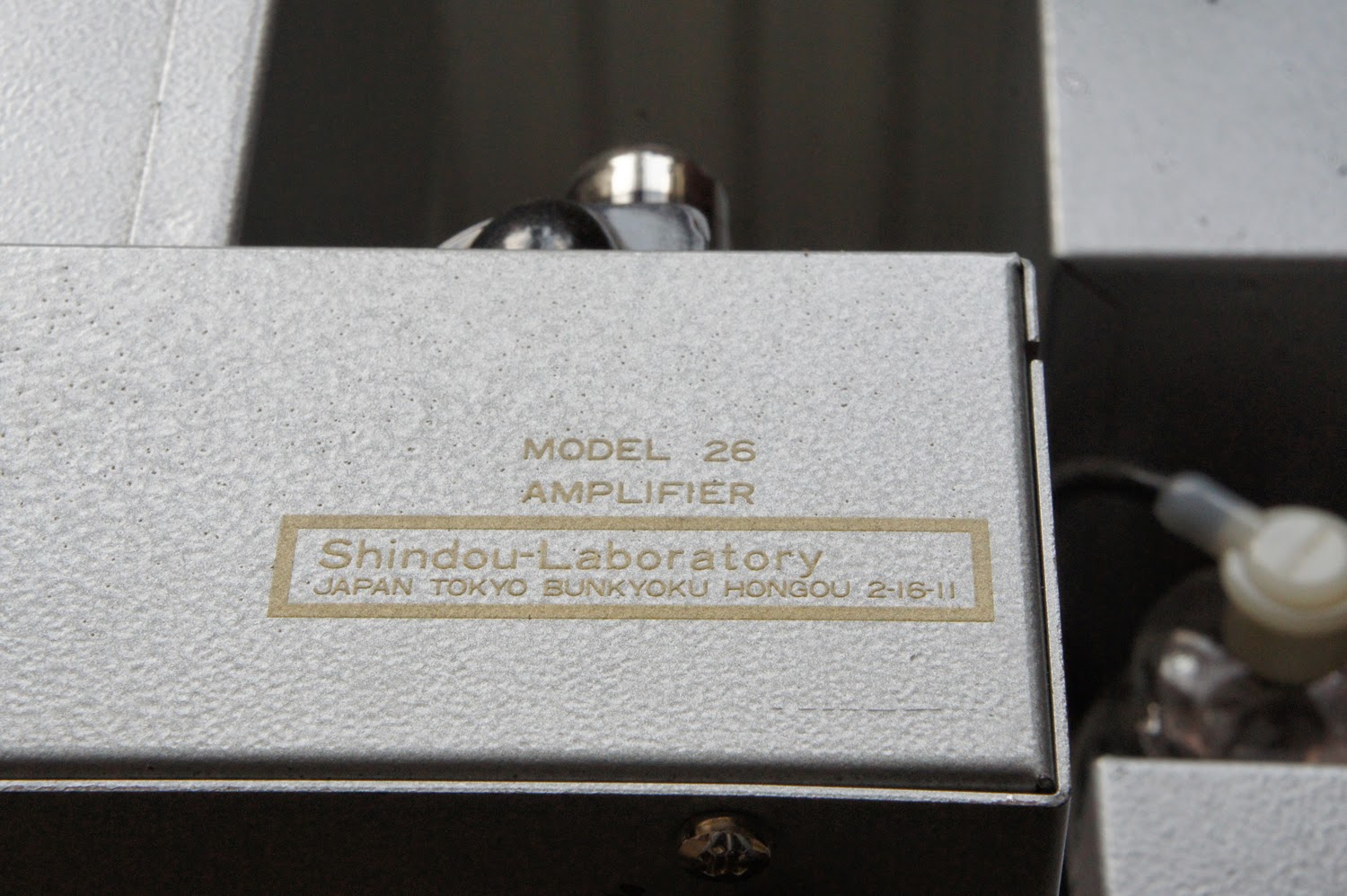
A pair of rare Shindou 1970ties 6bg6g-Mono-Amplifiers with doubled rectifiers tubes


Shindou-Laboratory Model 26 Amps


But I am here today to work out the reasons for such superiority? I do mind the Shindo tube amplified chain and the analogue filtered crossover as main reasons for such a harmony, but who knows? Hans owns another set of vintage Shindo power amplifiers, called Shindou-Laboratory Model 26 Amplifier (they seem to be early models Pavillon Rouge). This mono blocks do incorporate the 6bg6g-tube, a late tv-penthode, easy and cheap to optain. Untypically these early amps from the 1970ties are silver hamerite coated, since the better known Shindo amps are always appear with green metalized laquer and golden inscription. I do like the more purist approach of the early amps a lot better, but we do not discuss design issues here. These Shindo power amps give a good option to evaluate the portion of harmonic properties of the 300b tube in the final soundstage, since they are built as doubled mono set, with improved double power supply. Seen from this point of view they might have an advantage again the small Concertino stereo amplifier. We did set these amps up and to be honest, the difference is big, the 6bg6g-tube do sound very different. It must be these power tubes creating the major difference, since there are less than ten components inside the amp, the transformers look just by appearance a lot more refined than the ones from the Concertino. The marvelous homogeneity seems to be a part of the typical soundstage of the 300B directly heated triodes. Wasn't it at the early beginning in Japan and Paris that the 300B was described as a major component, a time when we were to young to really know? May be, we switched back to the Concertino amp and the major portion of harmonies immediately where back on stage. A well balanced transducer, like the LM22A/555W/597 with dipole low frequency extension, is able to show such a little detail with tremendous effect and insight into the overall performance. I would go as far, that the set up without the famous direct heated triode is something very different. But at this point I would rate the Shindo power amplifier as another causal major component for this stage of refinement, were other amplifiers will do a difference.

We did follow on with a blasphemic approach. A little class-d-amp from Hans, which he uses for television purposes, was set into service instead the Shindo tube amps. A so called digital amp with 10 watts of power and one RCA-input in size of two cigarette boxes. We did set it up with digital source as input and truly were impressed from this little "junk box". It did play with a good portion of harmonies in the foremost manner. So it showed a bit to present bass with little superficial highs, but with unbelievable refined mids it did astonish both of us. But who will spend a good 15k EUR on speakers and will set it up with a 50 EUR digital amp?


RFT 15'' speaker on the table, right the little class-d-amp in evaluation, weighted down to compensate the torsion of the cabling on top of two generations of Shindo(u) power amplifiers
Conclusion... Such a horn installation like the Line Magnetic, but as well with a Sato or some Western Elelectric originals, will mark a unsurpassed approach to music with properties no other speaker design can obtain. They offer a whole lot qualities other transducing principles are not able to match, but they need as well to be fed with the best refined signal quality. Only than they might be able to match some place in audio heaven. In reverse, they will dramatically show any roughness or impurities of the incorporated electronic components with emphasis. To my current knowledge the analogue crossover with mild 6db path has a widely underrated importance to the overall harmonic presentation, as a refined 300b-tube amp carries a tremendous part of the wonder. The extension with a dipole for the lower frequencies marks as well a exceptional statement in the lower registers and is a important contribution to the final harmony. To my taste such a installation betters any digitally filtered, corrected and delayed approach with length. But it needs a educated ear with a clear direction to naturalness to understand the differences, the most people rely to some more sensational performance.


Read on soon, Volker


Thursday, 1 May 2014

The End 2014 in Munich from 15th to 18th of May

Hello to everybody,

thirteen times we will wake up and than again is time for the "High End Munich",  "the high end show for excellent home entertainment" so the subtitle of the organizer. I am curious if this fair will survive within the next five coming years. Founded in 1982, with a first event in Düsseldorf, its current successor in Munich marks a end of a cultural development. The most people do not use anymore specialized audio components to listen to their favorite music, they stream now their songs from web resources or clouds or they do use their universal remote for all options, their smart phone for their personal audio entertainment. (Attention dear public broadcast companies, it is just some years of advance, when a similar development will match your business, youtube is watching you.)


So, if we know that music reproduction does not anymore rely to dedicated hardware or a particular storage medium, what the hell will be exhibited in Munich 2014 and for whom? And what kind of people are going there? To my estimation the first, second and third generations, the audio aficionados, the hifi nuts and the audio users, must now have been died of age, or must be already deaf, or have shifted to other interests with better prestige factor or better entertainment factor. Or they might have been sustainable impoverished as third typical option of this age. The few exceptions which prove the rule, cannot carry this event into long time business?!
At the fair some extraordinary events will entertain some public interest. As in the last years, Silbatone will do a show (no, nothing to sell, just proud korean ownership on sale) again with rare historic vintage Western Electric Equipment, yeah, a must to be seen,  – really? If you want to listen to such rare installation with authentic Western Electric Horns, drivers and dedicated extensions in a less than optimal prepared room, but instead with superficial loudness to impress the audience, than this might be yours.
But it shows as well the poor constitution of the hifi business itself. Endless presentations of repetitive loudspeaker designs, amplifiers, oil rig designed record players and streaming clients with million-megacycle-oversampling in 248bit mode do not carry any ingenious content or idea, nor do they offer any audible fascination. In direct competition the Western Electric collection offers a unusual, unique and outstanding sensational approach to catch even the interest of the flaneur. This 80 year old equipment outperforms almost everything modern with length, and might be able to shows a way of high efficiency with a low energy consumption foot print. If you want to take care about your ecological behavior, the acoustic mechanical amplifier principle of the horn coupler is a ideal device for audio even tomorrow. If you don't want end up with electrical class M devices or if you are to old to have wearables all the time as fashion accessoir, such a transducer has a lot to offer for the coming future. This horn principle of acoustic audio wave coupling with its inherent mechanical amplification harbors lots of possibilities even for the coming age of restricted energy consumption. In short such a well designed horn can perform mechanically very similar to a gramophone from the old days with extremely improved amplification factor to a unbelievable degree of audio performance just without electricity. But even with lowest powered tube amplification concepts, it is possible to maintain perfect audio harmonies and dynamics at a relatively low power consumption level. We need a well working DAC with optical input to match a device like tablet, phone ore computer, a 20 bit non oversampling dac with a tube output stage, working into DHT driver stage together with a 3 watts DHT output stage for amplification. This might couple to the driver of a horn like the WE15A/WE597A combo. Such a set up can outperform almost any stereo set built up to highest standards, just with a 10th of its electrical energy input. I am working on such ideas, as long it is not realized, there are some cheap options already available to bridge the time (image). But even for such a solution you don't need to go to Munich.

Read on soon, Volker


Wednesday, 23 April 2014

Incredible close to music III – The Horn and its Extension into Both Ends


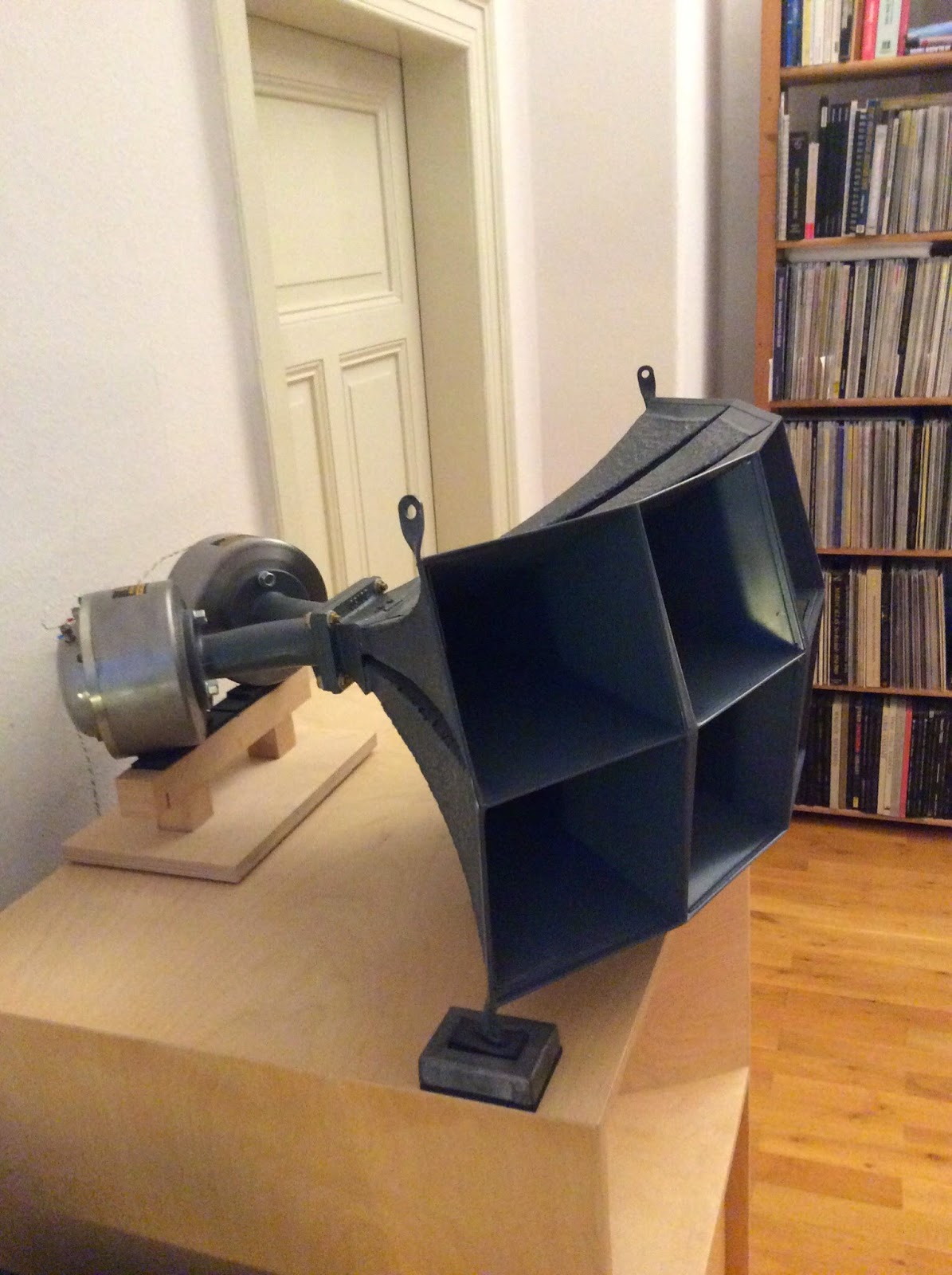
The LM22A/597/Siemens KL405 installation. If we weren't used to the look of such horn installations from Western Electric set ups, these transducers look more common to a professional music instrument than as being loudspeaking units.

When I did listen to Mikes Line Magnetic LM22-A horns the first time, some good three years ago, he just had begun to evaluate the complex issues of driving such a horn together with low frequency coupled woofers. At this very first trials he did perform them for me as well as full range units, just limited by their physical abilities. He just had got the LM-22A-horns with the dedicated LM555 receiver units in very late 2010 from Keith Aschenbrenner. His set up was part of the very first delivery of a handful of Line Magnetic horns ordered to Germany. At this time the LM 597 high frequency horn was not already produced, so the hf-extension needed evaluations for alternative solutions.
In the first step Mike did experimented with Altec stage monitors (15'' biflex drivers) as low end of his installation, later he tried several other speakers in baffles and different enclosure types. At this early stage I do remember listening to the setup, without any HF-extension. Of course it would need some extend into the higher frequencies, but it was with its reduction already better than the most other speakers I had heard in my live.
Original drawing from Western Electric in the 1930ties showing two alternative necks, the single and the double pathed for two receiver units to double the output energy.

In the last couple of years before Mikes interest shifted to such medium frequency horn types, he had already started to listen with modern active studio monitors instead of his Phy salabert baffle speakers. He as well switched from his Shindo amplifying chain to modern professional integrated preamps with RIAA equalization with the words: "I need to get something more neutral, I cannot stay anymore with the tasty colored tube electronics and the limitations of the Phy Salabert full range speakers". I do remember very well, when he showed me his completely new bought set up of studio equipment with these spoken words, – and to be honest, I did not understand his decision. Neutrallity is ok, I thought, but for what reason, when the result is a clean unemotional, uninvolving sound presentation, the typical professional sound. I could not follow on with his ideas and was really irritated about this development. For quite a long time, may be a year or so, he followed on with this concept. Finally his friendship with Norbert Gütte from LignoLab brought him back to the carpets of "tasty audio". He, the famous carpenter of such well known loudspeaker enclosures from A23, like the Rondo, did work out the templates for a double walled, sand filled Sato horn design. He combined it with large Double Onken enclosures, as well double layered and sand filled for the woofers. Mikes auditions at Norberts workshop showed him the tremendous properties of such medium frequency horns. In these days, around early 2010 several people were into such Sato horn concepts and a lively discussion about these set ups took place in a German web community. Mikes experience with Norbert Gütte's set up did lead directly into the decision to build up a similar concept for himself. It was right the time when Keith Aschenbrenner came up with the distribution of the Line Magnetic speakers, so it matched well prepared ground...

Schematic of the Sato horn published in the magazine L'Audiophile in 1983

In difference to the original designs from Western Electric (WE12A, WE13A, WE15A), the Sato horn is made completely from ply wood, even the neck is made from wood, which makes the build a little bit easier, if you are planning to do it as project. I am sure this difference will have a not unimportant effect on its general sound attitude, where the Western Electric originals incorporate casted metal necks (mostly made of bronze) in combination with wooden mouse openings. Only the WE22A and The WE16A are made from welded sheet metal and with casted metal necks.
The Line Magnetic horn replica offers two different casted aluminum necks, one for the LM555W receiver  (of course as well the original WE555A) and a another one to adapt other drivers like common Altec types or, if money does not matter, modern japanese equivalents like the Goto range. There are not so many alternatives, which will be able to cover the same wide frequency range, in particular at the lower end of the 22A's physical design (around 250 hz), so you either extend to four or more paths or you stay with a handful drivers to cover the medium frequencies. Here the very first compression driver design from Western Electric, the WE555A sets the pace, even by todays standards. Since this unit was designed as a universal receiver unit for even bigger horn types like the WE12A, but as well for a lot smaller types like the WE14A, used it in these days. Where the big horn designs do start around 100 hz and the the smaller designs will end up at 6000-7000 hz, the WE555A had cover them all. The most of the later designed compression drivers do not cover the half of this range, in particular at the lower end. I have been told, this is a result of the damped chamber behind the diaphragm, other drivers don't have, I do not know.


Of course there are drivers made today, which can even perform lower frequencies (Goto). Isn't it remarkable, that the very first design of the early 1930ties outperforms almost anything made with improved knowledge today? Is there no alternative way than to accept the rifts as a result of a advanced stage of mass production and profit expectation? – Again, a next example for the formerly in several of my articles named "staircase of technical progression" which always leads down.

When I did visit Mike the next time, he had made several improvements in his set up. After testing other hf-drivers from Siemens and other brands, he introduced the common known JBL 075 driver, together with different woofers to his horns. He now did accept the use a frequency dividing crossovers with three paths. The man who told me for almost 20 years about the advantages of crossover less homogenous full range drivers, the merits resulting from the absence of any phase degradation or time delays, was now using a three way separated signal. His experience with Norbert Güttes set up made this change possible. And now it even comes better, he did use a digitally delayed crossover unit and active amplification. Now all signals got converted into digital in order to be digitally separated, equalized, room customized, time aligned, even the already digital ones!  Again, and a bit slower,  c o n v e r t e d  i n t o  d i g i t a l  t o  b e  d i g i t a l l y  p r o c e s s e d  t o  b e  r e c o n v e r t e d  i n t o  a n a l o g u e!
I could not imagine a higher category of worst case scenario than this decision, when I heard about it the first time. At this point I did spend almost eight years to incorporate the wonderful merrits of transformer coupling and directly heated triodes into any of my pre- and amplification stages, and now this!? I had stored away my cd-player around 1995, when I got my Verdier and never missed it again. I do remember years of endless evaluations when Mike started with Shindos pre and power amplifiers, I do remember bronze parts around the tonearms and in combination with his Verdier, silver connections, every step was done after clear evaluation with good money. And now all signal got processed through a 300 EUR unit as a 'jack of all trades' solution with the words: "it is not listenable, may be almost not, – I think, but its hard to compare really…"? And: "electronic components are highly overrated within audio. The most important component is the speaker. If this will do right, electronics have to do the job?"I was more than skeptical about all this new "perspectives", since my experience of 20 years did tell me a different story.


He did in this early beginning, what lots of people were doing with their Sato horn's, they correct all frequency deformation and time delays together with additional room alignments to shape the sound stage to an ideal form in a tremendous matter. The three active channels are forwarded to three separate power amplifier stages per side, all were modern smps amps. Wit this set up Mike found a best possible solution in his room and if you would have asked him, he would have said: "I cannot get it any better at this stage". With digital correction systems you always have a toy to play out several curve shapes, as a result you will have ten or twenty curves, were each seem to better the next one, if you don't get lost on the way.

I do remember in his history a never ending evaluation of preamplifiers like the Kaneda, but mainly tube amplified designs with lots of different design topologies like SRPP, standard triode cathode followers or vintage pentode circuits, before he settled down with a first Shindo preamplifier.  In the first step he got the classic beginner menu served as "Claret" somewhere in the early 1990ties, shortly afterwards extended with a Shindo Concertino stereo power amplifier. More complex designs from the Shindo line followed, since it ended up in the late 1990ties were it is today with the Monbrison preamp and the 300B Mono Amps. I do remember listening evaluations of original 300b tubes from the fifties (engraved base), from the 1960ties (yellow printed base), reissues from 1990ties, were the best tubes was heaven, all others went into the second choice spares box. But with the new verdict "electronics are overrated", all these experiences were obsolete! Really?


.
To look at it from a different angle: For more than 20 years Mike followed an idea, where audio representation was defined by physical sensation, other than ingenious superficiality. We did learn, that a acoustic instrument succeedes by its harmonic properties, rather than its measured frequency spectrum. We were able to transmit this experiences to audio components with some success. With this idea all components have been evaluated through their harmonic properties, finally choosen for their musical superiority.

My irritations and skepticism about his new philosophy did reduce my interest a bit in 2011, so it took a year that I came back to have a look at the new advantages. Mike had completed with the smps amps, instead he reinstalled his classic tube amplification chain from Shindo. The digital correction was rejected, were now passive crossovers had taken place. He did use a Isophon 15'' woofer in a dipole enclosure and he had the new Line Magnetic LM597 high frequency horn installed, were the JBL did work before. The only adjustment was now a auto former were the energy for both horns got reduced at -3db to match the woofers output.


Again we did listen to digital program material, but this time even without the typical familiarization process to his new chain the resolved sound quality struck my down. Almost pure warm music attracted me in a way I never had heard before. Almost a holographic soundstage of widest possible dynamics and pure harmonic refinement surrounded me in the listening position, a level of naturalness I could not imagine before. Completely overtaken and deeply impressed I did drive home, knowing that I did hear something today, which opened my eyes for the advantages from big horn developments. I did learn that such a horn can do somethings, other designs are just not physically able to perform. Outstanding!

Line Magnetic 15'' field coil bass LM-BA5


Since that experience a good year ago, the Isophon woofers got exchanged to other woofers, like the dedicated Line Magnetic 15'' field coil driver. But finally Mike did end up with a "historic matching" solution how he said. The Siemens Klangfilm KL405's are permanent magnet units and got integrated in a double stacked array within his new made dipole enclosure to match physically the width of the LM22A. With this doubling principle they can as well double their output level, so that the autofomer for the horns can can be set out of service. I would not be able to clarify between the Isophons and the Siemens by remembrance, but I can say it is the best low frequency performance I did hear so far, completely fast, deep and three-dimensional, in a perfect balance of energy and transparency. It was so good, that it changed my longtime evolved ideas for my Tannoy enclosures, were I did realize a similar design idea now with a before unbelieved success.

Mike told me about the LM597 Loud Speaking Telephone which he got as newest extension now, I did read a lot about the supposed qualities of the originals to be the best hf-frequency driver available. But now I could not say anything about it, I just did visually realize that they were there. Right, that is exactly the point. This high frequency driver has a rare attitude, it is unobtrusive, completely invisible in acoustic terms, almost all other designs are not. I am personally very sensitive with tweeters, in particular with horn tweeters. It does not take long, when more conspicuous drivers are on play, that their dominance bring me into a feeling of unease. I never did like to listen to the most Altec drivers in longer terms in the past, even when their performance is very attractive at the first glance. This is one reason I personally prefer the Tannoy Dual Concentric, its integrated hf-unit is one of the best horn tweeters ever made, it is very similar in character to the LM597, – invisible and perfectly refined. Is that driver the key to the perfection of harmonies in Mikes set up. Yes and no!


In difference to himself I would judge several things like the complete chain for that reason, with its perfectly matching components, in particular the majestic analog front end, has a enormous influence to this harmonic presentation. With other words: I believe about the influence of built quality of electronics and do rate them as important for audible harmonic qualities. I still believe in all these little adding inexplicable effects from several components, like paper-in-oil-capacitors throughout the signal, as well now the new analogue crossover. The absence of switched power supplies and integrated circuits towards selected elaborated tube amplification, as well the rely to wooden materials in corporation with physical resonances and all the little forgotten improvements, which were long term approved in order to harmonize the audio signals as a chain. I think at this actual state his chain has reached attributes of performance, were musical harmonies dominate the character of audio perception and make the technical process of its origin completely forgettable. I did warn Mike several times just to settle down now with what he has, after more than 30 years of expedition the nirvana of audio, but Mike would not be him, if he will not start the next stage of examination. I know already what it will be. There are still some white areas on the map of the 1930ties to go. I would fear to destroy the rare grown tender plant. I do not know another audio set up of this stage of refinements, were the illusion of naturalness in tonality and performed dynamics is so perfectly present…


Read on about the final part soon, Volker


Wednesday, 9 April 2014

The SME 3012 MK1 Conversion Kit – What Customers say using the Tonearm Conversion Kit

M. Pacholak, D wrote:


Hallo Herr Heinze
ob Sie es glauben oder nicht, seit Gestern kann ich wieder Musik hören. Ich habe mir aus Polen eine Schablone für SME 3012 MK1/II besorgt ( hoffentlich die richtige ) und viel Zeit damit verbracht.
Der Klang mit dem neuen Tonarm von Ihnen lässt sich mit dem Klang des alten Modell überhaupt nicht vergleichen, alles hört sich anders an, viel viel schöner und mit mehr Musikinformationen. So macht Musikhören richtig Spaß und der Fuß wippt wieder mit…

Nochmals vielen Dank für die Mühe die sie sich für mich gemacht haben,

ein zufriedener Kunde


Jonathan Noble from Johannesburg, SA wrote:


"it's so beautiful, and is superb. You could say it combines the best points of the more regular 3012 mk2 together with the Shick, repackaged into the one arm.

The high mass from the stainless steel arm wand sorts out the bass. But highs are sweeter too and less splashy, and there is more inner detail of the musical kind, with an expanded tonal palette compared to the mk2 and Shick.


It's perfect for spu or 103, but medium compliance mc's may be at a disadvantage."


Jürg Schopper from Switzerland wrote in October 2015 about the kit:

"Die Qualität die Volker Heinze anbietet, ist eine Liga für sich. Da ich selber Tonarme produziere, weiss ich was es für eine Herausforderung ist, die Produkte in der hochwertigen Qualität zu erhalten, wie es in den 50er und 60er Jahren üblich war. Wir sprechen hier zudem von einer Kleinstserie. Hut ab und weiter so !"


Charles from Texas, USA wrote in July 2015:

I would like to offer a few comments about Volker Heinze and his superb SME 3012 conversion kit.  I purchased a complete 3012 arm from Volker and have installed the arm in a homemade stacked baltic birch plinth containing a grease-bearing Garrard 301 turntable.  The arm holds a Denon DL-103 cartridge housed in a Lignolab bronze housing and Ortofon metal headshell running into a homemade 1:15 step-up transformer utilizing Jensen transformers originally contained in a Neve mixing console. The transformer is run into a Dynavector P-75 phono preamp in moving magnet configuration, then into a Naim 72/Hicap/135's driving Harbeth Compact 7 loudspeakers. The word that comes to mind in describing this analog system is "organic." The music is presented with drive, dynamics and energy yet also with ease. There are few if any mechanical artifacts. One always gets the impression that there are real humans singing and playing the instruments and their musical and emotional intent is easily communicated to the listener. Volker is a pleasure to do business with.  He is extremely knowledgeable concerning all aspects of the SME arm and its installation and operation, and is always willing to answer patiently any question and provide helpful guidance and advice.  The quality of the arm and the additional parts are outstanding and would be appropriate for the highest quality turntables. I would highly recommend his service and product to all music lovers interested in the engineering and musical masterpiece known as the classic SME tonearm.


Martin from Kassel in Germany wrote in May 2015:


"Alles begann mit der Quad ESL 57. Fasziniert ob der Fähigkeiten dieser Lautsprecher setzte sich in mir der Wunsch fest, eine historische Kette zu betreiben. Da bin ich auch fast angekommen, allerdings mit in diesem Sinne nicht stilechter Verstärkung einer chinesischen Quad-Verstärkung. Schließlich gesellte sich ein Thorens 124 hinzu und - fast möchte man sagen: natürlich - ein SME 3012. Da die MK 1 Version mittlerweile quasi in Gold aufgewogen wird, bin ich auf einen MK II mit verbogenen Armrohr gestoßen. Nach einem ersten, sehr freundlichen Telefonat mit Volker Heinze war schnell klar: dies war die Ausgangsbasis für ein SME mit Volkers Conversion Kit. Fantastisch, wie unkompliziert und schnell ich dann mein neues Spielzeug in den Händen halten durfte.
Aber wie klingt es denn nun: ganz ehrlich, es ist mein erster Zwölfzöller, insofern kann ich wenig Vergleiche zu anderen bekannten Vertretern dieser Gattung anstellen. Und meinen vorigen Tonarm (einen RB 300) brauche und kann ich nicht ernsthaft zu einem Vergleich heranziehen. Außerordentlich hat mich allerdings die Abastsicherheit und die fantastischen dynamischen Eigenschaften beeindruckt. Was mir wichtig ist, ist die Spannung der Musik (ich höre überwiegend Klassik) zu transportieren ohne highfideles „gepunshe“. Und das macht er in einer Weise, dass sich die Tonarmfrage beim Musikhören gar nicht mehr stellt.
In Abwandlung eines alten Claims von Naim könnte man auch sagen: no conversion kit, no music.


Klaus wrote in 11/2014 the following letter:


"Im Jahr 2013 im August hatten wir letzmalig Kontakt. Ich hatte einen SME3012 Conversion kit bei ihnen gekauft und ihnen versprochen ihnen einen kurzen Bericht zu kommen zu lassen, wenn ich meine 4 Tonarme incl. ihrem Conversion kit bewertet habe. Um es kurz zu machen, meine beiden Favoriten sind ihr conversion kit und der FR-64s mit B-60. SME3012R und Ortofon RMG309i werden in Kürze von mir im ebay angeboten. 


Natürlich sind die klanglichen Unterschiede zwischen diesen 4 Tonarmen sehr gering. Im Bassbereich konnte ich die spürbarsten Unterschiede feststellen. Ihr Kit und der FR-64s zeichnen sich durch ein schlanken, trockenen und konturierten Bass aus und dies besonders, wenn man schwere Tonabnehmer/Headshell-Kombinationen mit einem Gesamtgewicht >36gr einsetzt. In leichteren Kombinationen bei gleichen Tonabnemern am SME3012R und am RMG309i waren die die Bässe nicht schlank und straff sondern eher bumsig. Im Mittel- und Hochtonbereich habe ich den Eindruck, dass der SME3012R etwas mehr und der RMG309i weniger ein leichtes, schönendes Klingeln über einen größeren Frequenzbereich der Musik überlagert haben und dadurch das musikalische Geschehen unnatürlich weit nach vorne bringen und dabei die Balance zwischen vorne und hinten verzerren. Diese Effekte treten mit ihrem Kit  und dem FR64-s nicht auf.


Ich habe meine Hörerfahrungen an 2 mono Systemen erarbeitet: 1. Platine Verdier, Accuphase C280 und A-20V, Frequenzweiche Behringer 2496 sowie Altec VOT A-5 mit 515B, 1005-Horn und 2*288c mit Bronze Adapter 30170 und 2. Thorens  TD-124 I, Welter HE-VV, Welter WT- 500 bzw. Bedini 20/20 sowie 2 Quad esl57 stacked. Die Monosignale erzeuge ich transformatorisch. Als Tonabnehmer kamen zur Anwendung SPU-Meister (Cu) und Denon DL103 nackt im offenen Bronze-Gehäuse montiert in eine SPU-G Haedshell ( so wie sie das letzthin auch sehr treffend beschrieben hatten). Am meisten hat mich allerdings überrascht wie nahe VOT und stacked Quads tonal bei einander liegen. Beide Lautsprecher vermitteln einen realen liveartigen Eindruck. Das musikaliche Geschehen ist vom Lautsprecher gelöst. Vordergrund, Mitt und Hintergrund sind realistisch und homogen dargestellt. Der liveartige Klangeindruck bleibt erhalten, selbst wenn man ins Nachbarzimmer geht. Die Quads müssten halt nur noch den Dynamikumfang der Altecs haben und die Altecs müssten die leicht schönenden Verzerrungen der Quads haben, dann wüßte ich, welchen Lautsprecher ich mit auf eine einsame Insel nehmen sollte. Kurzum, sollte ich eines Tages auf eine einsame Insel gehen können, dann werden ihr SME 3012 series I conversion kit und der FR-64 mit Sicherheit dabei sein. Ihre natürliche und verzerrungsarme Wiedergabe ist schlicht und einfach "bestechend".Vielen Dank für ihren Kit!!!!!!!!!"


Alexander Smith from Sydney, Australia send his original 3009 MK1 tonearm for conversion some time ago. Now it is mounted at his finished plinth for the Garrard 401:


ALEX: "The build quality of the 12" SME is re-assuringly perfect. The arm looks as it was meant to, and sounds confident."

Thanks,
Alex


Tatang Santoso from Jarkarta, Indonesia owns two kits:


Nottingham Analogue Deck with FR66s and converted SME3012


Hi Volker,On the deck are two tone arms :On the left  is the SME 3012, this is the one on which I installed  the kit arm from you.I put Ortofon SPU cartridge on the arm.This combination of heavy mass stainless steel arm and low compliant cartridgesounds great. Everything came out very open from the vinyl. Bass is solid.The arm kit is using silver wire that improves the high frequency.There are still available cartridges such as Ortofon SPU series, Decca or Denonwhich are only sound good if installed on heavy mass tone arm like that old type stainless steel SME arm.I used before the Ortofon SPU on my other arm SME 3012R with aluminum arm,it sounded terrible.On the right is the Fidelity Research FR-66S tone arm.Compared with the SME 3012 arm, the FR-66S produces less solid bass.(with SPU).Best Regards,Tatang


Erwin Brandstetter from Vienna, Austria, after he bought already the second kit:


"Volker Heinze's SME Series I conversion kit means the key to audio heaven. I have never heard so much music coming out of my system. Since I listen with this tonearm, I do not want to change something in my system, I just turn it on, take any record and enjoy the great envolving sound. For me, this is the definite tonearm."

Erwin Brandstetter did choose for both of his arms the silk isolated pure silver wire. As it can be seen the converted arm is used on a original plint equipped Thorens TD 124. The Lenco turntable with heavy plinth will get the other converted arm soon, where actually the Thorens arm is mounted. Both arms are in use with the Ortofon SPU pickup cartridge.